
 11 hours ago
5
11 hours ago
5 
Back when Betsy Sussler founded the legendary BOMB Magazine in 1981, downtown New York was synonymous with DIY interdisciplinary artistic effervescence (rather than the commodification of lifestyle). Betsy has carried that maverick spirit into everything she does, including her distinct approach to crafting the interviews between artists that BOMB has published since its inception. These are vibrant exchanges that are as spirited and lively as they are focused and serious, eschewing the ums and ahs that epitomize Warholian cool. They drop the reader into the intimate space of a conversation between peers, a conversation whose meanderings allow for the interlocutors’ characters to reveal themselves gradually in the process of articulating their own narratives.
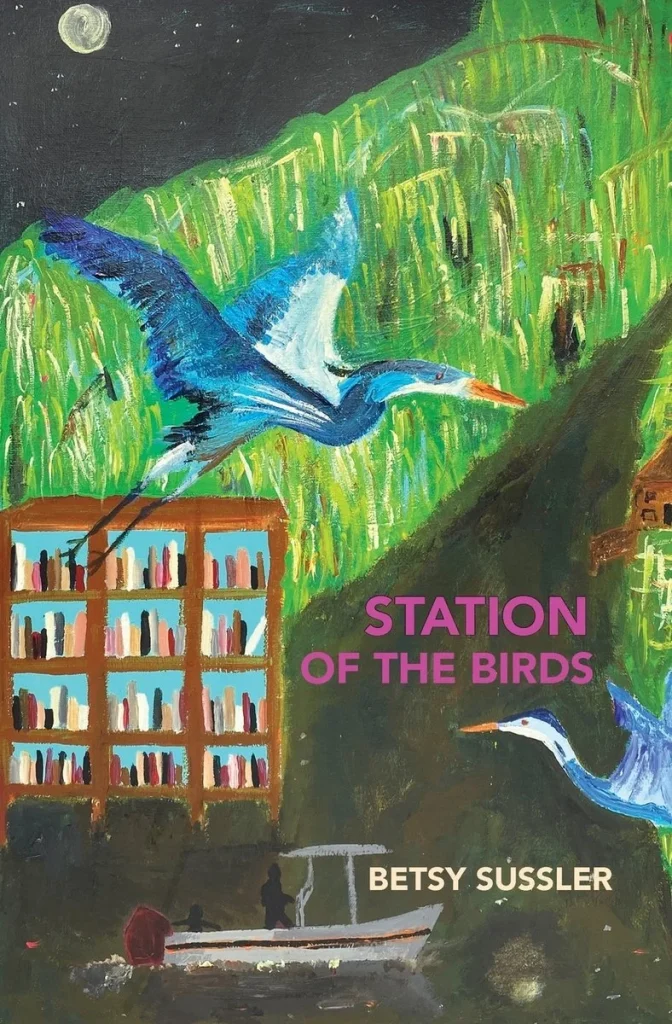
I served as senior editor of BOMB for nearly a decade starting in 2006, but only after having read Betsy’s stunning debut novel, Station of the Birds, did I realize that her talent at creating evocative atmospheres and complex characters, at stripping dialogue to its most resonant bits, had outlets beyond the editing of BOMB and her occasional writing for the magazine. Station of the Birds opens in New Orleans and immerses the reader in Louisiana’s Atchafalaya swamp, in its layered history and its many stories, to simply delirious effect.
We met on Zoom one Sunday in late February, during a snowstorm. She was in Brooklyn and I was in Queens, but for the duration of our 45-minute conversation we were transported to the balmier realm in which her book is set. Briefly outside time and place—like in the Atchafalaya, where the “the world below the waters, as the world above, lies suspended, murky with tree trunks, dense with moisture”—we delved into her novel’s palimpsestic layers.
Mónica de la Torre: Betsy, what an incredible book you’ve written! I didn’t know that you had a story like this in you. The last time we spoke about your writing, quite a bit ago, you were working on a family saga.
Betsy Sussler: I am writing a family saga, and I have just finished it. Station of the Birds is my first novel, which I wrote 30 years ago. It started as a screenplay, but when I took it out to Hollywood, they all said, “Wow, this is beautiful. Why don’t you make it into a novel?” And I thought, “Silly Hollywood!” I came back home and tossed the screenplay into a drawer. Then, about eight years later, my grandfather asked me to write a novel based on the story of his life. I decided that I’d write Station of the Birds first and use the screenplay as an outline to teach myself how to write a novel.
MDLT: What was the impetus for it?
BS: The kernel for Station started in the late ’80s. Two dear friends—Dickie Landry, the jazz musician, and Tina Girouard, the artist—had gone back to their hometown of Cecilia, Louisiana to be with their people. Dickie’s youngest son was in college at the time, and something horrible happened. While working at a gas station during summer vacation, he was murdered. It was a truly senseless act of violence. Then these crazy rumors started flying around. “He must have been selling drugs,” some said. “His father is a jazz musician who has played with musicians on both sides of the color line,” which in Louisiana in those days was forbidden. Dickie played with Black jazz musicians, Black zydeco musicians, and white musicians. Some thought that it must have been his fault, that he set the stage for wrongdoing.
I walk with my characters, I talk to them, they inhabit me, I inhabit them.
I had gone to college in New Orleans but I had not been to the Atchafalaya Swamp basin where Cecilia is located until I went down to visit Dickie and Tina a few years after the murder. I listened to everyone’s stories, everyone being Dickie and Tina and their friends. They were very generous with me. I took all these stories back home to New York and I let them gestate. Southern storytelling is almost mythological, dense and deep, so I started doing research into Jungian archetypes as well as the spiritual and religious influences that pervade the South. I wove the narrative from all of these elements.
MDLT: One of my favorite things about Station of the Birds is that it’s definitely not autofiction.
BS: The South, for me, has always been an enigma mitigated by the close friendships I made and still have there. The culture is utterly fascinating because of its complexity and divisiveness. How do I say this? The racism in the South—all across the United States—bears the seeds of its own destruction. When we work through that, we will become a better, stronger people. Everybody down South knows that the Black culture is the most vibrant and important source they have. They take from it all of the time.
MDLT: So you gathered all this material in the early ’80s for a screenplay.
BS: Because the Atchafalaya Basin is so mysterious and beautiful, I thought it would make an extremely provocative setting for a film.
MDLT: No wonder when I was reading the novel I kept seeing it unfold as a film in my mind’s eye. Everything is bustling in the landscape; no detail is inert. The writing displays this exquisite marriage of a vivid imagination and superlative powers of observation. It’s rare to strike such balance between the cinematic and the lyric—you’ve got an intricate plot, lots of visual details, and dense, writerly textures. And I love what you do with the birds. They’re ominous, alive, always lurking around. The taxidermized ones in the library are particularly animated. How did you manage to recreate the atmosphere of the place with such an incredible degree of detail?
BS: I wasn’t in the Atchafalaya for that long, but it had an effect on me. It didn’t leave me; it inhabited my imagination. When I was there I felt that I was breathing in all the collective stories embedded in the swamp; they entered through my breath.
But let me address a couple of things that you bring up. I came to writing from acting. I was married to a theater director who cast me in his plays because he wanted that second paycheck. I wasn’t a bad actress. I wasn’t a great actress, but I viewed it as an apprenticeship that would provide me with a better understanding of dialogue and character. And it did: I call it a kind of method writing. I walk with my characters, I talk to them, they inhabit me, I inhabit them. And it also affected the way I came to edit BOMB. Of course, when I edit, I am reading dialogues that are already on the page. I am looking to see where the narrative threads lead, if the participants have sufficiently explained their thoughts. I push things back, pull things forward, and see what’s missing. Writing a novel starts with a blank page and relies on the imagination, memory, and whatever observations or research you want to toss in there. It’s building a world that I’m making up as I go along.
Back to the birds. A blue heron in the Atchafalaya perched where Garland Frederick, my guide, docked his boat. He would ask, “Where do you wanna go?” And I would say, “Let’s just follow the blue heron.” We would literally track this amazing bird as it swooped through the swamp; that’s how we found one of the main settings, the outpost called Cane Island. For me, the heron became a character in the narrative. Later, when I was researching, I happened upon Aristophanes’ play, The Birds. It’s a satire where flocks create a city for birds, and they plan to charge a toll for messages sent from humans to their gods. So I lifted some of that. It worked rather nicely as a chorus.
Other influences: James Hillman, the Jungian psychologist has an interesting theory about the Oedipus complex. He posits that the most vital psychological component of the myth is that his father, after hearing the oracle proclaim that Oedipus would ultimately kill him and usurp his power, had his infant son abandoned on a mountain side. The father wanted to kill his son.
MDLT: That angle hardly gets any play.
BS: Exactly. There is another author who influenced me. Luigi Zoya writes about drugs and addiction. His theory is that addicts are practicing initiation rites but backwards. In other words, in an initiation right, you die and then you’re reborn. But in addiction, because of the high, you’re re-born and then, with withdrawal, you die. It’s a perpetual banging at the gate.
MDLT: So for the addict, paradoxically, sobriety equals death.
BS: Coming down off of the drugs, you die. You’re constantly hitting a wall.
MDLT: I suppose as a student at Tulane, you came across some folks who might have been a little bit like your protagonist, Daryl, right? I’ve spent some time in New Orleans, and the contrast between Uptown, where Tulane is, with its mansions and former plantations, and other parts of town, like, say, the Tremé, historically inhabited by free people of color, is pretty stark.
The racism in the South bears the seeds of its own destruction. When we work through that, we will become a better, stronger people.
BS: Yes, but I also had distant cousins who were lost boys: entitled, spoiled, and searching because their family fortunes were depleted. They didn’t know how to maintain the lifestyle they assumed would always be theirs. One of them in particular, rumor had it, became a drug dealer. I melded some of him into the novel’s protagonist, Daryl Monroe. This is where, as a writer, you transform a fantasy world into a real world and vice versa.
New Orleans, even though it’s a Catholic city, or perhaps because it’s a Catholic city, is incredibly decadent. To their credit, New Orleanians know how to live well. And then there’s this: when a Louisiana native starts telling you a story, they start in the middle. And maybe they meander and get to the end. And maybe they don’t. But they do not tell you the beginning. Because if you don’t know the beginning, that means you don’t belong and aren’t meant to know. So that alone was impetus enough to create these stories, to figure out the backstories, or make them up as in, “What if . . . ”
MDLT: In terms of your process, when did you rework the drafts that became the novel?
BS: The novel was written during the ’90s and since then I have periodically gone back into it. It was a first novel, and as such it was kind of over-the-top lyrical. It was turned down by many, many publishers, many of whom said, “Beautiful writing, send us anything else. We’re not doing this because it’s too dark, too dense, too difficult.” Over the years, I would go back into it and get rid of some of the meanders that weren’t guiding the reader or weren’t serving the story.
Once Spuyten Duyvil accepted it, thanks to my literary agent, the brilliant Madison Smartt Bell, I wanted to lose, not the nature of a first-novel, but get rid of the frills. I wanted to make it a more thrilling read. For instance, I would take a look at a word’s etymology and find one that worked more explicitly or contained a double entendre. What I call a spit and a shave edit. Before that, in the making of the novel, the drafts were rewrites. It would be like mushing it together: You weave, you meld, you see how things work together and, if they do, how they feed each other and my perception of what’s happening and why. Which takes me forever.
MDLT: You used the word thrilling. Plotwise, the novel is a bit of an action thriller. But you also bring a lot of psychological insight into describing the shifting relationships between characters. You used the phrase “push and pull” for your method of editing but it applies too to the relationship between Beau, the jazz musician, and his son Michael, Daryl’s partner in crime, not to mention between Daryl and Monique, his lover. You explore desire and attraction, hatred and manipulation, dependency and resentment, in racial, familial, and erotic terms. You even engage magical realism to a slight degree.
BS: Thank you, Monica. I trust the book lives up to your incisive description. In terms of magical realism, New Orleans really is a Caribbean city. Carlos Fuentes noted this, and he’s right.
MDLT: Yeah, and magical realism owes an enormous debt to Southern Gothic. García Márquez was heavily influenced by Faulkner, who appears at the beginning of Station of the Birds.
BS: Daryl reads Faulkner, and Ovid. That was my entrance into the South. When I first got down there as a 17-year-old northerner not knowing how to navigate the society, I skipped too many classes because I didn’t want to stop reading whichever Faulkner I was immersed in. And then in theater classes, they made us workshop an enormous amount of Tennessee Williams.
MDLT: What were your thoughts around genre when you were writing the novel then?
BS: I thought of the novel as containing endless entanglements influenced by the culture, by the characters’ desires, and by their psychology. I let the characters do what they needed to do. I’d watch them and then push my way into their psyches. I’m going to read something to you. Peter Cole is a wonderful poet, as you no doubt know. And also a translator. This is from his book Things on Which I’ve Stumbled. The first poem is called “Improvisation on Lines by Isaac the Blind.” Isaac the Blind (born 1160) was a rabbi and Kabbalist who lived in Provence. This is the first stanza: “Only by sucking, not by knowing,/ can the subtle essence be conveyed—/ sap of the word and the world’s flowing.” This has been a most influential piece of knowledge for me, only by sucking, not by knowing.
MDLT: Wow! Tell me more about what it does for you.
BS: Although I did lots of research, I really just wanted to suck it up and meander and see where it would lead. I tried constantly moving descriptions around to see how they related to the action.
MDLT: And the meanderings are key to the storytelling—you slow down and then speed up the pace very intentionally throughout.
BS: I’m very proud of being called a storyteller. That’s what I do. I tell stories.
MDLT: The pleasure is multiplied when you tell stories within stories. There’s another book that was also important to the writing of Station of the Birds that we haven’t spoken about: The Arabian Nights. You reference it when Daryl is trying to keep Michael alive by telling him a story.
BS: Well, it’s really interesting you bring that up because it’s just plopped right in the center of the chapter, that story from Arabian Nights.
MDLT: Oh, it is straight from The Arabian Nights?
BS: I mean, it’s reworked, I condensed it. It’s from a beautiful leather-bound edition that I have since lost.
MDLT: I wouldn’t worry too much about finding it since there’s no definitive corpus of The Arabian Nights. The collection of stories that we’ve come to know is the collective result of centuries of narrating, compiling, editing, and translating stories that were being shaped and transformed as they were circulating.
Southern storytelling is almost mythological, dense and deep.
BS: There are some stories that are so important to our psyches that they come back again and again, transformed. Those are the stories I’m interested in telling.
MDLT: The story of violence. The story of finding a scapegoat or someone to sacrifice so others can go on living their lives and doing “business as usual” happens with your Jorge character.
BS: Thank you for bringing this up. That was a big part of the plot line. Look what’s happening now in the United States. The cruelty and the vicious incarcerations and attacks, as if we’re all vigilantes. This scapegoating, projecting blame, sadly, has been going on for centuries.
MDLT: Jorge is not white, he is not Black, so he ends up taking the brunt of the violence. That he doesn’t speak English makes it easy for others to blame him.
BS: Daryl frequents his father’s library, and that’s where I was able to catalog many of my references from Ovid’s Metamorphosis to Aristophanes, to the Greek gods. But yes, scapegoating really is an age old tactic.
7 Books That Complicate Stories About the South
These writers make space for the textured beliefs, experiences, and desires of a misunderstood region
MDLT: I wonder if there’s a relationship between the play by Aristophanes and the Sufi poem The Conference of the Birds.
BS: I am not familiar with the Sufi poem. In Aristophanes, the Station of the Birds—now the novel’s title—was meant to become a city state built and occupied by birds. But men intervened and the birds became their subjects. The birds are, in my mind, messengers to the gods.
The post A Debut That Unearths Stories Lurking in Louisiana’s Swampland appeared first on Electric Literature.




 Bengali (Bangladesh) ·
  English (United States) ·