

I wish my eyelashes would take some lessons from the hairs that grow on my mole.
For some reason, the ones I least want to appear end up darker, thicker, and longer-looking than the kind on my head.
Friends have said they experience the same thing, too. So what’s going on?
Why does mole hair grow so thick and dark?
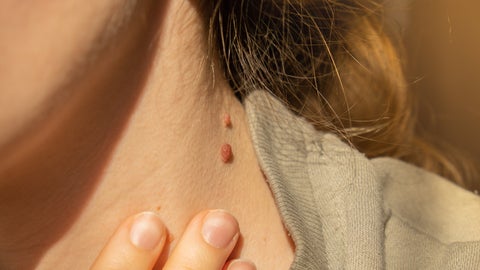
Pigmented moles, or those which are a different, darker colour to the rest of your skin, are melanocytic, the British Association of Dermatologists writes.
That means they “are made up of the cells (melanocytes) which produce the dark pigment (melanin) that gives the skin its colour”.
Healthline says this might affect any hairs growing there.
“In some cases, the hair that grows out of a mole may appear darker or thicker than the other body hair surrounding it. This is because the extra pigment in the cells may darken the hair, too,” they suggested.
But speaking to Mental Floss, dermatologist Lauren Ploch said that the exact process is still a “mystery”.
She said that microscopic investigations have shown that nevus cells, a type of melanocyte, don’t seem to invade the actual structure of mole hairs and haven’t been seen to affect colour or growth speed.
But we do know the skin that makes up moles is different to “normal” skin. It can be created by different hormonal balances and signalling proteins.
“I suspect that, while the mole itself may not have a direct role in creating a darker, coarser hair, the local milieu of signaling molecules and hormones in the skin that created the mole leads to a darker, coarser hair within the lesion,” Ploch posited.
Are hairy moles less likely to be cancerous?
Some people think that hairy moles can’t be cancerous. But while some anecdotal accounts suggest the risk may be lower, the Dermatology Associates of Atlanta calls the idea that hairy moles never have cancer a “dangerous myth”.
They added, “While melanoma tends to eventually make mole hairs fall out, this doesn’t happen until the cancer has advanced”.
They’re not alone. In a TikTok video, dermatologist Dr Sam Ellis said: “Whether or not a mole grows a hair has absolutely nothing to do with whether ot not it’s cancerous”.
Experts recommend following the ABCDE method to identify potentially cancerous moles instead.
These include:
A: asymmetry,B: border irregularity, C: colour variability,D: diameter (a mole that’s bigger than 6mm across), E: evolution (watch out for moles that change in size, shape, or colour).If you notice these, visit your GP.






 Bengali (Bangladesh) ·
  English (United States) ·