

Mammals first appeared on Earth over 200 million years ago, scuttling around alongside the dinosaurs as little mouse-sized creatures. But after the asteroid hit 66 million years ago, it was their time to shine — and the Age of Mammals began.
But the path to understanding our own branch of the animal kingdom hasn't been straightforward. In this excerpt from "The Story of the Mammals in 25 Discoveries" (Columbia University Press, 2026), author Donald R. Prothero looks at a time when philosophers and early naturalists believed giants roamed the Earth and explores the idea that extinction was heresy.
Many cultures around the world have a mythology that includes legends about gigantic races of humans that lived on Earth in the dark mysterious past. They may have fought against the gods, or they may have been destroyed by floods. These stories were reinforced by the discovery of gigantic bones, much larger than those of any living human, all over the Mediterranean and Europe.
The Greek philosopher Empedocles (492-432 BCE) reported gigantic bones from Sicily, supposedly remnants of a race of giants. The Roman historian Pliny the Elder (23-79 CE) mentioned fossil ivory in the ground, and according to the Roman historian Suetonius (69- 122 CE), Emperor Augustus owned a collection of large bones that had been found on the island of Capri, near Pompeii. The skulls of elephants, with their huge central opening in front (for the trunk), were thought to be the skulls of the one-eyed cyclops.
In the Middle Ages, these huge bones were again attributed to gigantic humans or other monsters (Genesis 6:4) that were drowned in Noah's flood. Giant tusks from Siberia were thought to be the horns of the mythical unicorn or the tusks of dragons. In some places gigantic teeth or vertebrae of mammoths were revered as relicts of saints. Nearly every possibility was suggested except that they were the bones of extinct elephants.
In the early seventeenth century, some giant bones dug up in a sand pit near Langon in southeastern France were exhibited around France as the remains of the giant Teutons, Germanic tribes that once roamed Gaul and were defeated by the Romans in 101 BCE.
Huge bones from southeastern France were once thought to belong to the giant Teutons. (Image credit: Universal History Archive via Getty Images)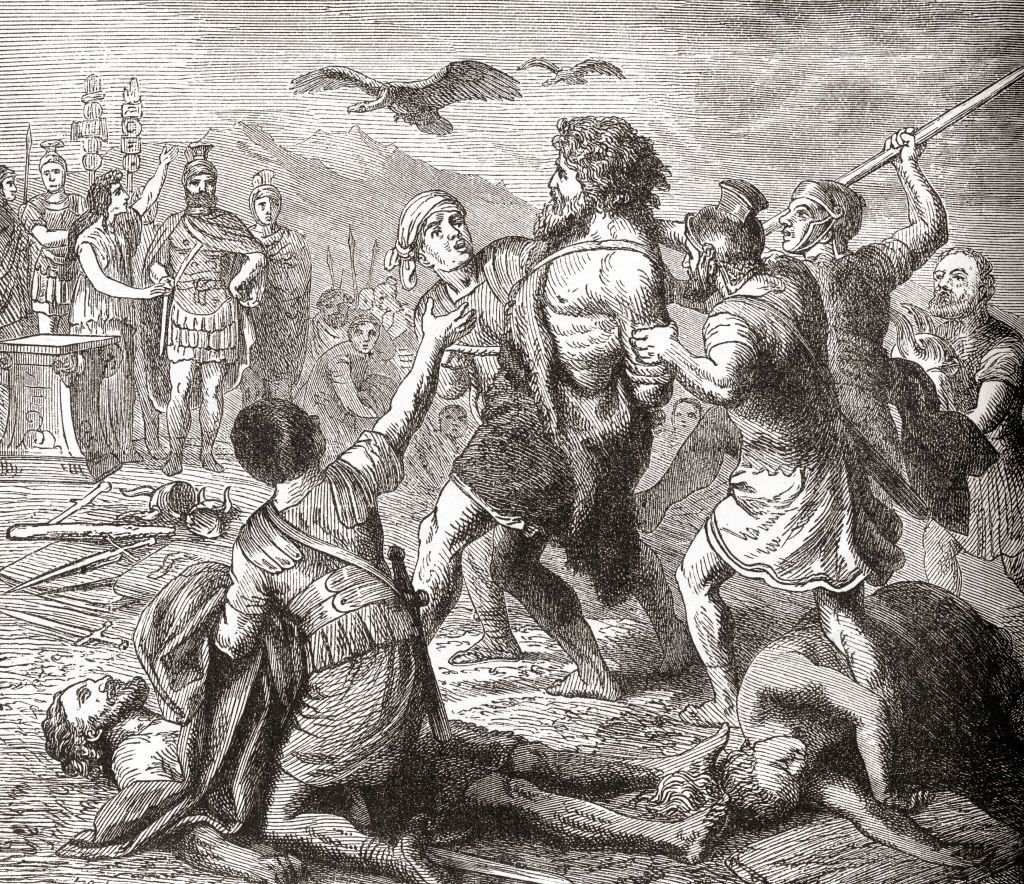
But in 1613 the famous anatomist Riolan attacked the prevailing interpretation, suggesting that they were the bones of an elephant. This generated a raging controversy between physicians and anatomists and the barber-surgeons who called them gigantic human bones. Others thought they were hoaxes or generated by mysterious "plastic forces" (vis plastica in Latin) that percolated through Earth. Still others attacked the anatomists for questioning the biblical account of giants on Earth. The controversies died down in 1618 without being resolved, and for the next two centuries most people continued to interpret new finds as gigantic humans.
The giant bones that kept turning up in the New World were also a source of much mystery and consternation. The Native American tribes usually attributed them to giant monsters fought by their ancestors and incorporated them into their folklore. When these bones were first seen by European settlers, they were thought to be the bones of gigantic humans that roamed the earth in biblical times. Others thought that the giant tasks so revered by the Native Americans were the works of Satan, placed there to tempt the believer.
In 1519, the Spanish explorer and conquistador Hernan Cortez received a bone of a "giant," a gift from the friendly Tlascalan tribe of Mexico during the conquest of the Aztecs. He sent it back to the King of Spain as proof that giants at once lived in the New World. In 1706, the Reverend Cotton Mather of the Massachusetts Bay Colony pronounced them to be "the remains of godless giants drowned in Noah's Flood." He sent some bones to the Royal Society in London to have them certified as evidence of this "wicked giant" because biblical scholars were calculating Adam's height at 123 ft. 9 in.
The Royal Society never pronounced an opinion on these bones, although by that time many members were becoming skeptical of the literal interpretations of Genesis. The stifling effect of religious dogma about giants and Noah's flood was complicated by another idea: the notion of Divine Providence. An omnipotent, benevolent God would never allow any of his creatures to become extinct. As the poet Alexander Pope wrote in An Essay on Man (1734), "who sees with equal eye, as God of all, a hero perish, or a sparrow fall."
The prevailing concept was that of a "great chain of being" that linked the animals to man to the angels to God. Breaking any link in that chain implied the destruction of the whole chain. In the same poem, Pope also wrote: "Where, one step broken, the great scale's destroy'd; From Nature's chain whatever link you strike, Ten or ten thousandth, breaks the chain alike."
By the late 1700s, however, it was becoming more and more apparent that many of the recently discovered fossils had no living counterparts. Remote corners of the world were being explored, and although many new and surprising beasts were discovered, clearly the gigantic beasts were not hiding in South America or Africa or the East Indies. Many strange fossils, such as the bones of hippopotami in Paris and London, were clearly related to tropical animals, but it was assumed that these bones had been washed from the tropics during the Great Flood.
The notion of extinction was still blasphemous. The New World soon provided unequivocal evidence that these large bones were not simply gigantic humans. In 1739, Charles le Moyne, the second Baron de Longueil, left Montreal with French and Indian troops to fight the Chickasaw Indians along the Ohio River. Somewhere along the Ohio he found the remains of what appeared to be three elephants. When the war ended in 1740, le Moyne collected the bones and shipped them to New Orleans and ultimately to Paris, where they came to the attention of French naturalists.
Fossils unearthed in Kentucky in the 18th century puzzled Benjamin Franklin, who thought they looked like an elephant, but the teeth were unlike those belonging to any known species. (Image credit: Mike Kemp via Getty Images)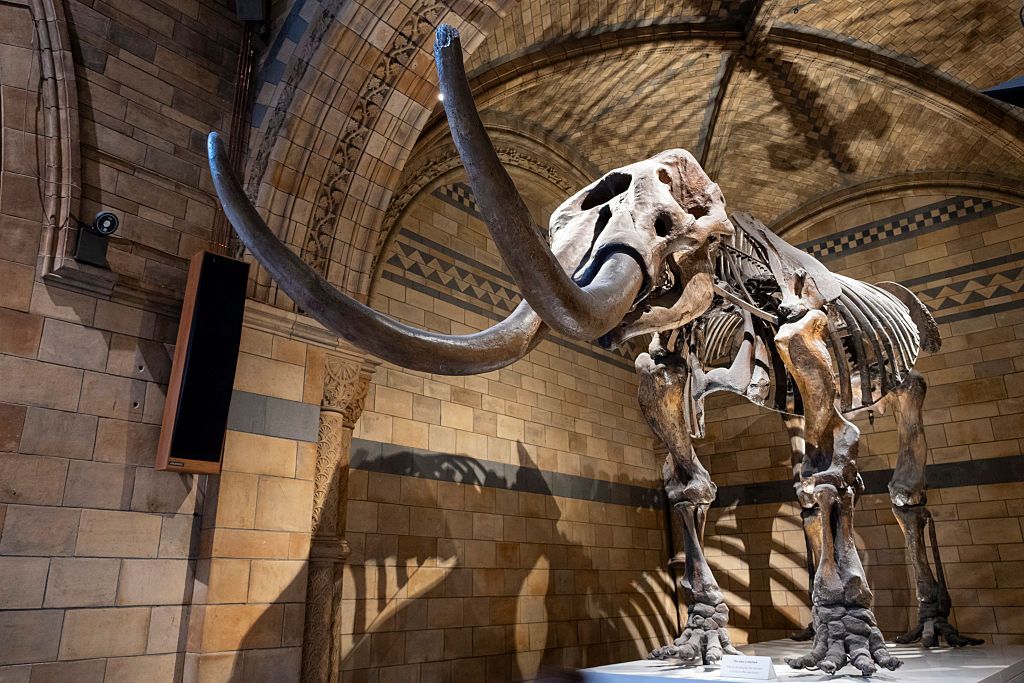
In the 1740s and 1750s, English settlers in the region sent more of these bones from Big Bone Lick, Kentucky, off to England and also to Benjamin Franklin in America. Most of the bones (especially the tusks) were clearly like those of elephants and mammoths, but the teeth were puzzling. They were clearly unlike any living elephant, yet they were part of an animal of elephantine size. (We now know that these were specimens of the American mastodon, Mammut americanum.) Franklin speculated that the teeth were reminiscent of a carnivorous animal, although he and others later decided it was a vegetarian.
In 1769, the famous British anatomist William Hunter took the carnivory suggestion seriously and suggested this was not a true elephant but a "pseudelephant" or "American incognitum" (Latin for "unknown") that had independently developed ivory tusks:
"This monster, with the agility and ferocity of a tiger . . . cruel as the bloody panther, swift as the descending eagle, terrible as the angel of night. . . . And if this animal was indeed carnivorous, which I believe cannot be doubted, though we may as philosophers regret it, as men we cannot but thank Heaven that its whole generation is probably extinct."
This very precocious suggestion was still not accepted by naturalists of the time. Nevertheless, remains of the "incognitum" and also of the Siberian mammoth (including frozen carcasses with hair and skin) were turning up again and again. Georges Louis Leclerc, the Comte de Buffon (1707-1788), concluded in his Théorie de la terre in 1749 that although most of the supposedly extinct animals were hiding somewhere in an unknown region, it was likely that the large terrestrial mammals such as the mammoth and "incognitum" had actually perished.
By 1778, Buffon was relating their disappearance to his ideas of violent cataclysms in Earth's early history. During this time the climate was warmer and polar regions had once been tropical, so "elephants" (meaning mammoths) could live in Siberia. This implied a nonbiblical Earth of much greater antiquity. Buffon suggested it was as much as 75,000 to 3,000,000 years old, rather than the 6,000 years demanded by most literalist biblical scholars.
Naturally, such revolutionary ideas were not popular with the theologians in the Sorbonne. Buffon was protected by the king, however, so he was not persecuted for his heresy, although his ideas were not widely accepted either. The fact of extinction was finally proved by one of the greatest scientists of all time, the Baron Georges Cuvier (1769-1832).
Jean Leopold Frederic Georges Cuvier was an impressive man. Tall of stature, he had a "massive" head crowned by a large mane of hair. One admirer wrote that his head "gave to his entire person an undeniable cachet of majesty and to his face an expression of profound meditation." After his death, scientists weighed his brain and found that it was a massive 1830 grams [4 pounds], more than 400 grams [14 ounces] above average, and 200 grams [7 ounces] heavier than any brain ever measured at that time.
More important, he was one of the most brilliant men of his time, with a command of many subjects, some of which he invented all by himself. Before Cuvier, natural history was a field that resembled stamp collecting, with many amateur naturalists compiling long lists and descriptions of new species without analyzing the similarities in their anatomy. Cuvier almost single-handedly revolutionized natural history by dissecting many different animals and discovering their underlying similarities and differences.
This became the foundation of comparative anatomy, a subject that has been fundamental to biology ever since. Naturalists and explorers sent him their fossil bones, and he was the first to correctly describe many types of extinct animals. Cuvier solved the mystery of the puzzling fossil teeth called the "Great Incognitum" and recognized them as the teeth of the elephant-like mastodons. He also correctly deciphered the huge marine lizards we now know as mosasaurs.
For this reason, he is also considered to be the founder of vertebrate paleontology. Cuvier is most famous for his "law of correlation of parts," wherein he discovered that certain types of anatomical features tend to be associated. If you are a flesh eater, you will have sharp teeth and claws; if you are a plant eater, you will have flat grinding teeth and hooves; and so on. Using this law, paleontologists have been able to reconstruct whole animals from just a few key bones because the other parts of the anatomy are so predictable.
Excerpted from The Story of the Mammals in 25 Discoveries: Amazing Fossils and the People Who Found Them by Donald R. Prothero. Copyright (c) 2026 Donald R. Prothero. Used by arrangement with the Publisher. All rights reserved.
Help us improve Live Science Pro: We're always trying to make our content better. Leave us feedback about Pro here.
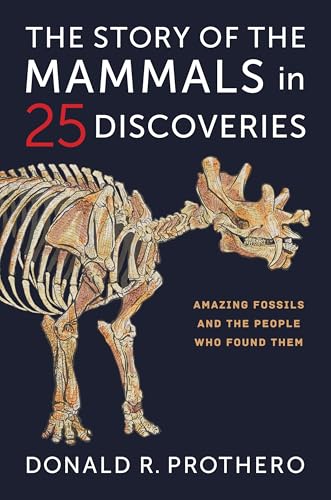
Donald R. Prothero takes readers on a journey through the history of mammals, opening a window onto the worlds of some of the most incredible and peculiar animals that ever lived. He tells the dramatic stories of fossil findings and the paleontologists who unraveled them, showing how scientific ingenuity advanced our knowledge of both ancient and present-day mammals.




 Bengali (Bangladesh) ·
  English (United States) ·