
 49 minutes ago
6

The post Ways to Donate to a K-12 Scholarship Fund: A Practical Guide for Everyday Givers appeared first on Penny Pinchin' Mom.
Most of what you find online about scholarship giving concerns colleges. Fewer guidelines cover the kids who need help earlier, in kindergarten through twelfth grade, where a few thousand dollars can decide whether a child gets the school, tutoring, or learning environment that actually fits them. If you’ve been wondering how to make a donation to a scholarship fund for K-12 students, and you want to do it in a way that makes sense for your budget, here is a walk-through of your options, the rules that matter, and a new federal tax credit that changes the math for everyday taxpayers.
Rules to Know Before You Give
If you only read one section, make it this one. These are the points that trip people up most often.
The Education Freedom Tax Credit (EFTC) starts January 1, 2027. Contributions that qualify for the credit begin on that date, and you claim the credit on your 2027 federal return, filed in 2028. The credit is up to $1,700 per person, or up to $3,400 for married couples filing jointly. Each spouse has their own $1,700 limit, so the $3,400 applies when each spouse makes a qualifying contribution filed jointly. It is a credit, not a deduction. A credit reduces what you owe, dollar for dollar. A deduction only reduces the income your tax is calculated on. You give first. The credit is something you claim later, when you file your taxes. It is never an instant discount. Only cash contributions count. Cash, checks, bank transfers, and credit or debit card payments qualify. Stock and other appreciated assets do not, and neither do gifts made through a partnership or S corporation. You designate the gift. You need to identify your contribution as a qualified contribution when you make it. The gift has to go to a qualified Scholarship Granting Organization (SGO) in a state that has opted in. You do not have to live in that state to claim the federal credit. It is nonrefundable. The credit can reduce your federal tax bill to zero, but it will not turn into a refund check. Any unused amount can be carried forward for up to five years. No double benefit. A dollar you claim as this credit cannot also be deducted as a charitable contribution. No picking a student. You can choose which SGO or fund to support, but the SGO decides which students receive scholarships. Keep your paperwork. Your SGO will send a written acknowledgment, and you should hold on to it with your tax records.Why K-12 Giving Is Different
College scholarships get most of the attention, but K-12 families face a different kind of challenge. Tuition at a school that fits a child’s needs, tutoring for a student who is falling behind, fees for a specialized program: these costs show up years before a college application does, and they often land on families already stretched thin.
Approximately 90% of American students are eligible for a scholarship through the new credit. It is worth keeping two questions separate: who can receive a scholarship and who can claim the credit. Those who can claim the credit include any individual taxpayer who gives to a qualified scholarship granting organization (SGO), regardless of their own income.
So where can your money actually go? Here are the main ways people support K-12 scholarships, starting with the newest one.
Option 1: Give to a Scholarship Granting Organization and Claim the EFTC
This is the option that changes the equation for budget-minded givers. A Scholarship Granting Organization (SGO) is a nonprofit that connects private donations to education scholarships. It is not a government agency, and it does not run schools. Starting January 1, 2027, when you make a qualifying cash contribution to an SGO that a participating state has approved, you can claim a dollar-for-dollar federal tax credit of up to $1,700 per person, or up to $3,400 for married couples filing jointly, according to the IRS.
The sequence works like this:
You make a qualifying cash contribution to an SGO and designate it as a qualified contribution. The SGO sends you a written tax receipt with the date, the amount, and the organization’s information. Under the Treasury’s proposed regulations, that acknowledgment is also expected to include a unique donor number, which the SGO sends a written acknowledgment by January 31 showing your total qualified contributions for the year, your unique donor number, and the SGO’s EIN . The SGO separately awards the scholarship to an eligible student. You claim the credit when you file your taxes. The IRS program page explains that you will report your contribution on Form 8525, using the donor number and the SGO’s number.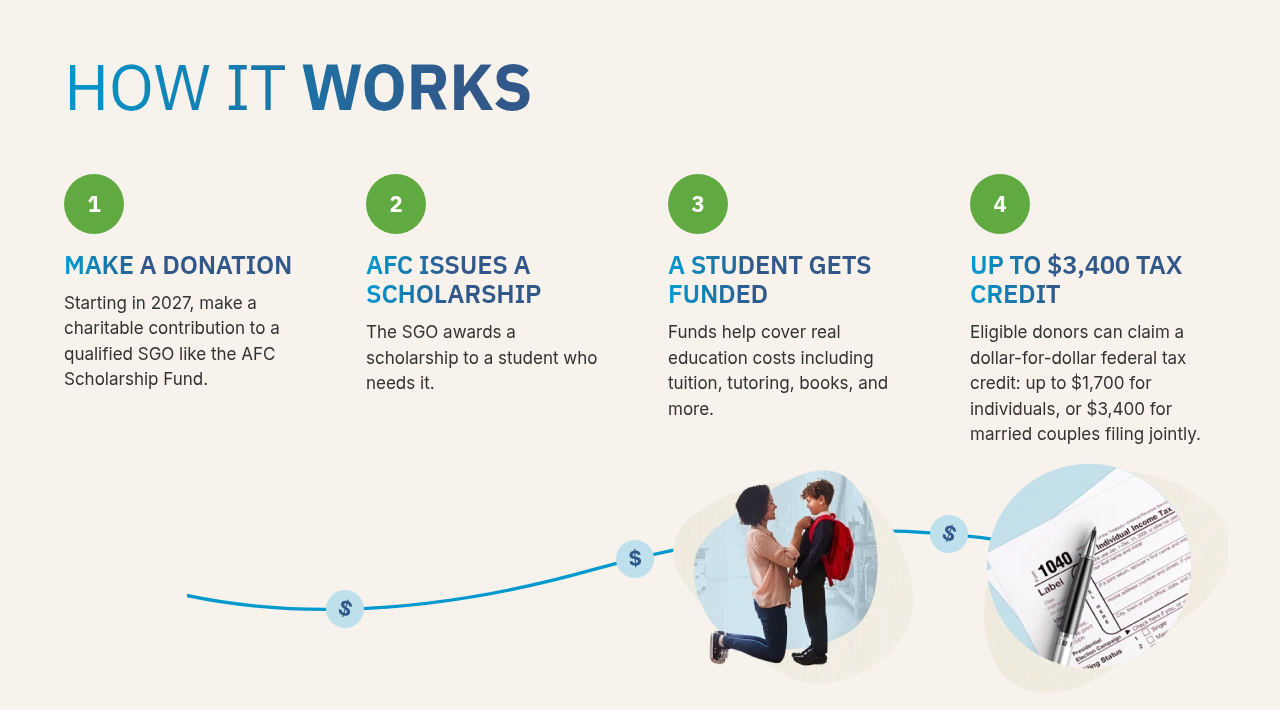
Scholarships can cover tuition, fees, tutoring, and other qualified education expenses, and the dollars go to the school or qualified education provider on the student’s behalf, not to the family as cash. You can see the full list in AFC’s guide to what EFTC scholarship funds can be used for. SGOs are also required to direct 90 percent of contributions toward scholarships, which is a big reason the structure holds up to scrutiny. If you want the full picture of how these organizations work, AFC Scholarship Fund’s SGO explainer walks through it, and AFC’s five-step guide to giving to an SGO covers the process step by step.
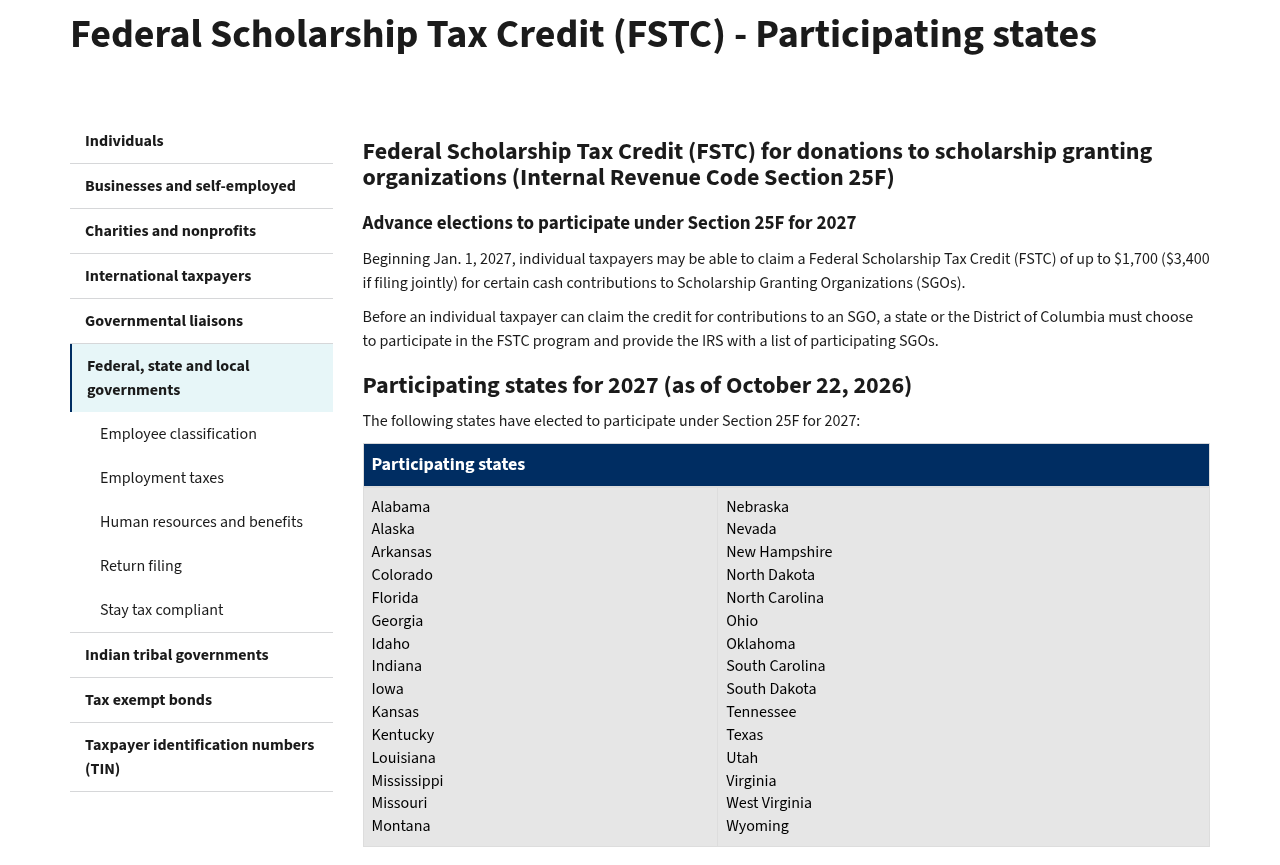
Because the credit is federal, you can give to an SGO in a participating state even if your own state has not opted in. According to the IRS list of participating states, 30 states have opted in so far, and that number is still growing.
Option 2: Give Directly to a School or Local Scholarship Fund
Many private and charter schools, parochial schools, and independent schools run their own tuition assistance or scholarship funds, and a gift to one of these is a classic way to help local kids. If the school is a 501(c)(3) public charity, your gift is generally eligible for the regular charitable deduction.
That deduction has changed, and it matters for how far your money goes. Starting with the 2026 tax year, taxpayers who take the standard deduction can still deduct up to $1,000 in cash gifts to eligible charities, or up to $2,000 for married couples filing jointly, per the IRS. People who itemize face a new floor, where only giving above 0.5 percent of adjusted gross income is deductible, and the tax benefit for those in the top bracket is capped at 35 percent, as Kiplinger explains.
The upside of giving directly is that you can see where the money goes. The tradeoff is that the tax benefit is a deduction, and a deduction’s value depends on your tax bracket. A $1,700 deduction for someone in the 24 percent bracket saves about $408. The credit, by comparison, is worth the full amount.
Option 3: Use Your Employer’s Giving Programs
This one is easy to overlook, and it is friendly to tight budgets. Plenty of employers offer matching gift programs that double what you give, and some run payroll giving that lets you spread a gift across the year in small amounts. Ask your HR department what is available. A few dollars each paycheck adds up, and a match can turn a modest gift into a bigger one. Payroll giving may matter for the new credit too. Under the Treasury’s proposed regulations, after-tax payroll deductions are among the cash methods that can count toward the EFTC. As always, check with the SGO and your employer to confirm how the gift would be documented and designated before assuming it qualifies.
Option 4: Give Through a Donor-Advised Fund or Community Foundation
If you already have a donor-advised fund, you can recommend grants to qualified charities, including schools and scholarship nonprofits that serve K-12 students. Community foundations also manage local scholarship funds, often tied to a specific town or county, and they can be a good fit if you want your giving to stay close to home. One small note: the IRS says contributions to donor-advised funds generally do not count toward the new non-itemizer deduction.
A bigger caution applies to the EFTC. The credit is built around your own qualified cash contribution, which you designate at the time of the gift. A grant from a donor-advised fund may not work the same way, so ask the fund sponsor and the SGO before you assume a grant will count toward the credit.
Option 5: Give Time, Skills, and a Little Noise
Not every contribution is financial. Tutoring, mentoring, helping a local scholarship nonprofit with an event, or simply telling friends about the new credit all move the needle. Many families have never heard of the EFTC, and awareness is the first hurdle. If you’re the budget-savvy friend everyone texts when they have a money question, you may be the reason a neighbor learns they can direct taxes they already owe toward a scholarship.
A Quick Look at the Math
Numbers make the credit-versus-deduction difference easier to see. Say a married couple filing jointly makes qualifying contributions of $3,400, with each spouse giving $1,700, and they owe $5,000 in federal taxes. With the credit, they now owe $1,600. That is $3,400 straight off the bill.
If the same $3,400 were only a deduction, and the couple was in the 24 percent bracket, it would save roughly $816. For a single filer, the picture is similar: a $1,700 gift earns a $1,700 credit, but a deduction of the same size saves about $408. Roughly four times the tax benefit under the credit, on the exact same gift.
One caveat keeps this honest. Because the credit is nonrefundable, it can only offset what you actually owe in a given year. A couple with $1,800 in federal tax liability could not use the full $3,400 in one year, but the unused $1,600 can generally be carried forward for up to five years. For a deeper comparison, AFC’s breakdown of what the credit is really worth is a helpful next read.
Where AFC Scholarship Fund Fits
AFC Scholarship Fund is a national scholarship network designed to connect everyday taxpayers with K-12 scholarship opportunities through the EFTC. It is a cause-based option for people who want to support students broadly rather than hunting for a single local program, and it offers multiple scholarship funds, including funds connected to faith-based education, special education, and military families.

AFC Scholarship Fund is built by the American Federation for Children, drawing on more than 20 years of school choice advocacy across the states , so it is not starting from scratch. By federal rule, 90 percent of every qualifying donation goes to scholarships.
A few honest notes on timing. The EFTC does not take effect until January 1, 2027, so nothing is open for qualifying gifts yet. AFC Scholarship Fund’s donor portal is also not live. When the portal launches, it is designed to walk donors through the process, from choosing a fund to getting the documentation needed at tax time. For now, the best use of your time is learning how the credit works and getting ready.
Want to see how the credit could work for your household? Click here to find out more about the AFC Scholarship Fund.
Common Questions
Can I give stock to a K-12 scholarship fund? You can give appreciated assets to many charities and take a deduction under the regular rules, but stock does not qualify for the EFTC. The credit applies to cash contributions only. Do I need to itemize to claim the EFTC? No. It is a credit claimed directly on your federal return, so it does not depend on itemizing. Can I choose which student receives my gift? No. You can choose which SGO or fund to support, but the SGO awards scholarships independently, following a required priority order. Can I get both a deduction and a credit for the same dollar? No. A dollar claimed as the credit cannot also be deducted as a charitable contribution. Does my state have to participate for me to claim the credit? No. The credit is federal. You can give to an SGO in a participating state from anywhere, although the scholarships fund students in the state that approved the SGO. Can I start giving now? Not for the credit. It takes effect January 1, 2027. In the meantime, you can read up, compare your options, and decide how you want to give. The EFTC donor timeline lays out the steps from gift to tax filing.The Bottom Line
There are several good ways to support K-12 scholarships: giving to a school or local fund, using an employer program, working through a donor-advised fund, or lending your time. The newest option, giving to an SGO under the EFTC, stands out for budget-conscious givers because it offers a dollar-for-dollar federal credit of up to $1,700 per person, or up to $3,400 for married couples filing jointly. You give first, claim the credit when you file, and as long as you owe enough in federal taxes to use it, the net cost to you can be zero. Start by learning the rules above, and by January 2027 you will know exactly how you want to participate.
The post Ways to Donate to a K-12 Scholarship Fund: A Practical Guide for Everyday Givers appeared first on Penny Pinchin' Mom.





 Bengali (Bangladesh) ·
 English (United States) ·