
 1 hour ago
6


Bitcoin’s inflation problem has a fresh complication. U.S. wholesale prices rose 6.5% over the year to October, their fastest annual increase since November 2022, even as the monthly pace cooled sharply.
The November 13 Producer Price Index release offers ammunition for two competing readings: the latest month was less severe, but the accumulated inflation problem remains substantial. For cryptocurrency investors, the key question is which message carries more weight with the Federal Reserve.
Bitcoin inflation outlook: a slower month, a hotter year
Final-demand producer prices increased 0.3% in October, compared with a revised 1.4% in September. The annual rate nevertheless climbed from 6.3% to 6.5%. These measures answer different questions: the first tracks one month, while the second compares prices with a year earlier.
The measure excluding food, energy and trade services rose 0.5% for the month and 4.9% annually. That detail complicates any argument that a softer headline monthly figure settles the inflation debate.
Energy prices at the final-demand level edged lower, while goods and services prices increased. The release therefore does not present a simple picture of falling energy costs eliminating pressure throughout the economy.
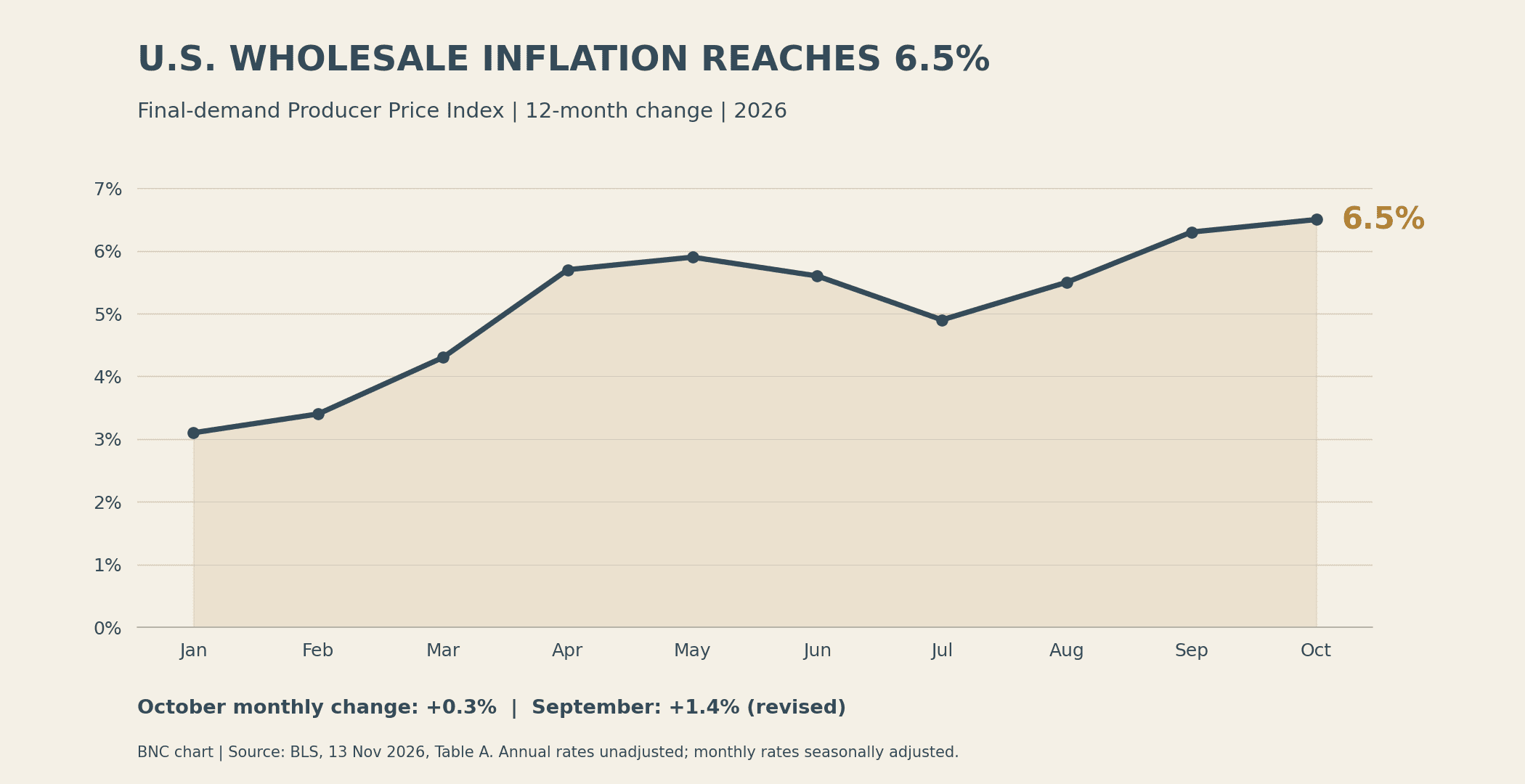 Annual change in final-demand producer prices, January–October 2026. BNC chart; June–September values reflect revisions in the November 13 release. Source: BLS Table A.
The BLS defines PPI as a measure of selling prices received by domestic producers. It is distinct from the prices households pay and from the personal consumption expenditures measure targeted by the Fed. Comparing its 6.5% reading directly with the Fed’s 2% goal would mix different indexes.
The Fed had already warned that a pause was not a pivot
At its October 28 meeting, the Federal Open Market Committee held its policy rate at 3.75%–4%. Two members, Lisa Cook and Beth Hammack, preferred a quarter-point increase. The committee’s statement said: “Inflation remains elevated.”
That split matters. Holding rates steady can provide time to assess incoming information without signalling that the next move will be a cut. Investors who treat every pause as easing risk misreading the decision.
Governor Christopher Waller made the distinction explicit in his November 10 speech, saying “further tightening of monetary policy will be needed, sooner rather than later.” He supported at least a quarter-point December increase under his expected outlook and said a stronger move might be warranted if inflation proved worse.
Waller spoke before that day’s consumer inflation release and before Friday’s PPI figures. His remarks establish the concerns policymakers brought into this week; they are not a reaction to the new wholesale-price report or a commitment by the full committee.
He also singled out the AI infrastructure buildout as a potential source of price pressure, alongside energy costs. That connects two markets often treated as separate stories: enthusiasm for more computing capacity can support investment while raising concerns about the cost of equipment and power.
For crypto readers, the implication is a feedback loop to watch, rather than a demonstrated cause of Bitcoin’s decline. Strong technology investment is not automatically a signal that financing conditions will become easier for every risky asset.
Why Bitcoin can struggle when inflation rises
Bitcoin’s fixed supply underpins its long-term scarcity argument. Its market price, however, is set by buyers and sellers facing changing financing costs and competing investment choices. Those are separate mechanisms.
If persistent inflation keeps interest rates higher, cash and interest-bearing assets can become more competitive, while borrowing to take market exposure becomes more expensive. That can work against speculative demand even when the underlying inflation story sounds favourable to scarce assets.
It does not follow that every inflation release must push Bitcoin lower. Expectations matter: a troubling number can be less troubling than investors had anticipated. Positioning, liquidity and subsequent policy commentary can also change the response.
That is why this report should not be assigned sole responsibility for a move already under way. BNC’s latest Bitcoin market analysis describes November 13 trading around $68,600–$69,200 alongside negative funding on several exchanges. Those observations document a weak market; they do not isolate the effect of PPI.
Three signals that would clarify the next move
First, watch whether subsequent Fed communication treats the slower monthly increase as progress or focuses on persistent underlying pressure. The next scheduled policy meeting is December 8–9, leaving room for more data and debate.
Second, distinguish price stabilisation from renewed buying. A market can stop falling because leveraged positions have been closed, without attracting enough fresh demand to sustain an advance. ETF flows and spot-market activity would help test that distinction, using figures dated to the same trading session.
Third, assess funding rates alongside price. Negative funding indicates demand for short exposure relative to long exposure in perpetual futures. It can accompany weakness, but it can also leave a market vulnerable to a squeeze if prices recover. It is context, not a forecast.
The strongest reading of Friday’s release is therefore conditional. A slower monthly pace offers evidence that the pressure can ease; the annual rate and underlying measure show why policymakers may remain unconvinced. Bitcoin’s next durable move needs more than a comforting interpretation of one headline.




 Bengali (Bangladesh) ·
 English (United States) ·