

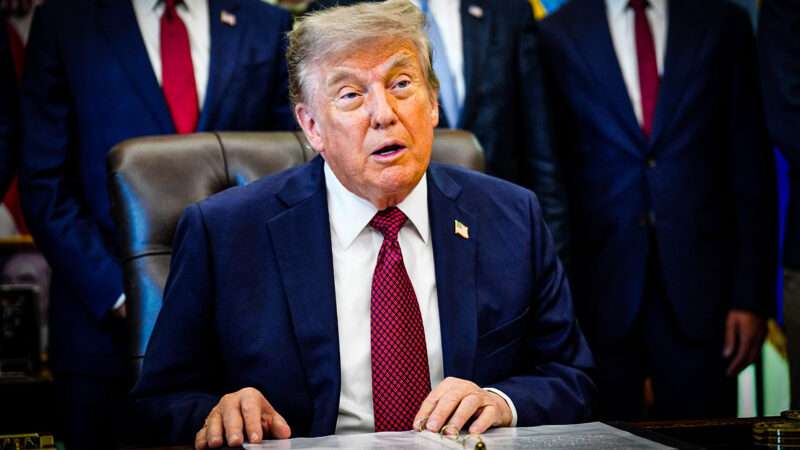
"For 250 years, America has stood as a Nation that believes in the potential of its people," the Trump administration said in a statement a few months back. "Upon returning to office, for the first time ever, I appointed a White House Pardon Czar to lead our clemency efforts with a clear focus on both opportunity and accountability….The story of America is filled with individuals who have demonstrated real change in their hearts and earned a second chance."
More people will have to wait. President Donald Trump this month denied about 6,000 clemency applications after White House staff had recently floated granting 250 pardons to celebrate America's semiquincentennial.
That plan did not come to be. It is not uncommon for presidents to be shy about using the pardon power. But Trump's playbook for clemency isn't notable so much for its bashfulness as it is for its process, or lack thereof.
The president began his term issuing about 1,600 clemency grants to those involved in the January 6 riot, some of whom were convicted of violent offenses. That corrected "a grave national injustice," he said, which could begin "a process of national reconciliation." It is difficult to argue Trump did that, however, when considering he issued blanket grants instead of evaluating individual cases to determine specific prosecutorial excesses on the merits.
"As of November 6, the Justice Department reported, about 600 people had been charged with 'assaulting, resisting, or impeding law enforcement agents or officers or obstructing those officers' during the riot," Reason's Jacob Sullum wrote last year. "They included 169 defendants 'charged with using a deadly or dangerous weapon or causing serious bodily injury to an officer.'…Trump's avowed support for law enforcement and opposition to violence are hard to discern in his blanket clemency, which encompasses defendants who flouted both principles."
The president, meanwhile, has become famous for extending mercy to people with political and financial connections. When Trump pardoned Scott Jenkins—a disgraced former sheriff convicted of cartoonish levels of corruption—U.S. Pardon Attorney Ed Martin did not beat around the bush about why. "No MAGA left behind," he posted on X. "Thank you, @potus Trump, for pardoning Sheriff Jenkins!"
This appears to be a feature, not a bug. "Perhaps the most important part of the pardon playbook is finding a way to get Trump's attention," Gabe Kaminsky wrote for The Free Press in December. "That strategy was successful for [Juan Orlando] Hernández, the former Honduras president who was convicted last year of conspiring with drug traffickers to import over 400 tons of cocaine to the United States." Trump freed him from his 45-year prison sentence after a letter from Hernández, who addressed the president as "Your Excellency," made its way to Trump via adviser Roger Stone. The next month, the administration would go on to arrest Venezuela's Nicolás Maduro on similar charges.
That's not to say Trump hasn't given out good grants. The pardon czar he invoked in his April statement is Alice Marie Johnson, whose draconian life sentence for nonviolent drug offenses was commuted by Trump during his first term before he issued her a full pardon. One wonders if there was another Johnson sitting in his recent stack of 6,000.
The post Trump Says He Believes in Giving People a 'Second Chance.' For 6,000 People, the Answer Was No. appeared first on Reason.com.



 Bengali (Bangladesh) ·
  English (United States) ·