

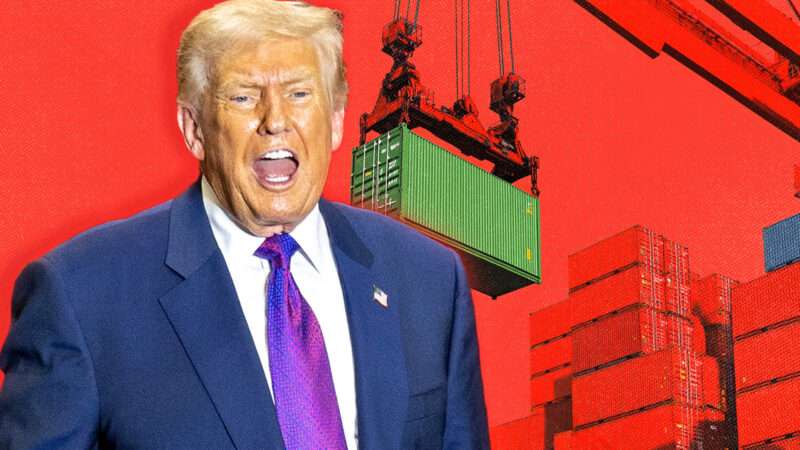
As President Donald Trump told it, his "Liberation Day" tariffs aimed to correct "unfair trade practices by other countries." But there was little rhyme or reason to the widely varying tariff rates he announced on April 2, 2025, and a long line of subsequent revisions compounded the confusion and uncertainty, wreaking havoc with the plans of American businesses that rely on international trade.
Trump's executive order imposed a 10 percent "additional ad valorem duty" on all but a few trading partners, without regard to whether they had adopted policies or practices that unfairly impeded imports from the United States or artificially boosted exports. Imports from Singapore, for example, were subject to the 10 percent tax even though that country was collecting zero tariffs on "nearly 100%" of imports. Brazil likewise was hit by the 10 percent tax, even though it was running a trade surplus with the United States.
An annex to Trump's executive order listed higher, supposedly "reciprocal" tariffs on goods from 57 countries. Those tariffs were based on Trump's longstanding but economically fallacious belief that bilateral trade deficits are inherently unfair and problematic. When the value of goods imported from any given country exceeds the value of U.S. exports to that country, Trump assumed, the explanation must be "non-reciprocal trading practices."
The formula that generated Trump's country-specific tariffs, which ranged from 11 percent for Cameroon and the Democratic Republic of the Congo to 50 percent for Lesotho, reflected that simple-minded assumption. To arrive at those rates, the Trump administration divided the U.S. trade deficit with each country by the value of U.S. imports from that country, then arbitrarily halved the result. In many cases, the rates produced by that formula were puzzling.
In 2024, for example, Lesotho exported about $237 million in goods, primarily clothing and textiles, to the United States. That same year, Lesotho imported about $9 million in U.S. goods, which consisted mainly of vehicles, "milling products" such as malt and starches, machinery, and chemicals. Lesotho is a very poor country, with a per capita gross domestic product (GDP) of about $972 in 2024, and that fact alone goes a long way toward explaining the high ratio between its exports and imports.
At the time, Lesotho was taxing U.S. imports at a rate of 10 percent. Trump's decision to tax Lesotho's exports at a rate five times as high looked anything but "reciprocal." Last July, he implicitly acknowledged that point, reducing Lesotho's rate to 15 percent—a 70 percent drop.
Or consider Israel, which Trump had previously described as "our best ally" and "a fair-trading partner." In anticipation of Trump's tariff announcement, the Israeli government made its trade policy even friendlier to the United States by eliminating all remaining import taxes on U.S. goods. Israel nevertheless got hit by a 17 percent "reciprocal" tariff. That rate was subsequently cut to 15 percent, then cut again for certain categories of goods.
There were many such adjustments, not always in a downward direction. In July, for instance, Trump dramatically increased the tariff on Brazilian goods, from 10 percent to 50 percent. He also raised the tariff rate for seven other trading partners, including Canada (from 25 percent to 35 percent), the European Union (from 20 percent to 30 percent), and Mexico (from 25 percent to 30 percent). At the same time, he cut the rate for a dozen countries, including Cambodia (from 49 percent to 36 percent), Bangladesh (from 37 percent to 35 percent), and Sri Lanka (from 44 percent to 30 percent).
The timeline of Trump's tariffs is perplexing, even if you focus on a single country. Less than a week after "Liberation Day," Trump raised the country-specific tariff rate for China from 34 percent to 84 percent. The next day, the rate became 125 percent, in addition to the 20 percent tariff that Trump had imposed on Chinese goods in the name of reducing the flow of illicit fentanyl, for a total of 145 percent.
In May, Trump extended those tariffs to low-value packages from China, which had previously been exempt under a "de minimis" exception. Ten days later, Trump cut the 125 percent tariff to 10 percent for a 90-day period, after which it would rise to 34 percent—the rate he had initially announced on April 2. In August, he extended the 10 percent "reciprocal" tariff for another 90 days. Three months later, he cut the 20 percent "drug trafficking" tariff in half and extended the 10 percent "reciprocal" tariff until November 10, 2026.
That deadline was obviated by the Supreme Court's February 20 decision in Learning Resources v. Trump, which held that the law the president had invoked to justify both the "reciprocal" and "drug trafficking" tariffs, the International Emergency Economic Powers Act (IEEPA), did not authorize import taxes at all. Although the impetuous, haphazard, and zigzag pattern of Trump's IEEPA tariffs was not relevant to the Court's interpretation of the statute, Chief Justice John Roberts thought it was worth noting.
"Since imposing each set of tariffs," Roberts wrote in the majority opinion, "the President has issued several increases, reductions, and other modifications. One month after imposing the 10% drug trafficking tariffs on Chinese goods, he increased the rate to 20%. One month later, he removed a statutory exemption for Chinese goods under $800. Less than a week after imposing the reciprocal tariffs, the President increased the rate on Chinese goods from 34% to 84%. The very next day, he increased the rate further still, to 125%. This brought the total effective tariff rate on most Chinese goods to 145%. The President has also shifted sets of goods into and out of the reciprocal tariff framework. And he has issued a variety of other adjustments."
It was a bewildering ordeal for exporters, importers, and the U.S. businesses that rely on them for materials, parts, and finished goods. Faced with a mercurial president whose decrees were unpredictable yet crucial to their bottom lines, those businesses had to make decisions about purchases, investments, and prices in highly uncertain, constantly changing conditions. And although Trump has switched tracks, turning to other tariff options now that IEEPA is off the table, that wild ride is not over yet.
The post Trump's Mercurial, Constantly Changing Import Taxes Took American Businesses on a Wild Ride appeared first on Reason.com.



 Bengali (Bangladesh) ·
  English (United States) ·