

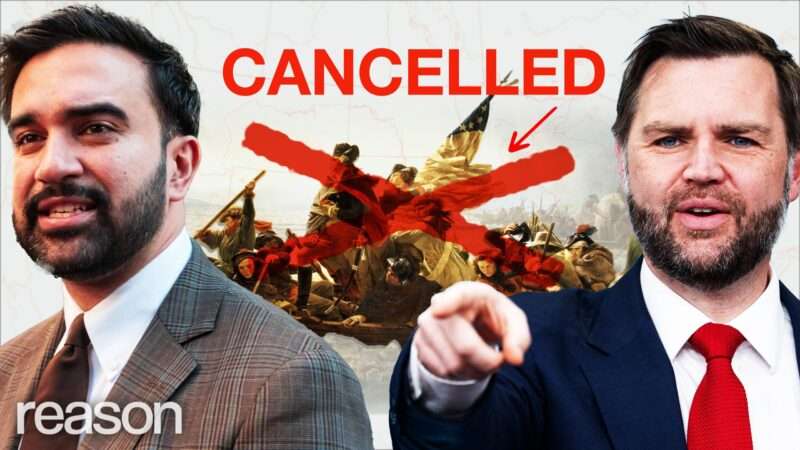
On the 250th anniversary of the Declaration of Independence, it's worth asking: What was the American Revolution actually about?
We all remember the broad strokes we learned in school: Independence from the British crown. Taxes on tea. Life, liberty, and the pursuit of happiness.
But on a deeper level, the American Revolution was—and is—a revolution in political theory, reimagining what a legitimate government is and what its relationship to its citizens should be.
Washington's troops won the ground war 245 years ago at Yorktown, but the ideological battle continues against forces on both the left and the right who are pursuing a ruthless assault on America's core values. The American Revolution isn't over.
Inscribed inside the dome of the Jefferson Memorial are the words: "I have sworn upon the altar of God eternal hostility against every form of tyranny over the mind of man." Thomas Jefferson wrote that in an 1800 letter, but that feeling of hostility toward the tyranny of a distant monarch is what drove him and his fellow revolutionaries in 1776.
Supreme Court Justice Neil Gorsuch summarized the Declaration's core ideas in an interview with Reason: "The Declaration of Independence had three great ideas in it. That all of us are equal. That each of us has inalienable rights given to us by God, not government. And that we have the right to rule ourselves."
That's why Jefferson declared that a legitimate government requires the "consent of the governed." Thomas Paine put it more scathingly in his 1776 pamphlet Common Sense, writing that "government by kings was first introduced into the world by the Heathens." Monarchy was the Devil's most effective and enduring form of "idolatry."
We don't fret over tyrannical kings in today's America. Only ceremonial vestiges of hereditary monarchy remain in the modern world. The Revolution achieved a complete victory in that sense.
Yet a counterrevolution is underway, one that views the American Revolution and the republic it birthed as a failed liberal regime that has outlived its usefulness. And these counterrevolutionaries sit remarkably close to the levers of power.
Self-Rule Under Threat
Three years before he became vice president, J.D. Vance told podcaster Jack Murphy that America had reached a point of no return. "We are in the late republican period," he said. "If we're going to push back against it we have to get pretty wild and pretty far out there and go in directions that a lot of conservatives right now are uncomfortable with. Indeed, among some of my circle the phrase 'extra-constitutional' has come up quite a bit."
Vance regularly cites and associates with a group of so-called "postliberals." He appeared on a panel with one of this movement's leading intellectuals, Patrick Deneen, a Notre Dame political science professor and the author of Regime Change: Toward a Postliberal Future, in 2023.
Deneen believes there is an unbridgeable divide between the "elite" and "ordinary" people. "What is needed," he writes in the book, "in short, is regime change—the peaceful but vigorous overthrow of a corrupt and corrupting liberal ruling class," which will be replaced by a more virtuous one. He envisions the kind of aristocratic government favored by the ancients like Plato and Aristotle, endorsing "aristopopulism," where an elite class works to further the interests of the masses.
"The replacement of the current elites in our society ought to be more closely aligned to the interests of ordinary people," Deneen said at the panel.
He invokes a "premodern conception of liberty—expressed in the pages of Plato, Aristotle, the Bible," where institutions like the family, the church, and the state worked together to impose "guardrails" protecting individuals from becoming "slaves" to their own desires.
My colleague Stephanie Slade writes about the postliberal right for Reason magazine.
"He says people like [himself] should just be in charge of our government. That's what he means by regime change," Slade says. "[That] we should replace the current elites."
She notes that postliberals are willing to frame the entire American Founding as a mistake: "They might say, yeah, America did have a liberal founding and that's why it was a mistake. Actually, this whole experiment was a mistake, and it maybe took a couple hundred years for that mistake to play out….We now can see that it doesn't lead to good conservative outcomes."
In his book Common Good Constitutionalism, Adrian Vermeule, a postliberal Harvard Law professor and appointee to President Donald Trump's Council of the Administrative Conference of the United States, wrote that "the central aim of the constitutional order is to promote good rule, not to 'protect liberty' as an end in itself." That's a rejection of the spirit of 1776. Paine saw the existence of government as a necessary evil because of "the inability of moral virtue to govern the world." A minimal state, in his view, should be restricted to supplying "freedom and security."
As Gorsuch put it in the same Reason interview: "If you think of the Declaration as kind of our mission statement, our ideals, and the Constitution is the how-to manual—well, the Constitution is all about dividing power. Madison realized men are not angels and that their aspirations for power need to be checked and checked and checked again."
The "regime change" Deneen and Vermeule call for isn't explicitly violent. Deneen describes "Machiavellian means to achieve Aristotelian ends." The strategy manifests as a steady expansion of presidential authority, as we've seen under Donald Trump's second term: the 143 executive orders he signed in just his first 100 days, more than any other president in history; his decision to send troops to American cities without permission from local authorities; his declaring of 21 national emergencies while in office; and his decision to send illegal immigrants to overseas prisons in defiance of the judicial branch.
Incidentally, one of the grievances listed in the Declaration of Independence was King George III's penchant for shipping the accused "beyond Seas to be tried for pretended offenses."
Before he became vice president, Vance encouraged Trump to emulate Andrew Jackson and dare the Supreme Court to try enforcing its rulings against him. "If I was giving him one piece of advice," Vance said, "fire every single mid-level bureaucrat, every civil servant in the administrative state, replace them with our people, and when the courts—because you will get taken to court—and when the courts stop you, stand before the country like Andrew Jackson did and say, 'The chief justice has made his ruling, now let him enforce it.'"
"That's a really dangerous idea to be even casually trotting out there, let alone for somebody who is now the sitting vice president to be on the record," Slade says. "He said it a number of years ago when he was just a candidate for office, but I've never seen anything from him since he's been in office that makes me think that he doesn't ultimately believe in that sort of approach to politics."
Some postliberals call for measures far more dramatic than the steady erosion of constitutional restraints currently underway. Michael Anton, who worked in Trump's State Department over two terms, wrote in his book The Stakes about the prospect of a "Red Caesar"—a right-wing dictator who would rise from the ashes of the fallen republic. "Caesar's word replaces constitutionalism and even, in the final analysis, law," he wrote.
In a podcast conversation with pro-monarchist blogger Curtis Yarvin, Anton discussed what that might look like. "Caesarism is a form of monarchy, but that follows a nonfunctioning republic, a republic that doesn't work anymore," Anton said. Yarvin proposed that the path to power would begin with declaring a state of emergency in an inaugural address, "taking direct control over all law enforcement authorities….Basically like Caesar, you're using all of the force available to you."
"There is just clearly much more of a sense that government power is meant to be used to advance our side in the face of our enemies," Slade says. "And the enemies are the left, the political left, and anyone on the right who isn't going to line up with [them]. [They believe] political power should be used to reward our friends and punish our enemies, and that to me is a clear violation of one of the core principles of rule of law, which is equal treatment for everyone under law."
In the COVID era, President Joe Biden imposed national mandates by executive fiat, and his administration tried to suppress dissent by pressuring tech companies to censor critics.
The Democratic Party has also flirted with the idea of packing the Supreme Court to get its way, which is not a new impulse for the party. When President Franklin Delano Roosevelt tried to pack the Court in 1937, it cost him the support of progressives who had previously backed the New Deal.
FDR is revered by progressives and cited by Yarvin as a prototype for an American Caesar. "Was FDR a dictator? What does it mean to be a dictator? What does this pejorative word mean?" Yarvin asks. "A dictator is somebody who rules alone. And that, I think, is a beautiful thing."
The Revolution was, first and foremost, about self-rule: We would no longer abide by a diktat from an overseas king. From the very beginning of the republic, power-seeking men have tried to undermine that vision. In its earliest days, there was a plot to install a Prussian prince as king of a new American monarchy.
Jefferson accused John Adams and Alexander Hamilton of being monarchists, recounting in horror a dinner conversation in which Hamilton told him "the greatest man…that ever lived was Julius Caesar."
But monarchy is seductive because strongmen promise order in chaotic times. In the wake of Shays' Rebellion, a post-Revolution farmer's uprising, Jefferson worried the Constitution's drafters were overreacting by creating a powerful presidency that would devolve into a monarchy. "What country can preserve its liberties if their rulers are not warned from time to time that their people preserve the spirit of resistance?" he wrote. And then, famously: "The tree of liberty must be refreshed from time to time with the blood of patriots and tyrants. It is its natural manure."
Hopefully, patriots won't be shedding blood anytime soon. But Jefferson's point stands: Preserving the promises of the Revolution will always be an ongoing battle.
Self-rule was one of those promises. Another was self-ownership, which includes the right to do what you want with your own property.
The Rise of 'Right-Wing Progressivism'
The Declaration accused the king of "cutting off our Trade with all parts of the world."
The American colonies experienced unprecedented economic growth, a topic of keen interest to the laissez faire economist Adam Smith, whose book The Wealth of Nations also turns 250 this year.
Smith was fascinated by the American colonies, observing that their "progress has been more rapid than that of the English in North America. Plenty of good land, and liberty to manage their own affairs their own way, seem to be the two great causes of the prosperity."
Other imperial powers, such as the Spanish and Portuguese, mandated that their colonists trade only through state-created monopolies. Smith pointed out that because American colonists could export lumber to the wider European market, they were incentivized to clear and improve land. Low taxes enabled them to reinvest their profits.
Smith criticized England's Navigation Acts for prohibiting colonists from buying from other countries and for discouraging manufacturing to protect domestic competitors. Although England's "mercantile spirit" hampered the economy, Smith believed that in virtually every other respect the liberty of the English colonists "to manage their own affairs their own way is complete," concluding that both England and the colonies would be better off with an independent America that traded freely with England.
Like the American revolutionaries, Smith described economic freedom as not just smart policy, but as a natural right. "To prohibit a great people…from making all that they can of every part of their own produce," he wrote, "is a manifest violation of the most sacred rights of mankind."
That revolutionary understanding is still under attack today from both the left and the right. Socialists like Sen. Bernie Sanders (I–Vt.) and New York City Mayor Zohran Mamdani talk about individual profits as if they are the property of the collective. And Trump has the same mercantilist instincts toward trade that Smith argued against 250 years ago. "I love tariffs. Most beautiful word," Trump said in September 2025. "I said my favorite word in the English dictionary is the word tariff."
The postliberal right argues that laissez faire economics has undermined the working class. "Conservatives have outsourced our economic and domestic policy thinking to libertarians," Vance said at a 2019 National Conservatism Conference. "Do we serve pure unfettered commercial freedom, do we serve commerce at the expense of the public good, or do we serve something higher? And are we willing to use political power to actually accomplish those things?"
"It is really important to recognize that what the postliberal right is pushing in terms of economics is progressivism," Slade says. "It's not conservatism."
Tucker Carlson made the point in 2019 when he praised Elizabeth Warren's "economic patriotism" platform, noting it "sounds like Donald Trump at his best."
What the so-called "economic patriots" of the left and right are converging on is a rejection of the spirit of 1776 and an embrace of monarchy. In the 18th century, many colonists could trade only through state-licensed monopolies. Warren has proposed remarrying corporations and the state through "stakeholder capitalism," in which political appointees sit on corporate boards to steer them in the right direction. Trump took a major step toward the corporatist approach in 2025 when directing the federal government to take a 10 percent stake in Intel. Before him, President Barack Obama took stakes in GM and Chrysler as part of a bailout package.
"I don't think it's really a sustainable political equilibrium to have two parties that are both economically leftist," Slade says. "The American people are not on board with that. That is the horseshoe in action. And it's part of why I think there is an opportunity for old-school Reagan-style free-market conservatism to make a comeback."
The slow abandonment of the revolutionary ideas of self-rule and private property that American patriots fought for in the late 18th century is downstream of a third, fundamental aspect of the American Revolution that is also under attack: freedom of conscience.
Remarrying Church and State
The postliberal right wants to tear down the wall between church and state. "They want to integrate church and state instead of separating them," Slade says.
In some cases, it's Catholic integralists like Harvard's Vermeule, who has described a strategy of turning the government Catholic by "strategically locat[ing]" integralists "within liberal institutions…to undo the liberalism of the state from within." Deneen has suggested passing "blue laws" that would ban pornography, online gambling, and operating businesses on Sundays.
A Protestant variety of Christian nationalism is embodied by pastor Doug Wilson—a spiritual mentor to Secretary of War Pete Hegseth, who invited Wilson to lead a prayer at the Pentagon. In a recent interview, Wilson said the "governing authorities should recognize formally that Jesus rose from the dead" and that "the basis of law would have to be Christian, and I would want it to be Protestant."
Most of the revolutionaries were Christian Protestants, but they insisted on separating church and state to avoid the horrific religious wars that had ravaged Europe. "Torrents of blood have been spilt in the old world" to end religious discord by establishing state churches, wrote James Madison in opposition to taxes that would have funded an official church of Virginia.
An even deeper problem for these devout believers in divine providence was that marrying religion to the state removed the very freedom to choose faith that God desires. In his opposition to the Virginia law, Jefferson wrote that "Almighty God hath created the mind free" and that "all attempts" to force religious belief "are a departure from the plan of the holy author of our religion." Madison argued historically that Christianity reached its "greatest lustre" in the times before it incorporated with the state, and that religious laws would counterproductively discourage nonbelievers from entering a region he hoped would become a beacon of Christianity. "Religion then of every man must be left to the conviction and conscience of every man."
Slade draws on her own Catholic faith in making the case. "I am a libertarian because I'm a Catholic, because I believe that every person was created in the image of God," she says. "I just think it's morally wrong from a Catholic or Christian perspective to try to use the coercive, violent power of the state to make people live a certain way. Even if the way that these guys would like to make people live—going to church on Sunday, praying, investing in your community and your family, self-sacrifice—all these good Christian values. They're good Christian values, but they can't be coerced or imposed from the top down. It's wrong and morally offensive from a Christian perspective."
Slade says she understands the despair postliberals feel about the collapse of faith and virtue in contemporary America and that they have a point about the progressive capture of institutions. "What they're channeling is a really influential belief, which isn't totally wrong, that the left made a very concerted effort to make what is often referred to as a 'long march through the institutions' and to capture so many of our elite institutions—both at the governmental level but also at the cultural level: higher education, Hollywood, the mainstream media."
Critics of the progressive agenda—or "wokeness"—often describe it as its own kind of religion. Linguist and social critic John McWhorter has argued that it has "slowly transmogrified into a kind of replacement for Protestant Christianity" among its adherents.
Whether religious or not, progressives have imposed their social values on Americans through public school curricula, federal policy, and civil rights law. They have violated the freedom of conscience that Jefferson and Madison wrote about in a way very similar to how mandating religion would. Postliberalism is part of the political backlash.
A poll conducted in early 2021 of people who voted for Trump in 2020 didn't find agreement on nationalist economic policies—tariffs, industrial policy, any of that—but found near-universal agreement on a sense of cultural siege. About 90 percent agreed with statements like "the mainstream media has become just an arm of the Democratic Party" or "Christianity is under attack today."
"This sense that the culture has been captured by people who are hostile to people like me and who hate me and want to drive me out of the public square has created so much resentment and so much of a backlash that's driving this postliberal right-wing politics," Slade says. "I don't think it's possible to understand what's going on on the right without looking at what's been going on on the left, definitely ramping up during the period referred to as the great awakening."
Slade's new book argues that the remedy to this postliberal moment is a rediscovery of "fusionism"—the reintegration of liberty and virtue. "A good society needs to be both free and virtuous. And the Founders certainly believed this," she says.
John Adams wrote just 13 days before the signing of the Declaration that "the only foundation of a free Constitution is pure Virtue, and if this cannot be inspired into our People…they will not obtain a lasting Liberty."
"What he's saying is, we can have a limited government in a free society, but if the people aren't naturally virtuous, if they don't trust each other, if they aren't good to each other—that [the Republic] is going to end up succumbing to tyranny and to a strongman government," Slade says.
His fellow revolutionary and intellectual adversary Jefferson flipped the equation by writing that liberty "is the great parent…of virtue."
Balancing liberty and virtue means reconstructing some of the civic "guardrails" that Deneen laments having lost in modernity—but not handing the power to regulate our conscience to the government.
"What we're seeing a lot is people who are focused either on liberty but don't spend a lot of time thinking about how do we cultivate virtue, or who say, forget your liberty, we want virtue at the point of a gun," Slade says. "Government's job is to protect our basic rights and liberties. It should be prioritizing the protection of liberty."
"That doesn't mean that virtue isn't important. In fact, it's the highest, most important thing in life—to pursue a virtuous life," Slade continues. "But it's not OK to expect government to do that for us. Government protects our freedom and we use that freedom to pursue virtue."
The solution, Slade argues, has to be ground-up. She invokes Alexis de Tocqueville, who observed when he came to America in the 1830s that Americans excel at coming together and creating voluntary community solutions to social problems.
"We should have some muscle memory here. We should be able to get back to that idea of thinking of ourselves as being on the front lines of solving problems, building new civil society institutions, nongovernmental institutions that can try to solve the problems we see in our society," Slade says. "Good policy can make this easier. And bad policy can crowd it out and make it a lot harder."
The Declaration of Independence is 250 years old, but the Revolution it started is as vital as ever.
During the final days of the Constitutional Convention, Benjamin Franklin was famously asked what kind of government they were in the process of designing. "A Republic," he said, "if you can keep it."
Photo Credits: Horst Galuschka/dpa/picture-alliance/Newscom/ Dennis Flaherty / Jaynes Gallery / DanitaDelimont.com / Danita Delimont/ Tom Williams/CQ Roll Call/Newscom/ TIA DUFOUR/UPI/Newscom/Antonio Perez/TNS/Newscom/ Aaron Schwartz - Pool via CNP/picture alliance / Consolidated News Photos/Newscom/ Ron Adar / SOPA/ Images/Sipa USA/Newscom/ JT Vintage/ZUMAPRESS/Newscom/ AdMedia/SIPA/Newscom/ Hugh Rooney / Eye Ubiquitous/Newscom/ Bonnie Cash - Pool via CNP/CNP / Polaris/Newscom/AdMedia/Newscom/ Graeme Sloan/Sipa USA/Newscom/ Polaris/Newscom; Eric Lee - Pool via CNP/ZUMAPRESS/Newscom; Department of Defense
The post The American Revolution Isn't Over appeared first on Reason.com.





 Bengali (Bangladesh) ·
  English (United States) ·