

Like most cats, Cooper used to love climbing into cardboard boxes. But one day, a box full of foam packing peanuts caught this tabby by surprise. Her owner, Sean McGrath, soon heard a commotion coming from the box and pulled her out. Thanks to static electricity, foam pellets now clung to her fur from head to tail.
Cooper seemed stunned. “She just stood there, frozen,” says McGrath, 44, of St. John, Canada. He snapped a photo before brushing her off. That picture, taken 20 years ago, eventually found its way to Wikipedia. Cooper unwittingly came to embody static electricity. She has appeared in textbooks, college lectures and more — all to help explain this sticky science.
 Cooper the cat unwittingly learned that polystyrene packing peanuts become negatively charged when a cat snuggles into them. That charge caused them to cling to her fur, which became positively charged.
Sean McGrath/Flickr (CC by 2.0)
Static electricity is common in everyday life. It’s why rubbing a balloon on your head makes your hair cling to it. It’s why clothing fresh from the dryer can stick to your legs. It’s also behind the painful shock you sometimes get when you touch a doorknob.
But the science of static electricity is surprisingly mysterious.
We know it’s caused by an electric charge moving between objects when they touch. But how — exactly — does that happen? In most situations, “we really have no clue,” says Galien Grosjean. A physicist, he works at the Autonomous University of Barcelona in Spain. He’s one of a small, quirky group of scientists who are obsessed with static electricity. The crew includes physicists, engineers, chemists and materials scientists.
Each researcher in this group holds a piece of the static-electricity puzzle. But they’re finally putting some of the pieces together to make progress.
“Nobody really fully understands it,” says Bilge Baytekin. She’s a chemist at Bilkent University in Ankara, Turkey. “This is what I like about static electricity, very much.”
Do you have a science question? We can help!
Submit your question here, and we might answer it an upcoming issue of Science News Explores
Cooper and the box
For all the questions about static electricity, scientists already agree on some basics. Whenever two objects touch or rub together, they exchange some electric charges. When that charge builds up, you get static electricity.
The electric charges come from electrons and protons. Electrons have negative charge. Protons carry positive charge. Objects with equal numbers of electrons and protons have no overall charge. But as soon as objects touch, the balance of charges shifts.
 Static electricity can cause your hair to poof out. That’s because each hair takes on a positive charge, causing strands to repel one another.
Illustration by Simone Noronha
When Cooper jumped into the box, her fur rubbed against the packing peanuts, exchanging some charges with them. That gave her fur an overall positive charge. At the same time, the packing peanuts picked up a negative charge. Opposite charges attract, so the pellets clung to her fur.
A balloon rubbed on your hair has a similar effect. The balloon gets a negative charge as your hair gets a positive charge — so they now cling to each other. Meanwhile, like charges repel one another. So the positively charged strands of your hair may push messily away from each other.
And if too much charge builds up on you, watch out. You may get an electric shock when you touch another object, such as a doorknob. Your body’s excess charge gets discharged suddenly — and painfully.
Experiments show that certain materials, like the latex of a balloon, tend to charge negatively. Others, like hair, tend to charge positively. Scientists have a ranking called the triboelectric series. It predicts which way the positive and negative charges will go when two materials touch.
Those concepts are well understood. But look closer and static electricity gets more mysterious.
Sticky questions
Typically, electrons are the particles that transmit electricity. When a battery turns on a light bulb, for instance, electrons are moving through the circuit. But static electricity is different. It arises from what happens to a very thin layer on the surface of an object.
That’s harder to pin down.
When Cooper nestled into the box, did electrons move from her fur to the packing peanuts? Or was it charged atoms or molecules, called ions, that moved? It might also have been larger chunks of fur or foam that carried the charges. In most cases of static electricity, scientists don’t know which of these possibilities is correct.
Even textbooks get this wrong.
Baytekin remembers a book from her school days that described static electricity. One diagram showed how charge moved. “There was an arrow,” she says. “And on the arrow, it was written ‘electron.’”
The triboelectric series
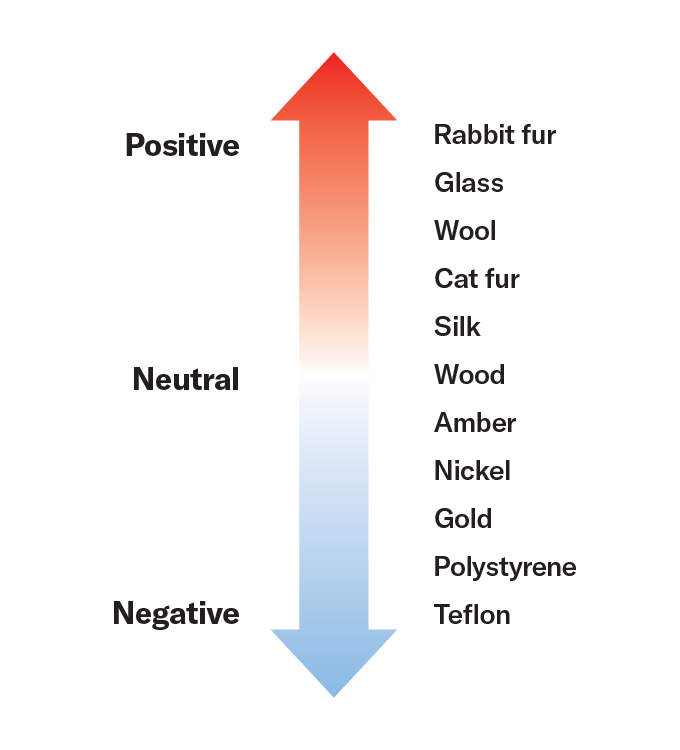 T. Tibbitts
Materials are more likely to charge positive (red) or negative (blue) depending on their place in a triboelectric series. When two materials in this list touch, the material that sits higher on the list tends to gain positive charge, and the lower one gains negative charge. Take a cat that brushes against polystyrene — or Styrofoam — packing peanuts. Its fur becomes positively charged. The packing peanuts take on a negative charge.
The triboelectric series raises questions, too. In that series, cat fur sits above polystyrene, which is what packing peanuts are made of. That tells us that Cooper’s fur charged positively and the packing peanuts charged negatively. But we don’t know why those materials are ordered the way they are. No one knows what makes one material more likely to charge negatively or positively.
The series also doesn’t explain why identical objects can charge when touched.
Part of the issue is that static electricity is in some ways a subtle effect. Imagine shrinking yourself down to the size of an atom. Now, stroll along the surface of a charged material. You’d stumble across an extra (or missing) electron only every 100,000 atoms or so.
Studying static electricity at that level is hard. “You have to trace something which is a very tiny minority,” explains Rolf Möller. “This is what makes it so difficult.” A physicist, he works at the University of Duisburg-Essen in Germany.
Static significance
The study of static electricity is almost as old as science itself. The philosopher Plato wrote about it around 360 B.C. “It’s so poetic that it’s so old … and that we still can’t make sense of it,” says Scott Waitukaitis. He’s a physicist at the Institute of Science and Technology Austria. That’s in Klosterneuburg.
Static electricity shapes our world on large and small scales. It sparks lightning, strengthens dust storms and helps pollen cling to bees and butterflies. It might even explain why Earth exists. In the early solar system, planets formed out of colliding bits of dust. Scientists think those bits stuck together in part due to static cling.
 Planets form from a disk of gas and dust around a young star in this illustration. As the dust particles collide, they become charged. That charge then helps dust particles stick together into larger clumps that will eventually become planets.
NASA-JPL
Static electricity can also cause damage. It ignites fires, gums up manufacturing and fries delicate electronic circuits. Cooper’s misfortune was minor in comparison.
Static electricity can be a particular nuisance in outer space. Space lacks humidity, that moisture in the air that helps keep charge from building up on Earth. Plus, gravity is weaker in space. So the push and pull of static electricity matters more.
Scientists Say: Regolith
“Forces that are not important on Earth start to become important,” notes Christine Hartzell. She’s a planetary scientist at the University of Maryland in College Park.
A lunar rover’s wheels or solar panels may not work as well if electrically charged moon dust sticks to them. An astronaut could get charged up from shuffling across moon dust, too. Then they could unwittingly zap sensitive equipment. Or they might track hazardous moon dust inside a spacecraft. So understanding static electricity is top of mind for NASA.
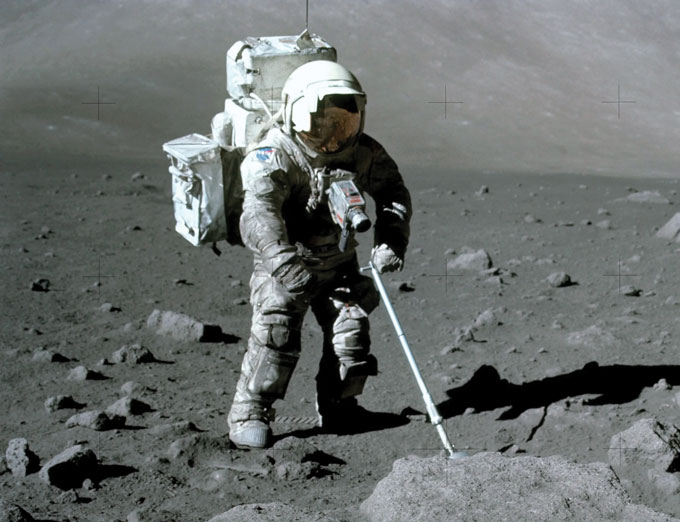 Electrically charged dust coated astronauts walking on the surface of the moon. The dust can be hazardous to astronauts’ health.Eugene Cernan/NASA
In June, static-electricity buffs gathered in Cocoa Beach, Fla. It was a meeting of the Electrostatics Society of America. Scientists there were trying to work through some of the mysteries of their field.
Some gave talks that were playful. One was about the charging of water in fancy showerheads. Another was about parasites that use static electricity to leap to their hosts. One even showed how a pickle glowed when hooked up to electricity.
Other talks were more serious — about industrial explosions and spacesuit design.
If scientists understood static electricity, they could better predict how materials charge. Maybe they could even learn to control it. And this might help prevent fires and other issues.
“We want to understand the fundamentals,” Baytekin says. “But we also want to help the people … who are actually suffering from these effects.”
Author Emily Conover highlights some of the enduring mysteries of static electricity. Watch to the end for a bonus surprise.Common ground
There’s one case where scientists agree on how static electricity works. That’s when one metal touches another metal.
Different types of metals vary in how tightly they hang onto their electrons. When two metals touch, some electrons move between them. They go to the metal that hangs onto its electrons more tightly. That gives this metal a negative charge.
Other materials don’t work the same way. So scientists want to broaden their understanding. “The ultimate goal would be to have some kind of unifying theory that worked across different materials,” says Hartzell at Maryland. “That would be awesome.”
But it’s a tall order. Static electricity might be too complex to precisely predict its effects in everyday scenarios, says Daniel Lacks. He’s a chemical engineer at Case Western Reserve University in Cleveland, Ohio. “I don’t think the final answer is going to be an easy, simple answer,” he says. “I think the final answer will be that it’s very dependent on many, many factors.”
 Physicists are performing careful experiments to understand the complex factors that influence static electricity.
© ISTA
Look, no hands!
Scientists are working on new types of experiments to reveal hidden sides of static electricity. But devising ways to probe this is no easy task.
When you’re trying to study static electricity, every touch matters. Touching something can charge it up. That can mess with the results of an experiment. So Grosjean and Waitukaitis have gone hands-free. In their experiments, sound waves hold objects. So nothing solid touches them.
If you’ve ever blasted music at top volume, you may have noticed that loud sounds can rattle objects. Even more powerful sound waves can make small objects float in midair. This technique is called acoustic levitation. And it prevents unintended charging.
In one test, Grosjean, Waitukaitis and others levitated glass beads. Then they dropped them on a glass plate. Afterward, they caught the beads again with the sound waves and measured how much charge the beads had picked up.
Their goal: See what happens when two objects of the same material touch.
Sound waves levitate a tiny glass sphere in an experiment. When the sound waves shut off it falls and hits the plate. That impact gives it an electric charge. When it bounces back up, the sound waves switch back on and catch it.© Thomas Zauner/ISTA
What they found was unexpected.
Each of the identical beads acted completely differently. An individual bead charged the same way every time it hit the plate. But other beads charged differently. One bead, for example, would always get a negative charge. Another would always get a positive charge. What made their behaviors so individual?
A little bit of cleaning revealed the answer. The researchers heated the beads to 200° Celsius (392° Fahrenheit), then let them cool. That baked off some invisible gunk on the outside of the beads. Then they ran the experiment again. Clean beads now consistently charged negatively when they hit an uncleaned plate. The gunk had affected how the beads charged, this suggests.
Close inspection revealed that the gunk was made of carbon-containing chemicals. That carbon comes from Earth’s atmosphere. It’s stuck to the surface of most objects, in a layer too thin to see. “At first, we were going to call it junk,” Waitukaitis said at the Cocoa Beach meeting. “Then we thought, maybe schmutz.” (It’s the German or Yiddish term for dirt or grime.)
His team shared its discovery in the March 19 Nature. The experiment didn’t show how charge moves. But it did reveal that what’s on the surface matters.
Know your history
Obviously, Cooper’s fur isn’t made of glass or metal. Fur is a polymer. These are substances made up of very large molecules. They also include plastics, rubber — and foam packing peanuts.
With polymers, static electricity can get even weirder. For instance, even an object’s past can matter.
Explainer: What are polymers?
In a different set of experiments reported in 2025, Waitukaitis and others pressed squares of a squishy polymer together. How many times a particular square had been touched overall determined how it charged.
These experiments are adding to the list of things known to affect charging. That had already included humidity, temperature and surface curvature. It also included roughness, object size and whether two objects touch, rub or roll across one another.
Identifying what matters for static electricity gives scientists new hope. In the past, it’s been hard to make progress because experiments that seemed similar might offer different results. Now that scientists are finding some of the reasons why, they might finally be able to make sense of static.
As for Cooper the cat, she found one experiment with static quite enough. After McGrath had brushed most of the foam peanuts off her, she dashed away. McGrath had to chase her down to remove the last of them. Lesson learned — she never jumped in a box with packing peanuts again. (McGrath did let his pet ferrets play in the box, though. They loved it.) McGrath is now a professional photographer. And though Cooper passed away years ago, her legacy lives on. McGrath has documented many weddings, engagements and other events. But the photo of Cooper, he says, is the most famous he’s ever taken.





 Bengali (Bangladesh) ·
 English (United States) ·