
 3 hours ago
8
3 hours ago
8 
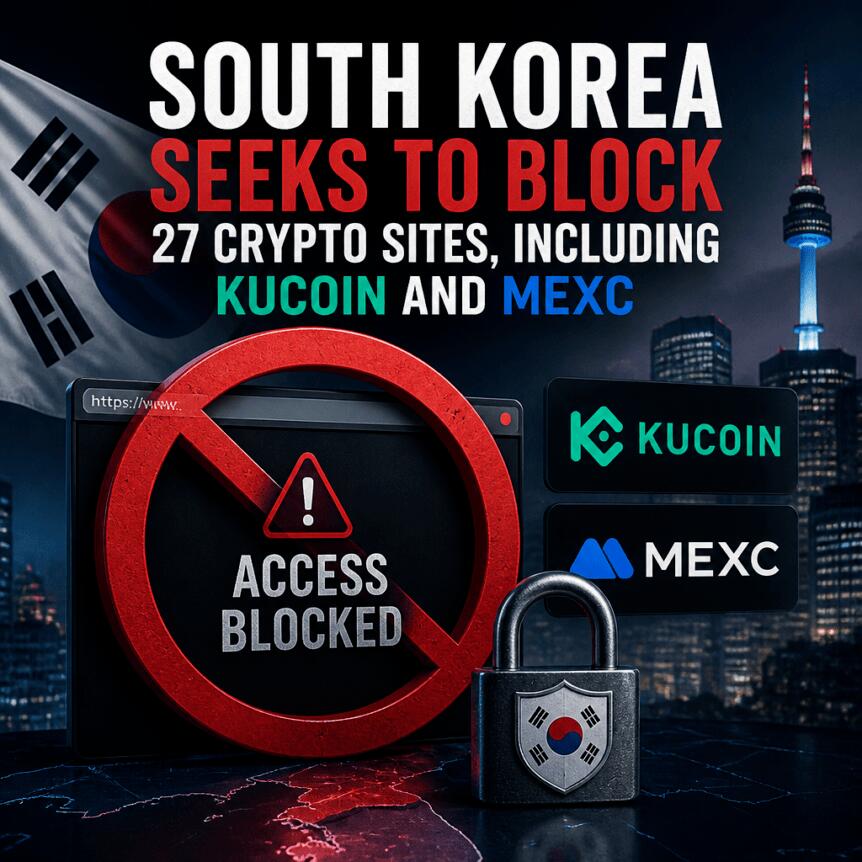
South Korea’s Financial Intelligence Unit (FIU) has approved restrictions intended to cut off domestic access to 27 cryptocurrency platforms that are not registered with the country’s financial authorities. The measures target unregistered virtual asset service providers (VASPs), including well-known overseas exchange brands such as KuCoin, MEXC, Phemex and Bitrue.
According to an FIU announcement published Tuesday, the decision followed a review by the Korea Media and Communications Standards Commission on Oct. 6 and 7, and is grounded in South Korea’s anti-money laundering framework—specifically the Act on Reporting and Using Specified Financial Transaction Information.
Key takeaways
South Korea will block access to 27 unregistered crypto websites, rather than limiting enforcement to mobile apps only. The FIU says the block will include both domestic enforcement (terminating hosted services) and overseas access restrictions. Authorities will assess whether offshore platforms are effectively targeting Korean users using indicators such as language support and won-denominated transactions. The FIU acknowledged the website blocks may complicate withdrawals for existing users and said withdrawal guidance will be provided through DAXA. The move follows earlier restrictions on downloads and updates for unregistered exchange apps on Apple’s App Store and Google Play.FIU approval extends enforcement from apps to websites
The FIU’s updated approach widens the scope of South Korea’s regulatory enforcement against platforms that have not registered under the country’s specified financial transaction information reporting and compliance regime. Under the approved measures, authorities can terminate services that are hosted domestically and also block access to websites operated overseas.
In its announcement, the FIU said the decision means blocking measures against illegal virtual asset operators will apply to internet websites, including those accessed through standard web browsers—an expansion that mirrors earlier action taken against mobile applications.
The targeted exchanges and how the list was framed
The list of affected platforms is not limited to a single region or operator type. Alongside exchanges such as KuCoin, MEXC, Phemex and Bitrue, the block list includes other names including CoinW, BTCC, BitMart and BingX, as well as DigiFinex and additional operators.
What ties them together is their status: the FIU’s framework applies to crypto platforms that have not registered under South Korea’s anti-money laundering legislation. In practice, this reflects a compliance gap—operators that want to serve Korean customers are expected to operate under the local regulatory requirements rather than remain outside the system.
How authorities determine whether offshore operators are aimed at Korea
While some restricted platforms are operated overseas, the FIU said authorities evaluate whether those operators target Korean customers. The assessment, as described by the FIU, considers whether a platform offers Korean-language services, markets directly to users in South Korea, or supports transactions in South Korean won.
This matters because it clarifies the enforcement logic: the goal is not merely to block firms headquartered abroad, but to restrict access to platforms that functionally attempt to reach Korean users. For traders and users, it also signals that localization—such as language support and fiat on-ramps in won—can be a key factor in whether an offshore exchange becomes subject to local restrictions.
Withdrawal complications acknowledged; DAXA support planned
The FIU also addressed a practical concern for existing users. It acknowledged that website blocking measures could complicate withdrawals for users who already have assets on restricted platforms. The FIU said authorities plan to provide withdrawal guidance and support through the Digital Asset eXchange Alliance (DAXA), working with the operators.
Notably, the filing does not eliminate the risk of friction during the transition. Users who rely on web access for account management may encounter higher barriers as blocks take effect. The key variable to watch is how DAXA-coordinated guidance is delivered in the real world—especially around the timing of restrictions and whether affected operators cooperate smoothly with the planned support channels.
Earlier app restrictions set the stage for broader access blocks
This announcement builds on earlier restrictions targeting mobile apps. Earlier coverage from Cointelegraph reported that South Korea blocked downloads and updates for unregistered exchange apps on Apple’s App Store in April 2025, following restrictions on additional apps distributed via Google Play.
The step from app-level restrictions to website blocking changes the enforcement surface. Even if users circumvent app limits, web access remains a primary path to interact with exchanges—accessing account pages, submitting withdrawal requests, or managing balances. By explicitly moving to website blocks, South Korea is attempting to reduce the avenues through which unregistered operators can reach consumers.
Going forward, the biggest questions for users are whether withdrawal assistance will fully mitigate disruptions and how quickly blocks will be implemented across the affected platform list. Investors and market participants should also watch for follow-up updates from South Korea’s FIU and DAXA as the operational details—particularly around existing user withdrawals—become clearer.
This article was originally published as South Korea Seeks to Block 27 Crypto Sites, Including KuCoin and MEXC on Crypto Breaking News – your trusted source for crypto news, Bitcoin news, and blockchain updates.




 Bengali (Bangladesh) ·
  English (United States) ·