

While at Brown University in Providence, R.I., oceanographer Lily Dove studied the physics of Antarctica’s Southern Ocean with the help of some unusual, furry assistants: Antarctic seals. “They’re oceanographers,” she says. “They are regularly making dives in areas that we don’t often get to sample.”
Dove didn’t work with the seals directly. Instead, she interpreted data collected by the Marine Mammals Exploring the Oceans Pole to Pole program. This international group of scientists collects ocean data through sensors attached to the foreheads of southern elephant and Weddell seals. (Don’t worry. The animals don’t mind.) The seals dive more than 100 meters (330 feet) in search of food, allowing researchers to monitor temperature, salinity and pressure at depths inaccessible to human divers.
Let’s learn about Antarctica
Dove used these data to study how climate change is impacting the Southern Ocean. That’s the vast ocean that circles Antarctica. In certain areas of the Southern Ocean, atmospheric heat moves from the surface to the deep ocean. This heat is typically trapped for hundreds of years once it reaches the depths, further increasing ocean temperatures.
Now at the Georgia Institute of Technology, Dove works with autonomous robots to study polar oceans. Some, such as floats, ride sea currents. Others, such as gliders, are pilotable underwater vehicles, meaning Dove can target specific locations. “And this is all remote,” she says. “I can sit here in Georgia and tell my glider in a whole different hemisphere where I want it to go.”
This tech is also more predictable than her past assistants. “Seals are very independent,” she says. Unlike a glider, “seals very much tell me where they want to go,” she says. In this interview, Dove shares her experience and advice with Science News Explores. (This interview has been edited for content and readability.)
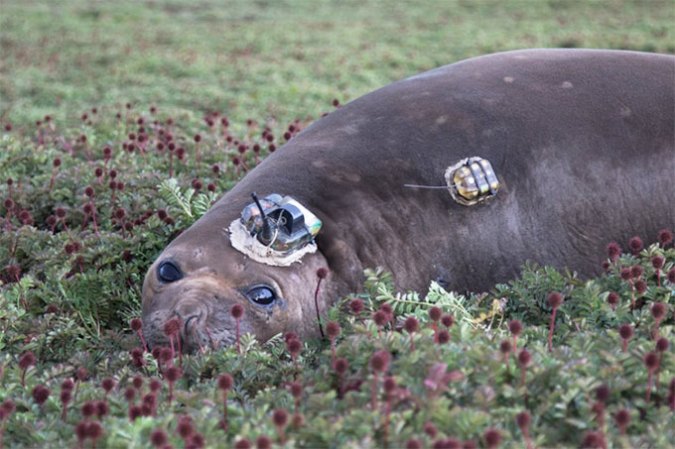 Part of Dove’s work has included analyzing data gathered by sensors placed on Antarctic seal species, such as Southern elephant seals. Etienne Pauthenet (EPFL, Switzerland)
What inspired your career?
Growing up in Florida, the ocean interested me as this powerful system that we take for granted. But I didn’t really consider it as a career back then. I knew I loved science, like physics and chemistry. In college, I knew I wanted to do one of those things or some combination. I changed majors like five times.
Then I realized that I liked those topics because they could help explain what I cared about: the Earth and the environment. I learned that you need all different kinds of science to understand the Earth system. Biology, physics, chemistry, geology — all of them. I ended up researching atmospheric chemistry.
How did you get to where you are today?
In graduate school, I took those skills from studying atmospheric chemistry and started doing oceanography instead. The atmosphere and ocean have the same physics. That made it feel like it was the perfect transition for me. I landed in a group that was investigating polar oceans, which wasn’t something I’d even considered before. I went to the Southern Ocean for the first time in 2020. The polar oceans are pretty remote and far away from where most people live. But they have massive impacts on our climate system, especially the Southern Ocean. It wasn’t until I was there that I realized that. That’s when I knew that this is exactly what I wanted to be doing.
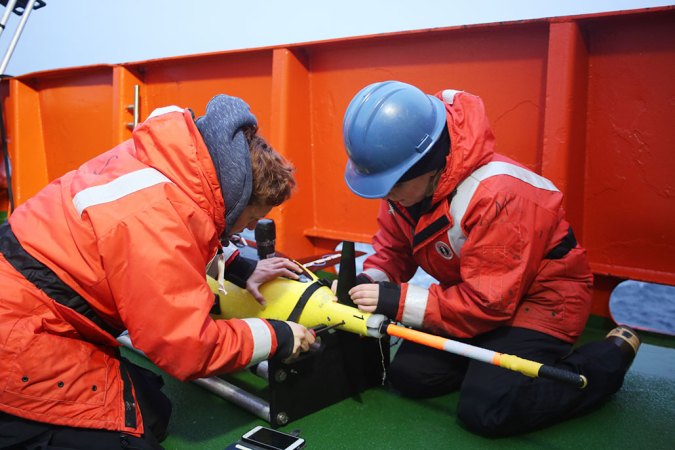 Dove now uses underwater autonomous vehicles, such as this glider being prepared for launch, to explore the ocean.Linnah Neidel
What was your biggest challenge, and how did you overcome it?
I’ve experienced quite a bit of discrimination in this field as a woman. There are a lot of assumptions people have about who is welcome to do polar science. Historically, women have not been included on research cruises. Women used to stow away on ships to get data for their research theses. There’s a famous case at the Woods Hole Oceanographic Institution of a woman stowing away on a research vessel in the 1950s.
That stigma is still present to an extent, but it’s changing a lot. And it’s not just about women. People of color, queer people and disabled individuals are also experiencing this less-overt discrimination.
Throughout my time in the field and in academia, there have been times when people have assumed I can’t do something. That’s really frustrating, but it’s also given me the skill to really speak up and advocate for myself.
What advice would you give to your younger self?
Say “yes” to as many opportunities as possible. That could be attending an event, talking with a scientist or taking a course. The worst-case scenario is that you learn something new that’s just not super interesting to you. The best-case scenario is that something grabs your attention, and you can’t let it go.
I am also glad that I didn’t hyperfixate on a particular area of study super early. I’m glad I got a strong basis in a lot of different scientific fields before I decided on a focus. It allowed me to be really flexible and open to new ideas.
If you already know that you’d want to do something specific, listen to your gut. But if you are not quite sure, lean into just learning a lot.



 Bengali (Bangladesh) ·
  English (United States) ·