

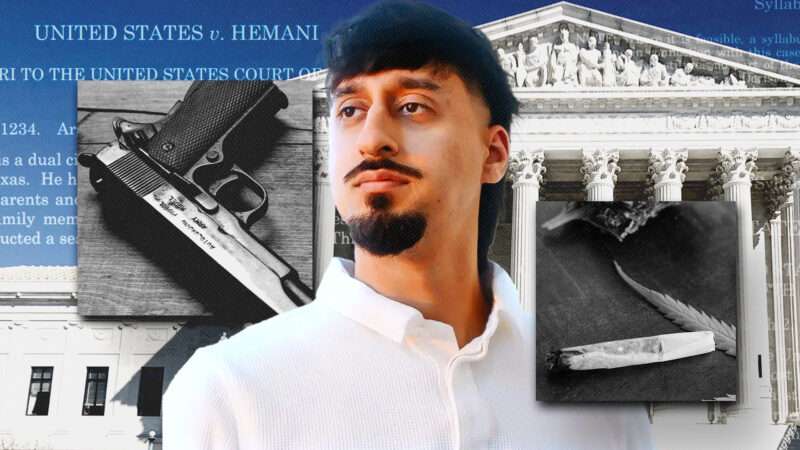
Until today, the federal law that prohibits "unlawful users" of controlled substances from possessing a gun was generally understood to cover all unlawful users of marijuana. But in a landmark decision issued this morning, the U.S. Supreme Court found the federal prosecution of a gun-possessing marijuana user to be in violation of that man's Second Amendment rights.
The decision came in the case of United States v. Hemani. "We do not question that sometimes an individual's unlawful use of marijuana (or any other controlled substance) may render him a danger to others," observed the majority opinion of Justice Neil Gorsuch. But here the government "asks us to conclude that anyone who regularly uses marijuana is categorically violent and dangerous without any further showing."
And that was simply too much to ask of the Court. To allow "the government that kind of 'broad power to designate any group as dangerous and thereby disqualify its members from having a gun,'" Gorsuch wrote, "would risk allowing it to 'quickly swallow' the Second Amendment."
Gorsuch was equally dismissive of the government's argument that historical laws regulating the conduct of "habitual drunkards" could form a justification for this sort of modern gun control prosecution. "The habitual drunkard laws on which the government relies here differ dramatically from [the federal] unlawful user provision on every single metric the government invites us to consider," Gorsuch wrote. "They targeted different kinds of people, did so for different purposes, and operated in different ways. Whether any one of these problems taken in isolation would prove fatal to the government's cause, we need not decide. Taken cumulatively, we hold, they certainly do." And, Gorsuch added, "apart from pointing to habitual drunkard laws, the government has not even attempted to prove that any other specific historical principle might justify its prosecution in this case."
I expected the federal government to lose this case, given the current Supreme Court's generally hawkish stance on the Second Amendment. But I am somewhat surprised by just how overwhelming the government's loss turned out to be. Gorsuch's majority opinion was joined in full by Chief Justice John Roberts and Justices Clarence Thomas, Sonia Sotomayor, Brett Kavanaugh, Amy Coney Barrett, and Ketanji Brown Jackson. Meanwhile, Justice Samuel Alito, joined by Justice Elena Kagan (an unusual pairing to say the least), wrote separately in concurrence to say that they would have ruled for Hemani "on a different ground from those on which the majority relies."
In short, all nine justices agreed that the federal government's prosecution of this particular nonviolent marijuana user for possessing a gun violated the constitutional right to keep and bear arms. To call this decision a huge win for the Second Amendment would be an understatement.
The post SCOTUS Says Federal Prosecution of Marijuana-Using Gun Owner Violates the Second Amendment appeared first on Reason.com.



 Bengali (Bangladesh) ·
  English (United States) ·