

Key Takeaways:
Ripple Custody 1.43 adds support for Canton Network, CC and CIP-56 tokens. Institutions can be given the same custody and policy for managing Canton assets. The update introduces validator connectivity, transfer pre-approvals and two-step transfers.In addition, Ripple is continuing adding new brands to its stack of institutional custodial services, such as support for the Layer 1 blockchain for regulated financial markets, Canton Network.
The integration is embedded in Ripple Custody Canton-native assets along with other digital assets, minimizing the requirement for institutions to run their own custody system.
Ripple Custody is now integrated to Canton. https://t.co/Rzl18rxaJ3
— Canton Network (@CantonNetwork) October 7, 2026
Ripple Custody Adds Canton Network in Version 1.43
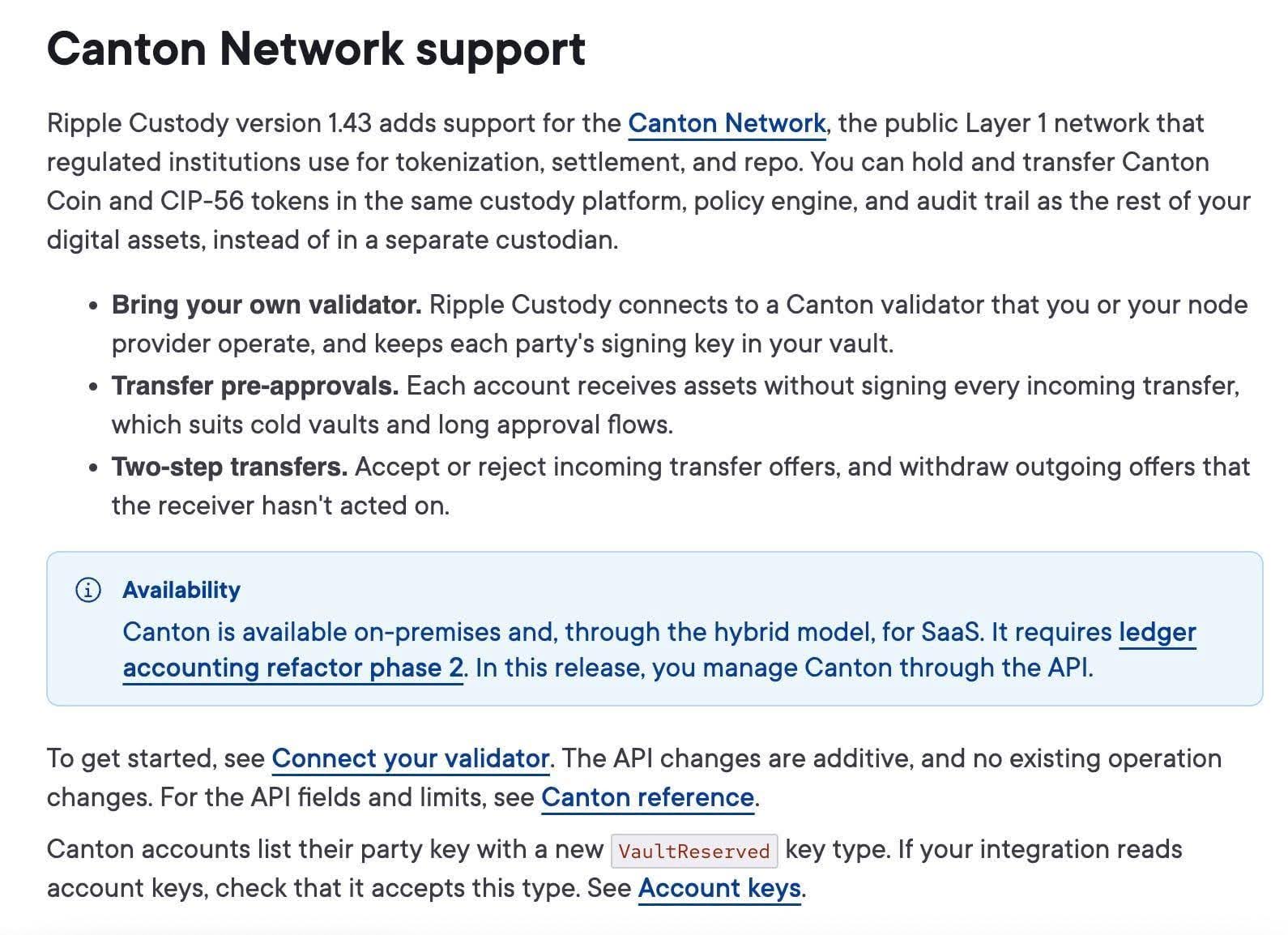
Today’s release of Ripple Custody (version 1.43) adds support for the CIP-56 token standard and adds Canton Coin (CC) and assets that utilize this standard.

Banks and asset managers are now able to custody and transfer these assets on the same platform, with the same policy controls and audit trail as other supported assets, including cryptocurrencies.
This is particularly crucial for institutions looking for exposure in tokenized assets but not connected with an extra separate custody provider or operations stack.
Canton offers a range of financial applications like tokenization, settlement and repo markets, and the integration is well-suited alongside Ripple’s enterprise-grade digital asset infrastructure furthering efforts.
Read More: Ripple Prime Adds $35B Brevan Howard to Multi-Asset Brokerage Push

Validator Control Stays With Institutions
Users are not required to put validator operations into Ripple by using Ripple Custody. Rather, the platform is linked to an institution’s own or their selected node provider’s validator while signing keys are stored within the custody vault safe.
This architecture provides institutions greater control over the participation in its network without overriding its current security and approval mechanisms.
Transfer Controls Target Institutional Workflows
The upgrade also brings features in which multiple approvals may be necessary during a transaction.
Please note that assets can be made Canton accounts via transfer pre-approval as opposed to needing to sign all transactions to the account one-by-one. This might be a beneficial option in cold-storage facilities or for organisations with a longer approval process.
Ripple Custody also facilitates two-step transfers, which enable institutions to accept or decline incoming transfer offers and revoke outgoing offers before they are accepted by the receiving party.
Unlike a send and receive model, these controls allow users more flexibility, especially those who are regulated and have a set compliance for transactions policy.
Read More: Ripple Shifts to Digital Assets Custody
Canton Integration Expands Ripple’s Multichain Custody Strategy
The support includes the option of on-premises, and is available via Ripple Custody’s hybrid SaaS deployment model.
For the time being, institutions will continue to control this aspect of Canton functionality through the API, and with the update they will gain functionality but won’t alter existing custody operations.
The integration is expanding Ripple’s assets beyond retail cryptocurrency trading, which are the mainstay of their business, to custody.
Ripple is embedding rather than pointing at Canton as an alternative blockchain, providing yet another network that financial organizations can control within a single custody setting.
The post Ripple Custody Adds Canton Network Support, Bringing CC and CIP-56 Into One Vault appeared first on CryptoNinjas.





 Bengali (Bangladesh) ·
  English (United States) ·