

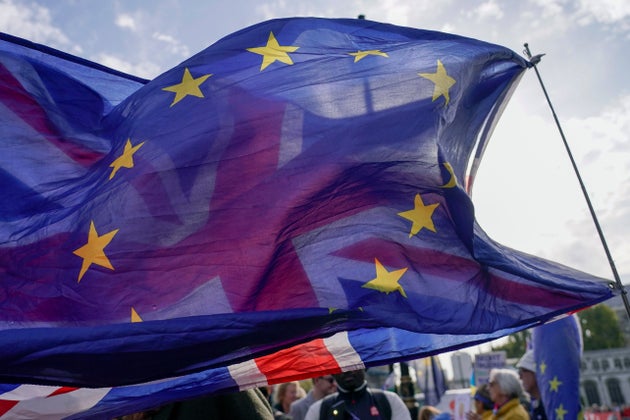
 A Union flag waves behind a European Union flag, outside the Houses of Parliament, in London, Wednesday, Oct. 19, 2022.
The EU referendum was one of the most bruising episodes in recent British political history.
It divided families, communities and workplaces. It encouraged people to see neighbours as opponents and turned complex questions about Britain’s future into a bitter culture war.
For too long afterwards, our politics remained trapped in the shadow of that division. And politicians must confront the falsehoods fed to the British people.
A decade on, we owe it to the country to move beyond the slogans and grievances of 2016 and ask: what arrangement best serves Britain’s future?
I came into politics because I believe in the social contract; the idea that government should create the conditions for people to build secure lives, raise families, find good work, thrive and meet their potential. Politics should be about expanding opportunity, not narrowing it.
That means being honest when policies are not delivering for working people. And having the confidence to revisit decisions when the evidence changes. On Europe, that moment has arrived.
Since 2024 the Labour government has made great progress stabilising our economy for investment, leading to the fastest growing economy in the G7. Now we need to go further.
Businesses face barriers selling into their largest export market. Young people have lost opportunities to study, work and build relationships across our continent. Families face higher costs while businesses absorb additional bureaucracy.
For a country whose prosperity has always depended on being outward-looking, the reality is stark. We are geographically European, economically European and strategically European. Yet we have chosen a relationship with our neighbours that creates friction where there was once freedom.
The City of London remains one of the world’s great financial centres, financial services thrive when markets are integrated, capital moves efficiently and firms can serve customers seamlessly across borders. Barriers between Britain and Europe weaken our competitive advantage.
Many of the communities that voted for change in 2016 had already endured decades of industrial decline, underinvestment and economic insecurity. They were not rejecting growth; they were demanding a share in it. The answer is not to revisit old arguments, but to ask how we deliver growth in every community.
The conversation about Europe must be part of a national discussion about how we create good jobs, attract investment and raise living standards in every part of the country.
Many of the promises made during the referendum campaign have simply not materialised. Organisations such as Best for Britain highlight the economic costs associated with leaving the single market and customs union, costs measured not just in lost GDP but in lost opportunities for communities.
Many of the challenges facing Britain today are inherently international. From energy security to migration management, from industrial policy to technological regulation, no nation can solve these issues entirely alone.
For Labour, this should not be an uncomfortable conversation. Labour has always been at its best when it combined patriotism with internationalism, embracing cooperation across borders.
None of this means pretending the referendum never happened. The country made a choice, and we have lived with the consequences. But true democracy is not a one-off event frozen in time. It is an ongoing conversation about how we build a better future together.
The central question facing Britain today is not whether Leave or Remain was right in 2016. It is whether we are willing to use every tool available to deliver growth, raise living standards, strengthen public services and expand opportunity for the next generation.
Ambition requires economic foundations. We cannot build the fairer, more prosperous Britain we want while accepting unnecessary barriers with our biggest trading partners and most important allies.
The case for a closer relationship with Europe is no longer ideological. It is practical. It is economic. And it is patriotic.
The time has come to stop treating EU membership as an unsayable idea. It should be part of the national conversation about Britain’s future. And, when the country is ready, it should be an option.
Because if Labour is serious about delivering prosperity, security and hope to every part of our country, then rejoining the European Union should be firmly on the table.
Rachel Blake is Labour MP for Cities of London and Westminster
Listen to Commons People, the podcast that makes politics easy. Every week, Kevin Schofield and Kate Nicholson unpack the week’s biggest stories to keep you informed. Join us for straightforward analysis of what’s going on at Westminster.




 Bengali (Bangladesh) ·
  English (United States) ·