
 4 hours ago
9
4 hours ago
9 
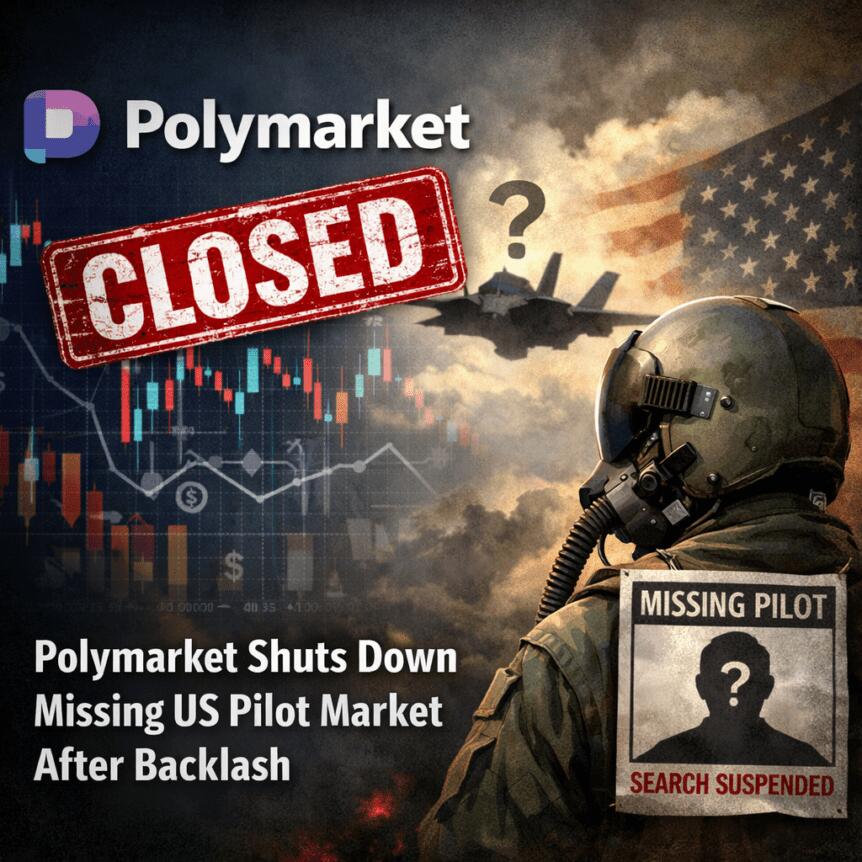
Polymarket has pulled a market tied to the fate of a missing U.S. service member after a wave of backlash, saying the listing violated its integrity standards. The decision comes amid heightened scrutiny of prediction markets that touch on real-world human outcomes and potential military actions.
The controversy centered on a prediction asking whether U.S. authorities would confirm the rescue of a pilot reportedly shot down over Iran, a topic that drew rapid and emotional reaction from users. Signals from the market suggested a majority—more than 60% of bettors—did not expect a rescue by the upcoming Saturday, highlighting how quickly sentiment can polarize around volatile, real-time events.
U.S. Representative Seth Moulton condemned the market as “disgusting,” expressing concerns about people speculating on the fate of a potentially injured service member. “They could be your neighbor, a friend, a family member. And people are betting on whether or not they’ll be saved,” he wrote, underscoring the human dimension behind the bets.
Polymarket stated that it removed the market immediately, adding that it should not have been listed and that the company is reviewing how the listing passed internal safeguards. The platform did not offer further detail about which specific rule or policy was violated.
Key takeaways
Polymarket deleted a market linked to the fate of a missing U.S. service member after backlash, signaling a potential tightening of internal safeguards for sensitive events. Officials and commentators are calling for clearer governance of prediction markets that touch on human safety and military outcomes, amid questions about which rules apply to borderline cases. Historical tensions around insider trading concerns persist in prediction markets, with recent reporting suggesting substantial profits from timing bets on geopolitical events and renewed calls from lawmakers for regulator guidance. Polymarket’s monetization strategy, including a recent fee overhaul, has intensified scrutiny around the platform’s business model and its alignment with user interests and integrity standards. The episode underscores the ongoing friction between innovative risk markets and ethical, regulatory, and operational safeguards—an area likely to attract regulatory attention in the near term.Polymarket’s misstep and the boundaries of prediction markets
From the outset, the market’s subject—whether authorities would confirm the rescue of a potentially endangered service member—presses into delicate territory. Prediction markets have long drawn scrutiny when they intersect with real-world crises, where outcomes can directly affect real lives. Polymarket’s decision to remove the market suggests a recalibration of what content it deems appropriate for its platform, even as the broader market remains interested in forecasting events that straddle news cycles and human risk.
Users quickly noted the lack of clarity around policy enforcement. As coverage of the incident circulated, questions arose about which specific rule in Polymarket’s “integrity standards” had been breached. Critics argued that without transparent guidance on how safeguards are applied, users are left to guess at the boundaries between legitimate forecasting and ethically fraught betting lines. This kind of ambiguity can erate legitimate concerns about governance and user trust—issues that affect not only participants but potential partners and investors evaluating the long-term viability of decentralized or crypto-native prediction platforms.
Polymarket’s action follows a broader context of scrutiny in the sector. The platform has recently expanded its price feeds and product lines, moving into equities and commodities in collaboration with data providers, a move that coincided with a notable uptick in activity and monetization. In March, the company implemented a revamped fee structure, which Cointelegraph noted propelled daily fees well above prior levels and brought revenue into a higher profile. While monetization is essential for sustainable operation, it can also intensify incentives to broaden markets and attract trading volume, complicating the governance calculus when sensitive topics are on the table.
Insider trading concerns persist in prediction markets
Beyond governance questions, prediction markets remain under the lens for potential insider trading issues. Last month, reporting highlighted a group of traders who reportedly profited by accurately timing bets on U.S. strikes in the Middle East. The betting activity centered on the timing of events that could only be known with public or near-public information, and investigators flagged the pattern as suggestive of informational advantages being exploited through blockchain wallets created specifically to target those events. The episode underscored the tension between fast-moving information markets and safeguards against unfair advantages.
In response to those concerns, lawmakers entered the conversation. At least 42 Democratic lawmakers pressed the U.S. Commodity Futures Trading Commission (CFTC) and the Office of Government Ethics to warn federal employees against using non-public information to trade on prediction markets. The appeal reflects bipartisan interest in establishing guardrails that protect both market integrity and the broader public interest, particularly when markets touch on national security or military actions.
Taken together, these developments illustrate a pivot point for the sector. On the one hand, prediction markets offer a compelling lens on how information and sentiment drive consensus around uncertain events. On the other hand, the same dynamics that make these markets attractive—liquidity, rapid pricing, and the potential for swift monetization—also invite ethical and regulatory scrutiny when real-world stakes are high.
What readers should watch next
The Polymarket episode is likely to reverberate through the ecosystem as platforms reassess which markets to enable and how to articulate rules with greater precision. Investors and participants should monitor whether Polymarket, or comparable platforms, publish more granular guidance on integrity standards and incident-response processes. Regulators may also weigh in with clarifications on permissible subjects, disclosure practices, and anti-insider trading measures for decentralized or crypto-enabled markets.
As markets evolve, expect ongoing debates about balancing openness and innovation with accountability. For traders and builders, the takeaway is clear: clarity and safeguards are becoming as important as the odds themselves, and the next wave of policy and product decisions will likely shape how widely these markets are adopted in mainstream financial ecosystems.
Readers should stay tuned to see how Polymarket and peers adjust their governance models, whether new guardrails emerge from regulatory discussions, and how participants adapt their strategies in response to these evolving standards.
This article was originally published as Polymarket shuts down missing US pilot market after backlash on Crypto Breaking News – your trusted source for crypto news, Bitcoin news, and blockchain updates.





 Bengali (Bangladesh) ·
  English (United States) ·