

Archaeologists in Peru have discovered the skeleton of an infant with a rare birth defect that left only one central eye socket in the child's skull. DNA analysis of the remains confirmed a chromosomal abnormality caused the deadly condition in the infant over 1,600 years ago, according to a new study.
"We cannot really say how long this individual survived," study co-author Lars Fehren-Schmitz, an anthropologist at the University of California, Santa Cruz, told Live Science in an email. But "the burial of this infant suggests that the Nasca treated this individual in death like most other infants."
The skeleton of this female infant was discovered alongside a second one inside a ceramic urn at the archaeological site of Jauranga in Peru's Palpa Valley, where numerous geoglyphs known as the Nazca Lines have been found. Archaeologists uncovered several dozen other burials dated to the Middle Nazca (also spelled Nasca) period (A.D. 325 to 440) at the site, but one of the co-buried infants had an extremely rare condition, researchers wrote in a study published Monday (Nov. 9) in the journal PNAS.
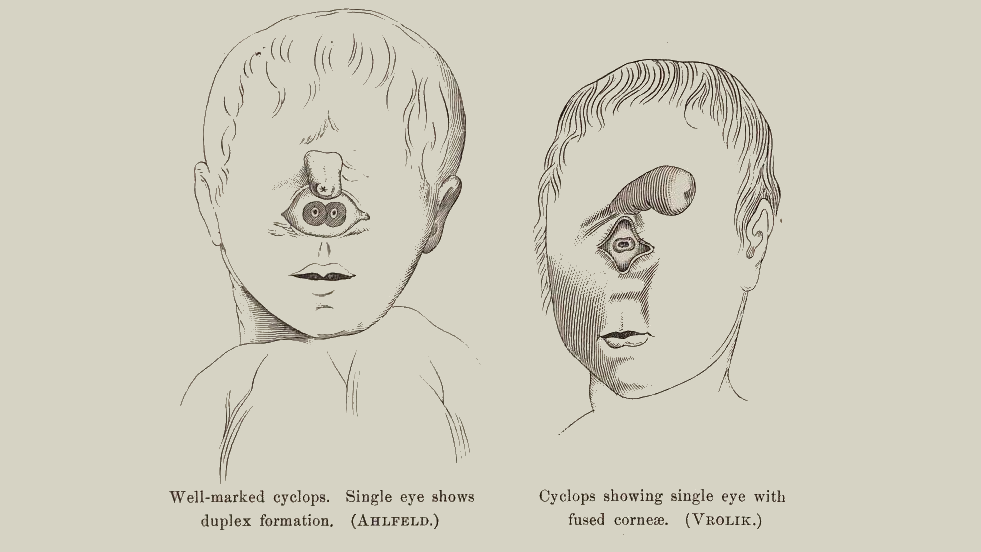
The infant had a very small skull and a single eye socket in the middle of her face, along with other developmental issues of the cranial bones. These traits match modern clinical descriptions of cyclopia, a lethal condition that occurs when the front part of a fetus's brain fails to divide into left and right hemispheres.
This condition can also cause alterations in the nasal structures, resulting in a missing nose or a tube-like nose above the single eye.
"The cause of the malformation was present at fertilization, but manifestation occurs around the fourth to fifth week in utero [in the womb], when the frontal lobe of the brain has to divide," study first author Elsa Tomasto-Cagigao, an archaeologist at the Pontifical Catholic University of Peru, told Live Science in an email.
Cyclopia is a rare condition, occurring in about 1 out of every 100,000 births. To learn more about the infant's short life, the researchers sequenced her genome. (DNA suggested the infant carried two X chromosomes, typical of a female.)
The team detected an extra copy of chromosome 13, meaning the infant had a genetic condition called trisomy 13, or Patau syndrome. It's known to be a major chromosomal cause of cyclopia; that said, only a small percentage of trisomy 13 cases involve cyclopia.
While trisomy 13 is associated with advanced maternal age, it is not clear whether that was the case for this infant, Fehren-Schmitz said.
"This condition has been documented in historic and modern anatomical collections, but to my knowledge this is the first archaeological example of this developmental abnormality," Siân Halcrow, a bioarchaeologist at the University of Otago in New Zealand who was not involved in the study, told Live Science in an email.
The researchers' estimate of the infant's age at death suggests she may have survived for several weeks or months after birth, Halcrow pointed out. "This raises important questions about how infants with profound congenital differences were cared for and treated in past societies," she said.
The infant was buried in a ceramic urn, the researchers noted in the study, which was a common burial method in the Nazca period, along with a second female infant who had no skeletal abnormalities. "The baby with cyclopia was at the bottom of the jar, while the other baby was on top. Nevertheless, it appears that they were interred in a single event," Tomasto-Cagigao said. The genetic analysis showed that the two infants did not have the same mother.
A burial of two infants in one urn is unusual for this culture, the researchers said, but there is not enough archaeological evidence to conclude that the infant with cyclopia was given a different type of burial.
"The fact that the individual was buried with a 'healthy' individual in a regular cemetery, without any special grave goods, suggests that, to some extent, the individual was not treated differently in death, even though it had such a rare condition," Fehren-Schmitz said. "It was neither 'excluded' because of it nor treated in a 'special' way."
In ancient Andean societies, some people with disabilities took on special societal roles, such as ones associated with religious practices. "If that reflects Nasca society as a whole, we can't say based on one case," Fehren-Schmitz said, "but it does reflect the community this infant was part of, even if only briefly."





 Bengali (Bangladesh) ·
 English (United States) ·