

An unassuming, brownish stone may be one of the most precious objects on Earth. The rare rock, called Teghaza 001, is a piece of ancient Mars and gives geoscientists an invaluable opportunity to study the planet's oldest material.
Now, a slew of recent studies based on evidence from the space rock are helping scientists understand more about the Red Planet's history of habitability.
Scientists believe that Earth and Mars coalesced around 4.5 billion years ago from the protoplanetary disk of gas and dust that surrounded our young sun. These two celestial siblings have since shared more than a few rocks in the intervening millions of millennia. Meteoroid impacts frequently gouge the Martian crust and have sent several hundred pieces of Mars hurtling to Earth — a free Mars return mission, paid for by the universe.
Two especially famous specimens include the Allan Hills 84001 meteorite, which contains tantalizing 4 billion-year-old organic molecules; and NWA 7034, a meteorite with 4.4 billion-year components and specks of ancient water.
But these Martian meteorites are lacking in a couple of respects. The former lacks mineral variety, and the latter appears to be a meteoritic mosaic that solidified from much older individual components, so neither faithfully represents some of Mars' oldest crust.
Teghaza 001, however, may help fill that knowledge gap.
Martian history right in our hands
The Teghaza 001 meteorite comprises 28 ounces (800 grams) of Martian material, split into eight pieces recovered in 2022 near the Taghaza archaeological area in Mali. It's owned by the Maine Mineral and Gem Museum.
In a preprint uploaded April 14, which has not yet been peer-reviewed, researchers measured the rate of multiple types of radioactive decay in different minerals, including tiny crystals called zircons, which are embedded within Teghaza 001, and found that the multiple measures agreed on an age at least 4.1 billion years ago. This may make the space rock the single oldest-known piece of Mars.
The space rock is rich in silica, suggesting that Mars may have been producing its own version of granite, which on Earth requires forces associated with plate tectonics. Granite must melt in extremely hot, pressurized subterranean conditions and then cool slowly, becoming lighter and eventually bubbling up through the ground to form the core of continents and the hearts of mountains.
But Mars has no tectonic plates, and its surface seems to be made of basalt, the dark, heavy volcanic rock that forms from quick-cooling lava — and also the stuff that makes the Hawaiian islands.
Are plate tectonics really necessary?
(Image credit: Mackay-Champion et al., Nature Astronomy, 2026)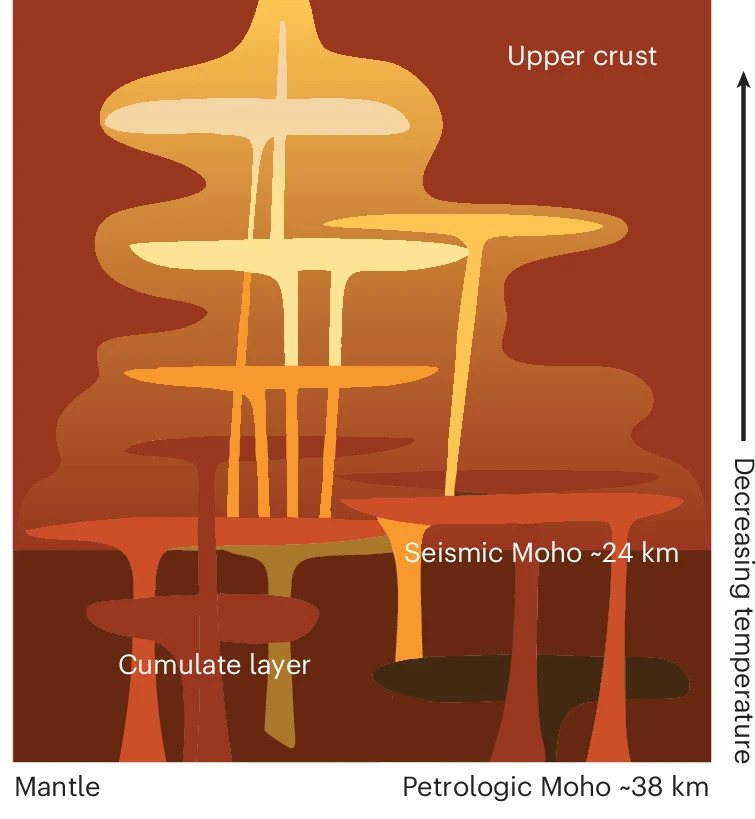
In a paper published June 26 in the journal Nature Astronomy, researchers revealed evidence that Mars may have been able to drive the geological processes that are mediated by plate tectonics on Earth.
The researchers used seismic data from NASA's InSight lander to model Mars' interior, and found evidence that it once housed huge, interconnected magma networks that may have stretched thousands of miles beneath its northern hemisphere.
"One of the big questions in planetary science is whether Earth is unique," study co-author Jon Wade, an associate professor of planetary materials at Oxford University, said in a statement.
"If Mars could develop this kind of complex crust without plate tectonics, then maybe the conditions needed for habitability can emerge on more planets than we realised, including those previously dismissed based on size or their apparent lack of tectonic activity," Wade added.
As a result, such processes may have helped early Mars develop an atmosphere, large bodies of water and potentially habitable conditions — a scenario that may be playing out elsewhere across the universe.
The solar system gives, and the solar system takes
While this may sound encouraging for the emergence of Martian life, Teghaza 001 also offered evidence that Mars began losing its water early in its history.
An illustration showing what a potential primitive ocean on Mars might look like. (Image credit: NASA/GSFC)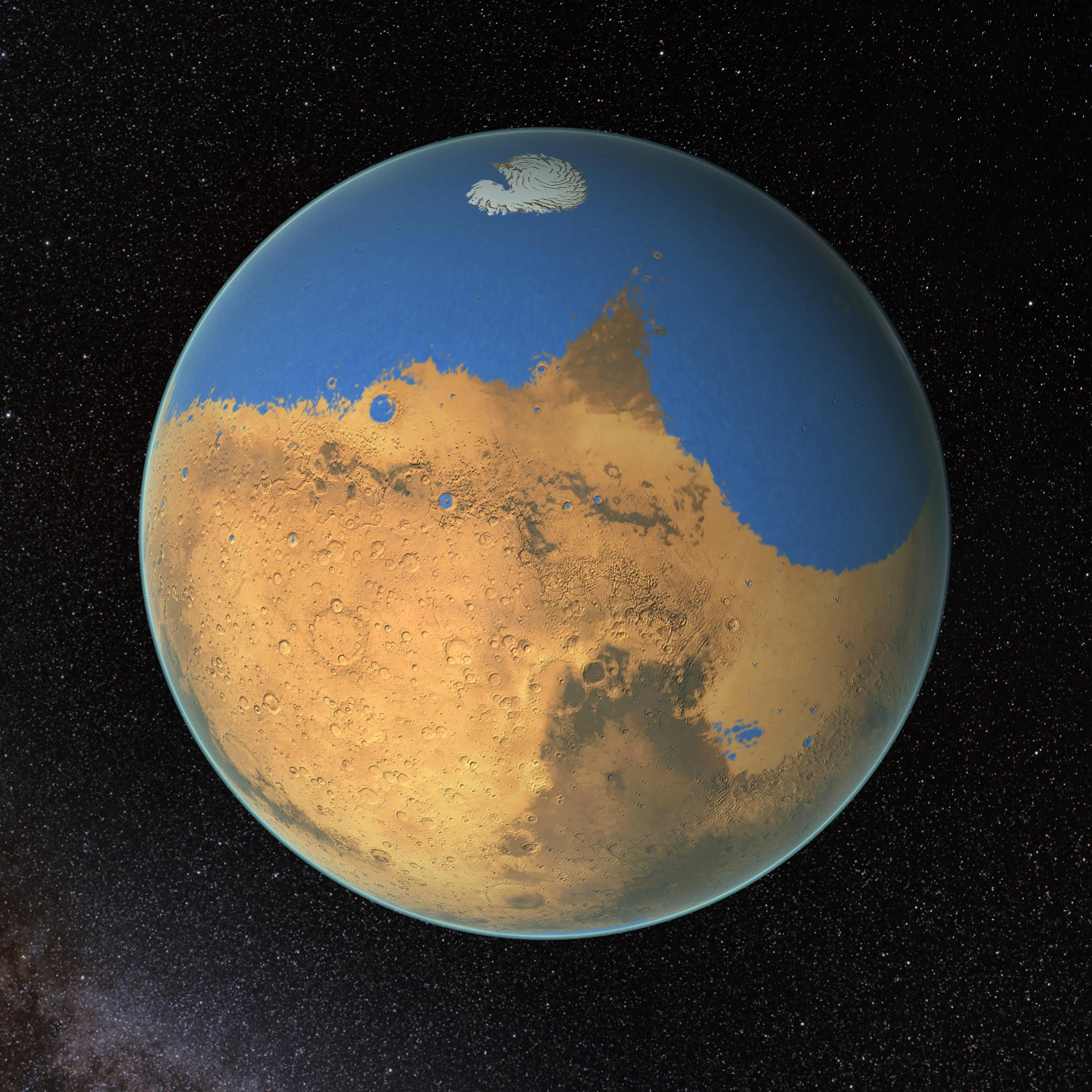
In a separate paper published June 10 in the journal Science Advances, researchers recreated Mars' hydrological evolution by tracing its hydrogen, a major constituent of water, by chemically analyzing a piece of Teghaza 001 and comparing it with two younger Martian meteorites.
To explore when Mars' water began seeping into space, the researchers examined the meteorites’ ratios of hydrogen to deuterium, a heavier version of hydrogen that contains a neutron in addition to the one proton and one electron that make up basic hydrogen atoms.
Because hydrogen is lighter, it more readily escapes into space, leaving behind a greater abundance of deuterium. The results "indicate that Mars lost a substantial proportion of its juvenile atmosphere to space within a few hundred million years after the magma ocean solidified," the researchers wrote in the study.
Importantly, this suggested that Mars was already rapidly losing its hydrogen into space by 4.1 billion years ago.
While Teghaza opens a rare window onto Mars’ earliest epochs, scientists urge that more samples are needed to truly understand Martian history. James Day, a professor of geosciences at the Scripps Institution of Oceanography at the University of California San Diego, who was not involved in this research, noted that this finding is drawn from a small, rare piece of evidence. "I would caution that all of these arguments would have been based on a single small stone," he told Live Science in an email.
What do you know about the Red Planet? Test your knowledge with our Mars quiz!



 Bengali (Bangladesh) ·
  English (United States) ·