

When the weather gets muggy, iridescent bees shift their metallic hue, a new study finds.
The insects are a rich blue-green when the humidity is low. But as moisture levels in the air rise, their color changes: It turns a coppery green.
Many bees have a shimmery exoskeleton. So this reversible mood-ring–like effect might be quite common, scientists now say. The day-to-day color of other bees and insects might similarly change with humidity.
Explainer: Insects, arachnids and other arthropods
Jorge De La Cruz is a college student at the University of California, Santa Barbara. There, he’s training as an evolutionary biologist. He first noticed the color-change effect while preparing bee specimens for preservation and study. This was at the Cheadle Center for Biodiversity and Ecological Restoration.
Museum scientists often place insect specimens in a moist chamber. It makes them more flexible for mounting and imaging. And under moist conditions, some bees appeared to starkly shift their color. This caught De La Cruz’s attention.
“It can be a bit alarming when you’re not expecting it,” says Madeleine Ostwald. This ecologist works at Queen Mary University of London in England.
De La Cruz and Ostwald teamed up with two other researchers to look into this further. They shared what they learned April 22 in Biology Letters.
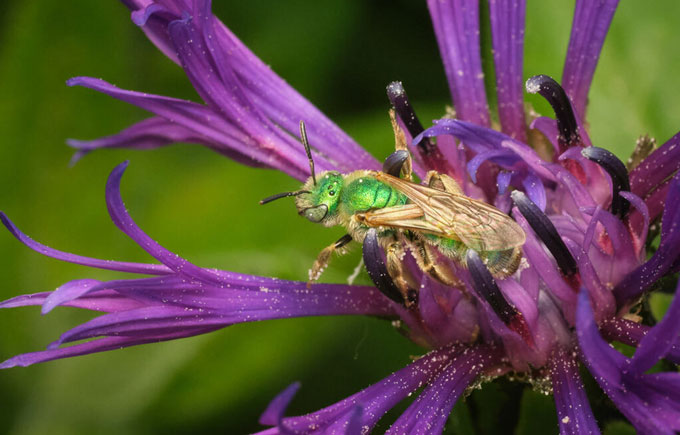 This sweat bee was photographed in Seattle, Wash. Its exoskeleton changes color with the humidity. Other iridescent insects may pull a similar color-change trick.Mike Davidson/iNaturalist
Humidity changes hue
The team studied two dozen museum bee specimens. All were fine-striped sweat bees (Agapostemon subtilior). The bees were exposed to high and low humidity for 55 hours each. After each exposure, the team took photos.
The researchers also reviewed more than 1,000 photos of living sweat bees. These came from the citizen-science app iNaturalist. Here, too, they noted the humidity present when an image had been taken.
In dry conditions (less than 10 percent humidity), the bees were blue-green. But at 95 percent humidity, they turned a light, coppery green.
Scientists Say: Exoskeleton
Humidity may cause layers in the bees’ exoskeletons to swell. That may change how those layers reflect light, creating an iridescence. That layering appears to scatter light at different wavelengths, creating colors. If the layers swelled, the space between them would increase. The extra space would reflect longer, redder light.
“Because we saw redder bees in more humid conditions, this fits with that [scientific explanation],” Ostwald says.
Future work with high-powered microscopes might confirm this. Lots of insects produce color with tiny structures rather than pigments, Ostwald says. So, the phenomenon might be widespread.
Color can be really changeable as something responds to the environment, she says — and “in ways we didn’t expect.” It’s important to study the color of the living organism in its natural environment to know its true hue.





 Bengali (Bangladesh) ·
  English (United States) ·