

Astronomers have discovered the lightest known pair of neutron stars — two ultradense stellar remnants that circle each other every 2 hours, 22 minutes, veering toward an inevitable collision about 82 million years from now. By timing radio pulses from one of the stars, the researchers detected three subtle effects predicted by Albert Einstein's general theory of relativity and found that the theory describes the pair's motion to within about 1% — proving the visionary physicist right yet again.
The researchers published their findings Sept. 15 in the journal Physical Review Letters.
Neutron stars are the collapsed cores of massive stars that exploded as supernovas. Each packs more mass than the sun into a ball roughly 12 miles (20 kilometers) in diameter. Some, called pulsars, spin rapidly and sweep beams of radio waves across the sky like cosmic lighthouses. Their rotation is so steady that their pulses work as extraordinarily precise clocks.
Very few pulsars orbit another neutron star. "There are only 30 such double neutron star systems, and the relativistic effects are very strong if they are in compact orbits," study co-author JinLin Han, an astronomer at the National Astronomical Observatories of the Chinese Academy of Sciences, told Live Science via email.
The first such pair, discovered in 1974 and known as the Hulse-Taylor binary, provided the first evidence for gravitational waves — ripples in space-time predicted by Einstein. Such waves carry energy away from an orbiting pair, so its orbit should gradually shrink, and the Hulse-Taylor orbit shrank at just the rate Einstein's theory predicted.
Later, the "double pulsar," which completes an orbit every 2.45 hours, matched the predicted rate to within about 0.01%. Eventually, this shrinking forces such pairs to merge, unleashing gravitational waves like those the Laser Interferometer Gravitational-Wave Observatory and Virgo interferometer picked up in 2017.
A newly discovered pair
The new system, designated PSR J1856-0039, lies roughly 4,200 to 6,500 light-years from Earth. In 2020, it turned up in a survey of the Milky Way's disk by China's Five-hundred-meter Aperture Spherical Radio Telescope (FAST), the world's largest single-dish radio telescope.
"We have discovered about 900 pulsars," Han said of his team's work. "After a few follow-up observations, this one is very extraordinary."
The pulsar spins about 43 times per second, and the two stars are separated by roughly twice the distance between Earth and the moon. But the "most attractive feature" is the short orbital period of about 2.36 hours, Han said. "This is the second-shortest one, and it must show stronger relativistic effects than the famous double pulsar and the Hulse-Taylor system."
The team observed the pair with FAST 17 times between 2020 and 2025, sometimes long enough to cover a whole orbit. The researchers measured the arrival times of the system's pulses and then fit that data to orbital models that accounted for relativistic effects, like subtle changes to the pulse arrival times at different parts of the stars' orbits.
"With so many measurements by FAST, which would be hard to match in accuracy with other telescopes, we got not only the basic parameters of the pulsar and its orbit but also three relativistic effects," Han said.
First, the orbit is shrinking as the stars radiate gravitational waves, drawing them about 9 feet (2.7 meters) closer each year. Second, the oval orbit turns slowly, by 17.6 degrees per year — some 150,000 times faster than the relativistic drift of Mercury's orbit. Third, because both gravity and speed slow time, the pulsar's clock runs at a varying pace along the oval orbit, shifting its pulses by up to about half a millisecond.
An illustration of two neutron stars generating gravitational waves (purple) as they spiral toward each other in a tightening binary orbit. The rate of this orbital shrinkage offers a natural test of Einstein's theory or relativity. (Image credit: ESA)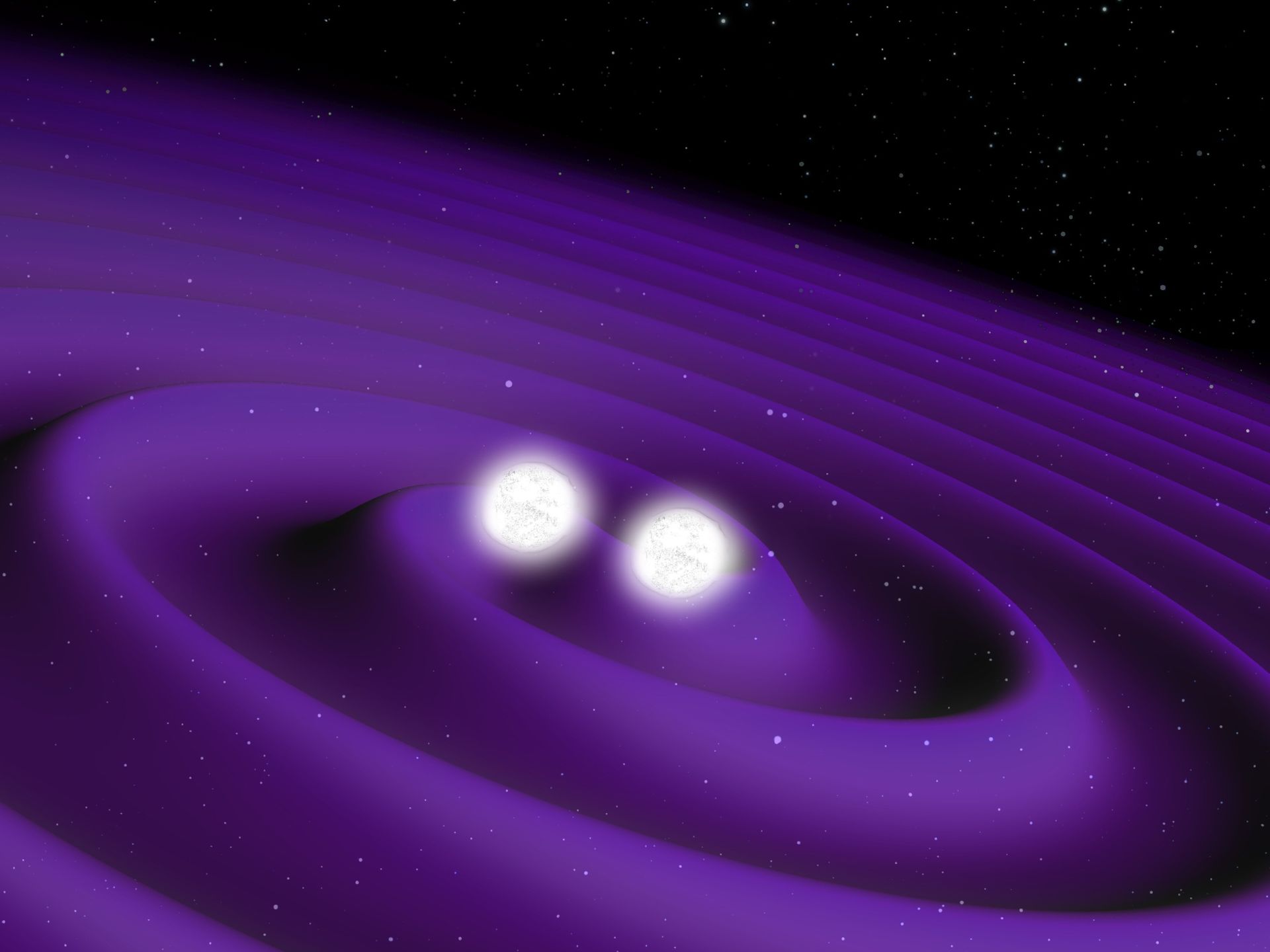
"From these measurements, we determined the pulsar mass and the companion mass," Han explained. "The total mass is the lowest among all known double neutron star systems." The pulsar weighs about 1.3 times as much as the sun, and its companion is just 1.19 solar masses — one of the lowest-mass neutron stars known. Simulations suggest that supernovas can't forge neutron stars much lighter than that.
The stars will merge in about 82 million years. That merger will probably leave behind a heavier neutron star of about 2.26 solar masses, though the remnant could instead collapse into a black hole, the researchers estimate.
Another win for Einstein
Any two of the three effects are enough to calculate both stars' masses. The third then serves as an independent check, because if general relativity is correct, all three must point to the same masses — and they do.
"We found that general relativity is needed to explain the data, and the consistency is about 1%," Han said. The double pulsar test is more precise, but it drew on 16 years of data, compared with about five for the new pair. "Unfortunately, we could not beat this description of gravity," Han added, referring to physicists' hope of finding cracks in Einstein's theory that might reveal new physics.
Next, the team hopes to detect "frame dragging," an effect in which a spinning mass twists space-time around it, making nearby orbits wobble. "In the future, we will monitor this pulsar, probably over decades, to detect the frame dragging induced by the neutron star's spin," Han said.
Measuring the effect would reveal the pulsar's moment of inertia, which depends on how its mass is spread out inside. That would provide "a novel constraint" on how matter behaves at the crushing densities in neutron star cores, Han said — one of the biggest open questions in physics.
See how much you know about black holes with our black hole quiz!




 Bengali (Bangladesh) ·
 English (United States) ·