
 1 month ago
48
1 month ago
48 
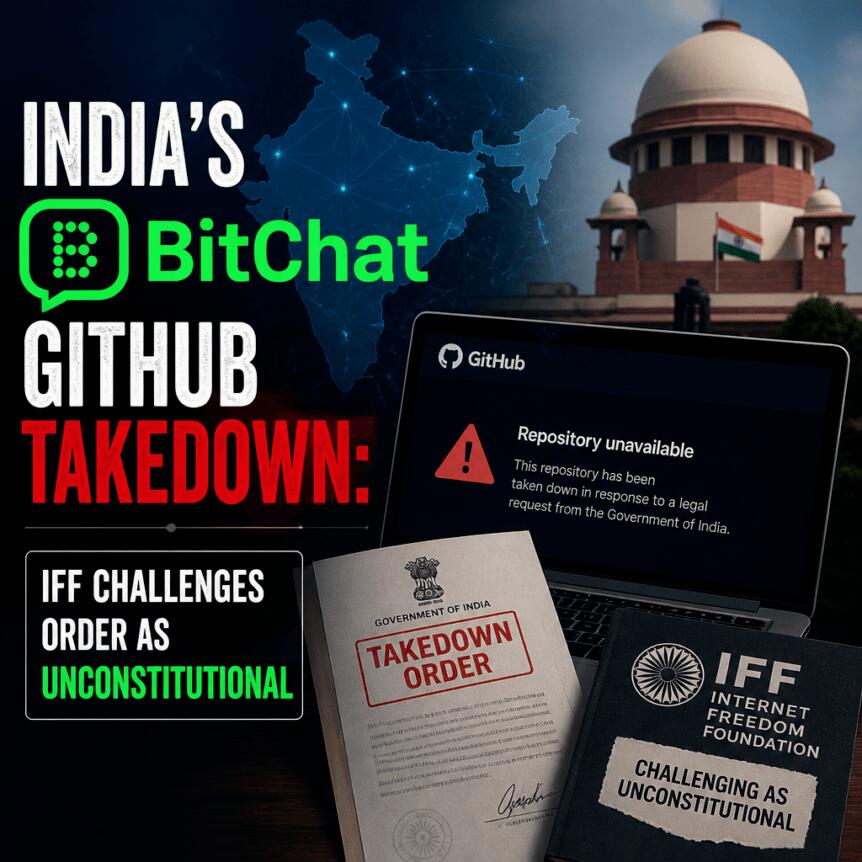
India’s Internet Freedom Foundation (IFF) has condemned a government order requiring GitHub to remove repositories linked to Jack Dorsey’s decentralized messaging app, BitChat, calling the action unconstitutional and a threat to both free speech and open-source development.
The dispute centers on how the Indian government justified the takedown. According to IFF, the order used Section 79(3)(b) of India’s Information Technology Act rather than the country’s formal website-blocking route, a process IFF says includes procedural safeguards. The group urged authorities to withdraw the notice and disclose all takedown orders issued under the same provision.
Key takeaways
IFF says the BitChat-related GitHub removal order should have followed India’s formal website-blocking process rather than Section 79(3)(b). The cybercrime agency’s directive reportedly demanded GitHub disable access to three BitChat repositories within three hours. Iff argues the order fails to identify unlawful content, instead targeting BitChat’s decentralized design as the basis for removal. BitChat routes encrypted messages between nearby devices via Bluetooth without relying on internet connectivity or centralized servers. Adoption of BitChat has reportedly increased during internet shutdowns and unrest in multiple countries since its release in July 2025.GitHub repositories ordered removed over “internet shutdown” concerns
A day before IFF’s public response, India’s cybercrime agency ordered GitHub to disable access to three BitChat repositories within a three-hour window. The rationale provided, according to IFF’s account, was that the decentralized messaging app could be used to circumvent internet shutdowns, evade lawful surveillance, and enable unlawful activity.
BitChat’s core design is meant to reduce dependence on the public internet. Instead of routing messages through centralized servers or requiring continuous connectivity, the app can relay encrypted communications between nearby devices over Bluetooth. In practical terms, that means it can function even when mobile networks or internet service are disrupted—an attribute that has historically drawn both interest from users in restrictive environments and scrutiny from authorities concerned about oversight.
IFF challenges the legal route and the lack of identified unlawful content
In its statement posted on X, IFF argued that the government’s approach exceeded its legal authority. The group said the order was issued under Section 79(3)(b) of India’s Information Technology Act, rather than through India’s formal website-blocking mechanism, which IFF says includes procedural safeguards.
IFF’s position is that this difference in process matters, because the method chosen can affect transparency and the ability to contest a removal. The organization also asked the government to withdraw the notice and to publish all takedown orders made under the provision, framing the request as a transparency measure rather than a technical objection.
Just as importantly, IFF disputed the substance of the justification. The group said the order did not point to specific unlawful content inside the repositories. Instead, IFF claimed the government’s case treated BitChat’s decentralized architecture itself—particularly its ability to support peer-to-peer communication over Bluetooth without internet access—as grounds for removal.
That framing has wide implications for open-source ecosystems. When takedowns are based on functionality rather than identifiable prohibited material, developers and maintainers may face broader uncertainty about what features are permissible to publish.
Why decentralized messaging has become a flashpoint during shutdowns
Since its release in July 2025, BitChat has reportedly seen rising adoption during periods of unrest, natural disasters, and internet outages. Earlier coverage from Cointelegraph described how the app’s Bluetooth-relay approach can help communities communicate without relying on internet infrastructure. According to Cointelegraph’s reporting cited in the original coverage, adoption surged in countries including Madagascar, Nepal, Uganda, Jamaica, and Iran.
That pattern is notable because it illustrates the tension between emergency communications and state control. In scenarios where networks fail or governments restrict connectivity, tools that operate without centralized infrastructure can become valuable—especially for coordination when traditional channels are unreliable. At the same time, governments often view the same resilience as a way for users to evade monitoring and shutdown measures.
For investors and builders in crypto-adjacent infrastructure—particularly those focused on privacy, censorship resistance, and decentralized networking—the BitChat dispute underscores a broader regulatory reality: decentralization can increase both technical robustness and legal risk, depending on how authorities interpret existing cyber and communications laws.
While this case concerns GitHub repositories rather than a blockchain protocol directly, it sits within a familiar policy theme affecting the wider decentralized tech stack: when software can keep working despite shutdown attempts, regulators may treat the code as part of the threat model.
What to watch next after the GitHub order
For now, the immediate question is whether GitHub access to the affected repositories remains disabled and whether the government provides further specificity on what it considers unlawful. IFF’s demands for withdrawal and transparency—especially publication of all takedown orders under Section 79(3)(b)—could determine how quickly this dispute escalates into a wider debate about constitutional limits and administrative procedure.
Beyond the legal arguments, readers should watch for how this case influences developer practices—particularly how open-source teams decide what to publish, document, or mirror when their tools may be interpreted by regulators as enabling circumvention during shutdowns.
Earlier reporting on BitChat’s launch and design is available via Cointelegraph, and context on adoption during protests and outages was also covered by Cointelegraph in articles including Nepal-related coverage, Jamaica-related coverage, and global unrest adoption coverage.
This article was originally published as India’s BitChat GitHub Takedown: IFF Challenges Order as Unconstitutional on Crypto Breaking News – your trusted source for crypto news, Bitcoin news, and blockchain updates.





 Bengali (Bangladesh) ·
  English (United States) ·