

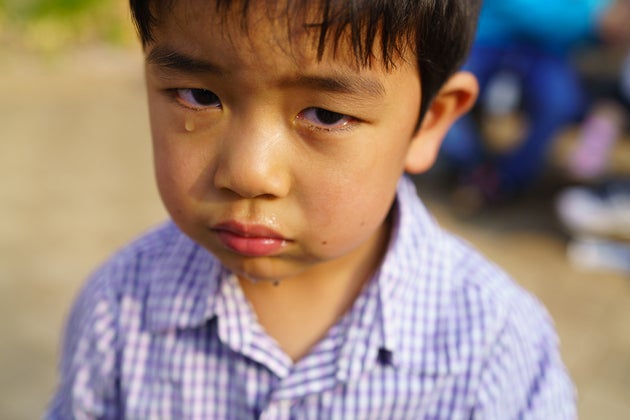
 Boys do – and should be allowed to – cry.
I was sat on a train the other day and a little boy who can’t have been much older than four started to silently cry.
It wasn’t forced or put on. It was quiet and barely noticeable, save for his shoulders bobbing up and down and the tears wetting his dark eyelashes, before rolling down his cheeks.
His parents, sat directly opposite and next to him, asked him what was wrong and he solemnly pointed outside the window to where everything was pitch black.
We were in a tunnel and, whether it was the dark or the feeling of being enclosed, he was scared.
It wasn’t his tears that surprised me in that moment. I know kids cry – it’s a pretty common way of communicating when you’re little.
It was his parents’ response that made me pay attention.
“Stop crying.”
“Come on, big boys don’t cry.”
All of a sudden, the silent tears made sense – this was a little boy for whom the norm was slowly becoming to bottle it up. But, being barely school age himself, he couldn’t quite do it.
I wish this had been a one-off event, but a week prior to this I’d watched as a parent told her (slightly older) son off for sobbing on a plane before takeoff.
Again, the same remark: “Boys don’t cry.”
All kids should be allowed to cry
As parents, many of us are trying our best, having been raised in families where these phrases, and the act of suppressing emotions, is normalised.
But we need a reminder – all of us – that crying is a perfectly healthy, perfectly normal response to a range of emotions: sadness, frustration, anger, sometimes even happiness.
If we tell boys not to cry, where does that emotion go? It is avoided or bottled up. And we know that kids who don’t learn to regulate their feelings effectively – and avoid them or suppress them instead – are more likely to not perform as well at school and more likely to suffer from poor mental health later in life.
We also know that men in the UK are significantly more likely to die by suicide than women. The Samaritans note that the reasons for this gender disparity are complex, but highlight that “social expectations placed on men mean that they may be less likely to disclose or seek help for suicidal thoughts or behaviours”.
Dr Ahmar Ferguson, an educational psychologist, tells me that when we tell boys they shouldn’t cry, “what they often learn is that some emotions are more acceptable than others”.
He reiterates that “most parents don’t say it with bad intentions” and it often comes from their own childhood experiences (what they were told growing up), or simply a desire to help their child move on from a difficult moment.
“The difficulty is that children are constantly making sense of the messages they receive from the adults around them,” he explains.
“If a boy repeatedly hears that sadness, fear or vulnerability should be hidden, he may begin to feel that those emotions are something to be embarrassed about.”
And we know the emotion doesn’t disappear because it isn’t expressed. As the psychologist explains: “It simply finds another route. Sometimes that can look like frustration, anger, shutting down, becoming distant from others, or finding it difficult to ask for help when life becomes challenging.”
In his work, he often meets adults who feel stressed, angry or overwhelmed, but have spent years finding it difficult to talk about sadness, hurt or disappointment.
“Those patterns rarely appear overnight. They are often shaped by thousands of small messages received throughout childhood about which emotions are welcome and which are not,” he explains.
What parents can do instead
The simplest solution is: the next time a child cries, let them. Get down to their level and put into words what they’re feeling. Validate their emotions.
From personal experience, this often leads to a child stopping crying much quicker anyway, as they feel seen, heard and comforted.
“Children need opportunities to experience emotions and learn what to do with them,” says Dr Ferguson.
“A boy crying is not evidence that something has gone wrong. It is evidence that he is having a human response to a difficult experience.”
You don’t need to have the perfect response. Something as simple as “I can see you’re upset”, “That looked really difficult”, or “Do you want to tell me about it?” gives a child permission to share what is going on without feeling judged.
If the tears are because of fear or worry, it can sometimes help to talk about a time you were scared or worried – and what helped you through it.
“The boys who grow into emotionally healthy men are not necessarily the ones who never cry,” concludes the expert. “They are often the ones who learned that emotions can be spoken about, understood and supported by the people around them.”






 Bengali (Bangladesh) ·
  English (United States) ·