

Tears sprang to my eyes as the elevator doors closed behind us.
“Are you excited?!” my husband asked eagerly, hugging me toward him and finding my belly with his hands.
“Of course!” I squeaked, interlacing my fingers with his as we looked down at the tiny melon taking shape beneath my shirt.
As we walked out of the clinic and into the parking lot, the tears kept coming, now accompanied by an elevated heart rate and sweaty palms.
Of course I’m excited, I reassured myself. Why wouldn’t I be?
I climbed into the passenger seat, pulling out my phone to review the ultrasound pictures that had just been uploaded to the app.
I swiped past sonograph images of tiny fingers and toes, a nose, a belly, videos of the heartbeat and the baby hiccuping. Until finally, I landed on the picture taken between my baby’s legs, to which someone had added a tiny yellow arrow and text in all caps that read: GIRL!
 The author's older daughter at her fourth birthday party. “Teaching our daughters the skills that they need to survive feels like clipping their fairy wings,” she writes.
My second thought: A girl. I cannot believe we’re having a girl. And I cannot believe my feelings about having a girl.
And finally: What are my feelings, exactly? Shock? Disappointment? Guilt?
...
A year and a half later, on a brisk fall morning, I’m sitting on a bench in Charleston, South Carolina, with my husband, eating a gluten-free biscuit. My mom is watching our one-year-old daughter back home so that we can take this trip. With another baby on the way unexpectedly, we need it. I’m 12 weeks pregnant.
I check my email for the umpteenth time – I’m waiting for the results of my NIPT test, which, along with a screening of chromosomal anomalies, will tell us baby No. 2’s sex.
“I really wish this didn’t matter so much,” I say to my husband, looking up from my phone.
“What do you mean?” he asks, biscuit crumbs escaping from his mouth.
“I wish that finding out the sex of our baby didn’t feel like such a big deal,” I clarify. “I mean, I know that boys and girls are equally beautiful, and gender is a social construct anyway. But still – it definitely matters to me, and I hate admitting that because it goes against everything I believe in.”
I hit refresh on my email inbox one more time before we start walking to our next destination. Lo and behold, the results have been posted.
My heart leaps into my throat as we load the results and scroll down and across the columns. Thankfully, baby seems “normal” and low-risk for the chromosomal anomalies that the test screened for.
Finally, my eyes land.
“Female,” I say, matter-of-factly.
“What?! Where do you see that?” Thomas exclaims, and I point.
He throws his head back and laughs, putting his arm around me.
“Another girl!” His eyes are bright.
I smile at him, wishing I could feel his enthusiasm, but my emotions haven’t yet caught up to this news. Or maybe I am keeping them at bay because they are not the emotions that I want to feel.
...
I was starting fifth grade at my Catholic elementary school when my mom sat me down to have a talk. “Lauren, I think it’s time to switch over to wearing the uniform skirt,” she said, making sure she was eye-level with me.
I groaned. “But why?”
“Well, because this is what girls wear,” she said, taking the green plaid skirt from the table and holding it up in front of me. “And I think it will look so cute on you.”
“Do I really have to?” I asked, folding my arms and rolling my eyes from my chair.
“You will have to when you get to high school, so you might as well start getting used to it now.”
I glared at her.
“Will you just try it on?” she pleaded, putting it in my lap. “For me?”
I relented, because I hated disappointing my mom. She had been so sad when I’d quit dancing the year before to focus on sports. If this small thing would make her happy, I guessed I could manage.
I slunk to my room, dragging the skirt behind me.
Once inside, I slipped on the shorts that went underneath, made of heavy blue cotton with an elastic waistband and the image of a roadrunner (our school’s mascot) in the corner. Then, I pulled the stiff, heavy skirt over the top. I struggled with the zipper and button on the side, twisting my body awkwardly and sucking in.
“Ugh,” I muttered, reaching under the skirt to straighten out the shorts that had become bunched in the process. I stood up tall, glancing at myself in the mirror. The skirt hugged my thin waist and hung just above my knees. It didn’t look bad; that wasn’t the problem. It just didn’t look (or feel) like me.
I twisted, and the fabric barely moved. I imagined how the weight of the skirt would slow me down when I attempted to run during recess. Not to mention how hot and uncomfortable it would be in the South Louisiana heat. And what about hanging upside down on the monkey bars?
I left my room to show my mom.
“Aw, you look so cute!” she squealed and clapped. “What do you think? How does it feel?” She tugged at the waistband.
“It’s fine,” I said flatly.
But it wasn’t fine. It felt like my worst nightmare came true.
Until that point, I had distanced myself from my girlhood as much as possible. I learned early on that being “like a boy” meant that you were taken more seriously, and it would get you further in life. Boys had more freedom, more fun, more opportunities. They were the leaders, the ones in power. Girls were the cheerleaders, the support people – forever relegated to the sidelines.
I didn’t want to be on the sidelines. I wanted to be in the game. More than that, I wanted to be the MVP. And the only way that seemed possible was to reject my femininity.
This worked while I was younger. But eventually, the cultural tides began to force me to submit to society’s litany of expectations for girls and women. Donning that skirt felt like walking through a door marked “womanhood,” then hearing it lock and close behind me.
...
 The author pregnant
 Finding out that I was having daughters was like putting that skirt back on.
My husband felt immediate elation about having a daughter. That’s because he didn’t have to grow up in a female body. He’s never been aggressively catcalled on a run, never had to use the buddy system to go to the bathroom at a bar. He’s never been afraid to walk alone at night or felt the need to grip his keys between his fingers and constantly look over his shoulder.
He grew up in a body where self-respect is implicit. He grew up watching men speak from a pulpit, lead the household, run organisations, coach teams and rule the country. He’s never hated himself or doubted his power.
I did not grow up in that reality. And neither will my daughters.
…
My eldest turned four last week. She wore a unicorn princess dress and relished in every glittery, girly detail, twirling and curtseying for all in attendance.
Perhaps the feminist progress we’ve made will protect my daughter from resenting girlhood the way that I did. Maybe she won’t fear wearing a skirt means losing her freedom, and maybe she’ll always love rainbows and dolls and tutus because she won’t perceive them as inferior. I love that for her, and I’m grateful for all the generations of women who have helped us get this far.
But unfortunately, all the girl power in the world still won’t protect her from men.
At her birthday party, I watch as my darling daughter runs around, handing flowers to strangers and befriending everyone she meets. She still believes the world to be a safe place, where she can frolic through fields without worrying about who might be watching.
I envy the way that she experiences life. Her innocence is like a balloon, lifting her above the harsh realities of being born into a female body.
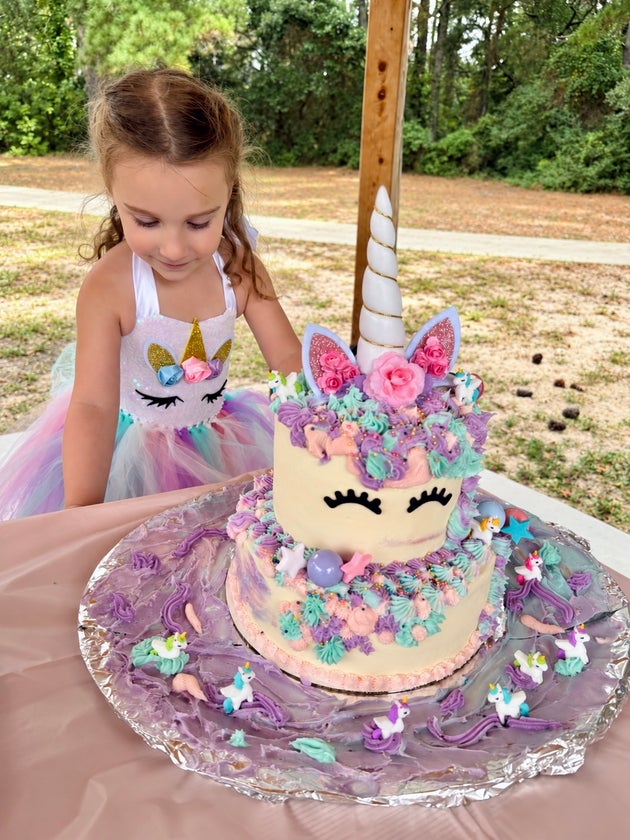 “Her innocence is like a balloon, lifting her above the harsh realities of being born into a female body,” the author writes of her 4-year-old daughter.
The Cornell allegations reminded me of why I initially dreaded the idea of raising a daughter. Because one day, I’ll have to pop that balloon and send her crashing down into a world where a group of men can abuse and torture a woman for hours with virtually zero consequences.
Because even in 2026, boys and men still learn in a thousand subtle and unsubtle ways to view women as objects rather than human beings. And because they do not respect our humanity, they don’t think they have to listen when a woman says “no”.
Teaching my daughters the skills that they need to survive feels like clipping their fairy wings. We tell our daughters that “the future is female” and that they can be anything they want to be, and then we burden them with the responsibility for men’s actions.
You shouldn’t wear that. Don’t go alone. Cover your drink. Trust no one.
And if they are assaulted, they will be the ones blamed for it, their actions scrutinised for reasons they were “asking for it” in order to excuse the bad behaviour of men.
It’s way past time for boys and men to alleviate this burden, but it’s going to take more than education for things to change.
...
Last year, we added a third sibling to the mix – a baby boy.
My son will grow up watching his two older sisters lead the way. Right now, he holds them up on a pedestal. He wants to be a part of everything they do. He lets them lead and is content to follow. His respect for them is innate.
Just as with my daughters, I cannot protect my son from the things he will inherit from the outside world. I can only ensure that he witnesses powerful women in our own home. Little boys need to see women in positions of power. They need to view women not only as full human beings but also as leaders – on the same playing field as the men in their lives.
For their part, their adult male role models need to value femininity and stop reducing women to their body parts or appearances. “Not all men” are committing the heinous acts the Cornell seven are accused of, but all men can do better. All men can speak up, step in and stop perpetuating rape culture with their silence. All men can work harder to elevate the girls and women in their lives. Because, as we’ve seen, nothing will change until they do.
Lauren Salles Gumpert is a freelance writer, speech-language therapist and aspiring author. She lives in Virginia Beach with her husband and three young kids. You can connect with her via Substack.
Do you have a compelling personal story you’d like to see published on HuffPost? Find out what we’re looking for here and send us a pitch at pitch@huffpost.com.




 Bengali (Bangladesh) ·
  English (United States) ·