

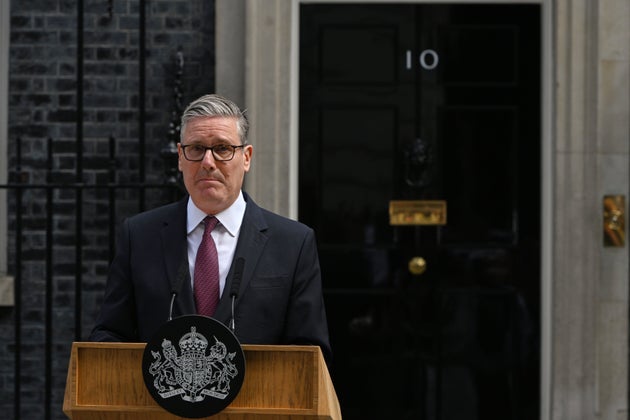
 Britain's Prime Minister Keir Starmer speaks to the media outside 10 Downing Street to announce his resignation in London, Monday, June 22, 2026. (AP Photo/Thomas Krych)
Keir Starmer was meant to fix the country, having promised a clean break from the chaos which engulfed the Conservatives.
But on Monday, less than two years after his landslide win, the prime minister acknowledged he no longer has the support of his Labour MPs and would stand down in weeks.
His announcement means the UK is now, remarkably, heading for its seventh PM – all-but certainly Andy Burnham – in a decade after years of alarming churn in Downing Street.
In a strange twist of fate, Starmer’s decision to stand down came just 24 hours before the 10-year anniversary of the 2016 Brexit referendum.
How are the two connected?
Even as he was giving his emotional speech on Downing Street, Starmer was slightly drowned out by Steve Bray, the anti-Brexit campaigner who is still blasting out EU anthems in Westminster a decade on from the referendum.
There’s no denying that British politics has been uncharacteristically disruptive over the last decade as voters grow impatient for the change promised by the Leave campaign.
And while all of the last six prime ministers were brought down by their own mistakes, Brexit played a part in their downfalls.
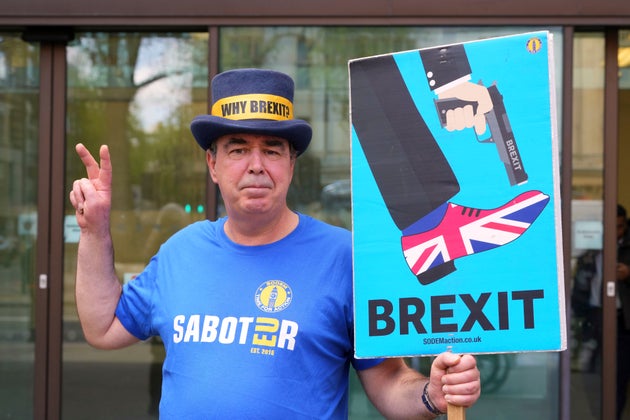 Anti-Brexit campaigner Steve Bray celebrates as he leaves Westminster Magistrates Court in London, Monday, April 14, 2025
Starmer successfully re-built UK-EU relations after years of friction – but it all came at the cost of his domestic reputation.
He became known as “never here Keir” because of his preference for the international stage.
He also tried to ignore the divisive issue of Brexit altogether to avoid alienating Labour voters who backed Leave, but ended up missing a major opportunity to pin the subsequent division on his opponents.
Rishi Sunak, in office for a year and 255 days, lost a general election where the Tories lost their worst election result in history – only five years after a landslide win in 2019.
He helped to ease post-Brexit trade frictions on the island of Ireland, but voters were too resentful over the mess left behind by his predecessors.
Liz Truss, in office for just 49 days, was forced to resign over her disastrous mini-Budget – a chaotic plan to realise the Eurosceptics’ vision of turning the UK into “Singapore-on-Thames”.
Her staggering tax cuts sent the pound plummeting and the Bank of England had to scramble to help.
Boris Johnson, in office for a comparatively long period of three years and 44 days, was pushed out primarily over his conduct during Covid with partygateand the Chris Pincher scandal.
He won the 2019 snap general election after campaigning on a vow to “Get Brexit done”. He was praised during his premiership for securing the withdrawal deal between the UK and EU, breaking years of deadlock.
But, in hindsight, the heavy economic cost of that agreement continues to weigh on the country.
Pro-EU campaigners at Best for Britain estimates the cost to the economy is anywhere from £180 to £240bn, as the UK’s GDP took a hit and the country became more vulnerable to economic shocks.
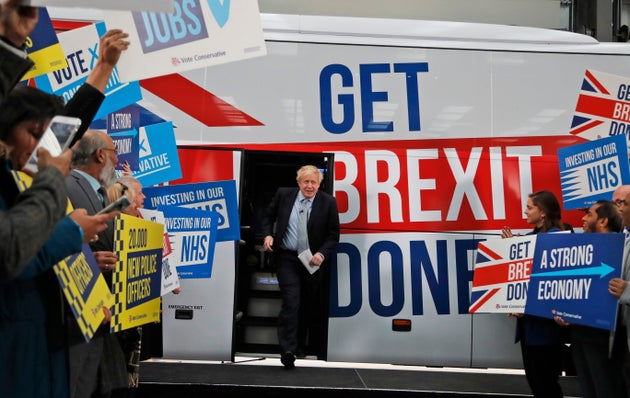 Prime Minister Boris Johnson addresses his supporters prior to boarding his General Election campaign trail bus in Manchester, England, Friday, Nov. 15, 2019.
 Theresa May, who stepped down after three years and 11 days, failed repeatedly to get a Brexit deal through the Commons.
She overestimated the Conservatives’ popularity in 2017 when she called a snap election and ended up governing with a minority in the Commons – scuppering her own chances to get legislation through parliament.
And finally, David Cameron, the man who called the EU referendum in 2016 and promptly resigned after the result did not go the way he wanted.
After five years leading a coalition government with the Lib Dems, the Tory leader then campaigned in the 2015 general election on a promise to ask the public if they wanted to stay in the EU.
His attempt to resolve an internal party row over membership and see off the threat from Ukip failed miserably as he misjudged the support for EU.
The past 10 years has evidently eroded public trust in politics and encouraged heightened emotions on social media.
The Brexit vote seemed to set a new precedent for division, less political goodwill and patience than before, politicians easily spooked by polls.
A majority (57%) of Brits now think it was wrong to leave the EU, according to YouGov.
That includes 23% of Leave voters, but calling to rejoin risks reviving toxic debates from a decade ago.
Listen to this week’s Commons People as we unpick exactly how the EU referendum continues to rock British politics – and what the next PM will have to contend with to reset our fractured nation.
Listen to Commons People, the podcast that makes politics easy. Every week, Kevin Schofield and Kate Nicholson unpack the week’s biggest stories to keep you informed. Join us for straightforward analysis of what’s going on at Westminster.





 Bengali (Bangladesh) ·
  English (United States) ·