

Some 290 million years ago — before dinosaurs roamed the Earth — a predator gobbled up three other animals. Later, it barfed up their bones. Over the ages, that puke hardened into a fossil. A newly imaged cluster of bones inside it now offers a window into some of the world’s earliest land predators.
Researchers shared their new findings January 30 in Scientific Reports.
Explainer: How a fossil forms
Scientists have a name for fossil vomit: regurgitalite (Ree-GER-jih-tuh-lyt). This sample held bones from three different animals eaten by one predator. That means “we can literally say, for sure, that these three were living at exactly the same place and exactly the same time, maybe to the week or even to the day,” says Arnaud Rebillard. He’ a paleontologist and was part of the research team. He works at the Museum of Natural History in Berlin, Germany.
Fossils of partially digested food, including vomit and poop, are valuable clues for studying Earth’s past. They reveal more than just which species lived in an area. They also help scientists figure out which animals were predators and which were prey.
“We need fossils like this to really tie together how the ecosystem functioned and how the food webs were structured,” says Martin Qvarnström. He did not take part in the new study. A paleontologist, he works at Uppsala University in Sweden.
Peering inside the puke pile
Rebillard’s team discovered the lime-sized barf blob at a fossil site known as the Bromacker locality. They scanned the fossil with powerful X-rays to get a 3-D image of what was inside (without breaking it open). That CT scan revealed a cluster of 41 bones from different animals. This suggests the debris had come from a predator’s gut.
Something leaving the gut can either be thrown up or pooped out. To find out which this was, the team analyzed chemicals in material surrounding the bones.
Unlike puke, fossilized poop tends to be high in the element phosphorus. Since it was low in phosphorus, the new fossil appears to be ancient vomit.
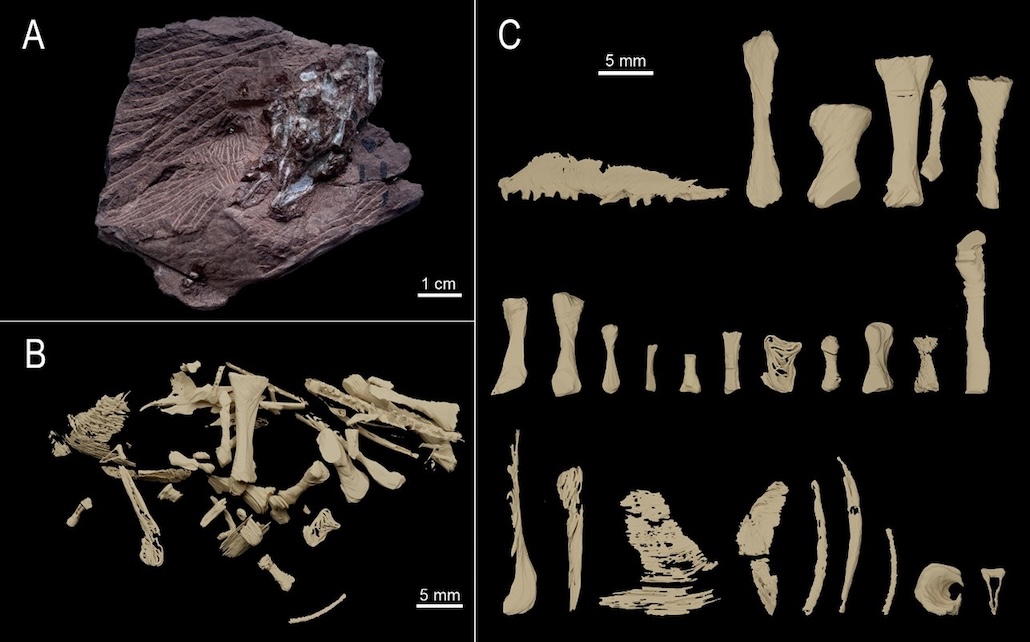 Researchers scanned 290-million-year-old fossilized vomit to find out what was in it. Figure A shows the complete specimen. Figure B shows a CT scan of it, revealing a cluster of 41 bones. Figure C shows scans of 25 bones from it that the team could attribute to prey species. Arnaud Rebillard
The researchers don’t know which predator threw up the bones. They suspect it was one of two animals similar to today’s monitor lizards (such as Komodo dragons). One candidate is Dimetrodon teutonis. It’s known for the sail on its back. The other is Tambacarnifex unguifalcatus. It had long, curved fingers and toes and sharp, backwards-curved teeth.
Both predators resembled dinosaurs. But they were not dinos. They weren’t even reptiles. Instead, they belonged to a group known as synapsids (Sih-NAP-sidz). This group includes today’s mammals and their extinct relatives.
What’s on the menu
Rebillard’s group found two small, lizard-like reptiles among the barfed-up bones. They also found the limb bone from a larger, reptile-like plant eater. Several more bones came from animals that could not be identified.
These bones from different species suggest the predator did not have a taste for just one type of prey. It ate whatever it could find.
“It’s kind of like a photograph of a moment in the past that is telling us about the animal that was living,” says Rebillard. “Any data that we can find about their behavior is very precious.”
Even several of today’s predators cough up bones and other body parts that are tough to digest. Owls, for instance, famously barf up the fur and bones of prey that they’ve swallowed whole.
Scientists don’t know if this is why the ancient animal spit up those bones. But that’s likely, Rebillard says. That, or the animal simply ate too much.
The site where this fossil was found preserves a snapshot of an early land ecosystem on the supercontinent Pangaea. Fossils from this site date from the Permian Period, 299 million to 254 million years ago.
Back then, predators that could travel on land often lived in semi-aquatic landscapes. There, they hunted crustaceans and fish. Around this time, plant eaters gradually started moving to dry, inland sites. New predators would soon follow.
Fossil poop and puke are much rarer inland than in aquatic habitats. That’s part of what makes the new fossil vomit so exciting. “We’re talking about almost 300-million-years-old ecosystems,” Rebillard says. Any fossil that gives such precise information about when and where animals lived “is extremely fascinating.”




 Bengali (Bangladesh) ·
  English (United States) ·