

Can you name every ingredient in a Twinkie? It’s not easy: The list has more than 35. You might recognize the eggs, sugar and flour. But after that, it gets hard.
It would take a mighty effort to guess it has hydrogenated tallow. Or sodium stearoyl lactylate. Or the food dye red 40. These chemicals, and many more, are now common ingredients in most U.S. diets. That’s because they’re found in many ultraprocessed foods, or UPFs. In addition to Twinkies, UPFs include chips, baked goods, granola bars and more.
“UPFs are industrially manufactured” using “very processed ingredients,” explains Filippa Juul. She works at a medical school, SUNY Downstate Health Sciences University in New York City. There, she studies how foods affect our health.
Scientists say: Chemical
Factories chemically alter the ingredients in UPFs to where they no longer resemble the foods from which they came. Then manufacturers combine these to make foods that aren’t like anything you could whip up in a home kitchen.
Compare the Twinkie to a cake you might make at home. Both have eggs, sugar and flour. The homemade cake might also include butter, vanilla and baking soda. But most Twinkie ingredients are things you can’t find in a grocery store.
Processing can alter a food’s flavor, appearance or texture. It can make foods last longer or withstand long travels to market. These are some of the many reasons big companies now make lots of ultraprocessed foods.
UPFs are convenient and widely available. In the United States, more than half of the calories people eat come from ultraprocessed foods. For kids and teens it’s even higher — 65 percent of calories. That number comes from a study of nearly 28,000 people, including 10,000 kids.
Scientists have begun worrying about how these foods — and their chemical additives — might affect our health. We’ve long known that eating foods full of fat and sugar isn’t good for us. UPFs may present new and unknown risks, experts now say.
Just because a food is processed doesn’t mean it’s bad for you. Some processing steps — such as pasteurization and fermentation — can make foods safer or even more nutritious. Ultraprocessed foods, though, tend to focus on flavor or convenience over nutrition and health.The shift toward a processed diet
For many years, the focus of healthy eating was cutting fats and simple sugars. In 2009, Brazilian nutritionist Carlos Monteiro began to suspect this was not the best approach.
In Brazil, people traditionally ate lots of whole foods, such as meats and beans. This diet was also quite high in fat and sugar. But obesity rates in the 1970s and ‘80s were low, Juul notes. In 1975, just 3 percent of Brazil’s men and 9 percent of its women were obese.
By 2009, four times as many men and twice as many women were obese. By then, the Brazilian diet had changed, too, says Juul. Whole foods were out. Snacks and soda were in.
Monteiro came up with a new system to classify foods. Called Nova, it puts foods into four groups. Each is based on how processed it is. Group 1 includes things that are processed minimally (such as frozen or cut), if at all. Group 4 is ultraprocessed.
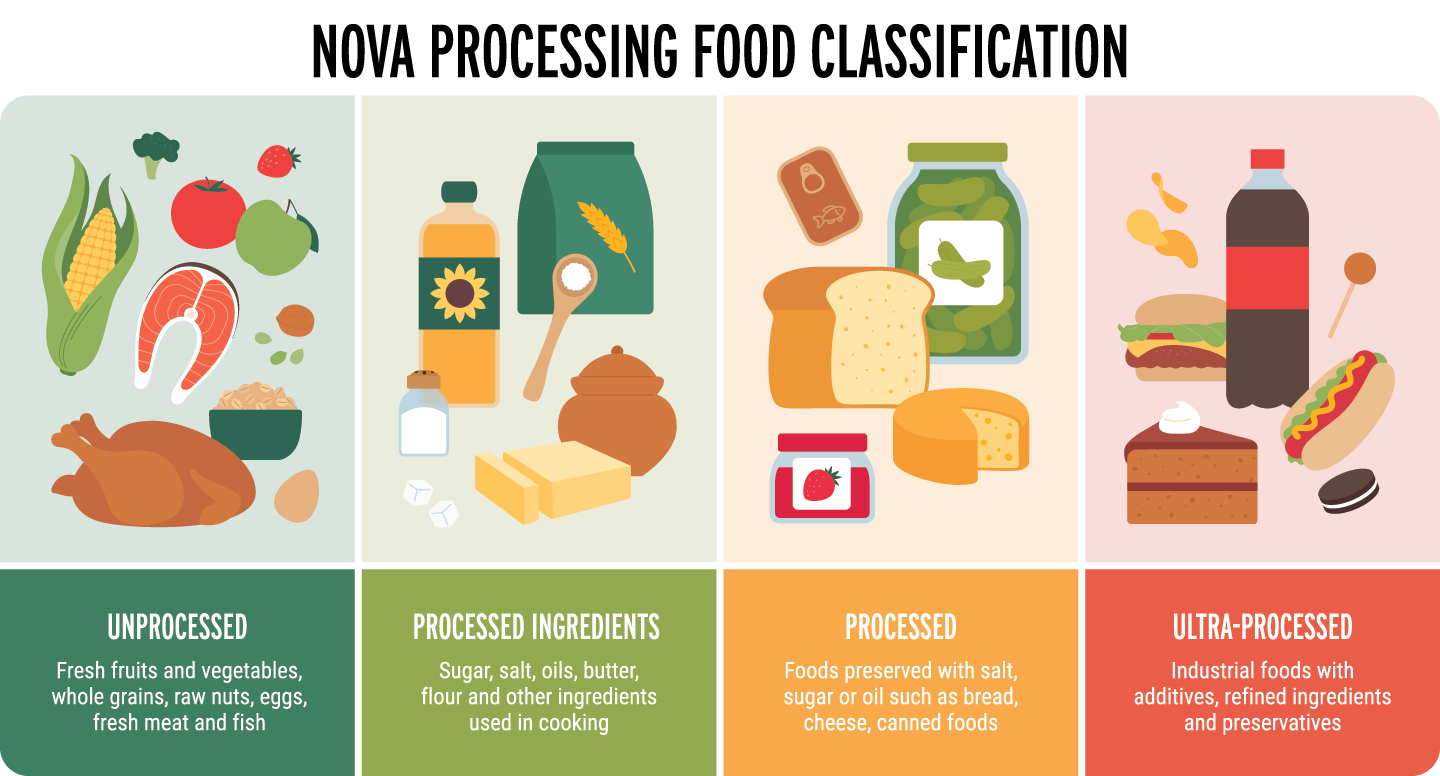 The Nova system groups foods into these four categories, based on how much they’ve been changed from their original form. A whole apple (group one) comes straight off the tree. An Oreo cookie (group four) is made in a factory from chemically produced ingredients. Anastasia Usenko/iStock/Getty Images Plus
Other researchers have come up with different ways to describe UPFs. Still, it’s not always easy to define what’s “ultra” processed. Nor is it simple to relate the healthiness of a food to how processed it is.
One thing is clear: UPFs are now eaten commonly worldwide.
And that worries food scientists such as Juul. “People who eat the most ultraprocessed food, or have a large proportion of ultraprocessed foods in their diet, tend to become unhealthier [with time],” she observes. They also tend to have higher risks of obesity, diabetes and high blood pressure.
Here’s an overview of the Nova system to distinguish the degree to which the foods you tend to eat are unprocessed, minimally processed or ultraprocessed.Gut feelings
Why UPFs are linked to these conditions isn’t yet clear. Benoit Chassaing thinks the answer may be in our guts.
A vast community of bacteria lives in our digestive tract. They’re known as the gut microbiome.
Scientists Say: Microbiome
Chassaing studies these microbes at Institut Pasteur in Paris, France. “We are currently investigating … the very specific impact of food additives” on the gut microbiome, he says. These are chemicals that are added to food to change how it looks or tastes. Colorants are additives that turn foods bright colors. Emulsifiers are additives that stop liquids from separating. This helps keep things like dressings, ice cream and chocolate smooth.
On their own, each additive is safe to eat. But how these chemicals might affect our gut bacteria is only poorly known, Chassaing says. And changes to those microbes could increase rates of diseases such as diabetes.
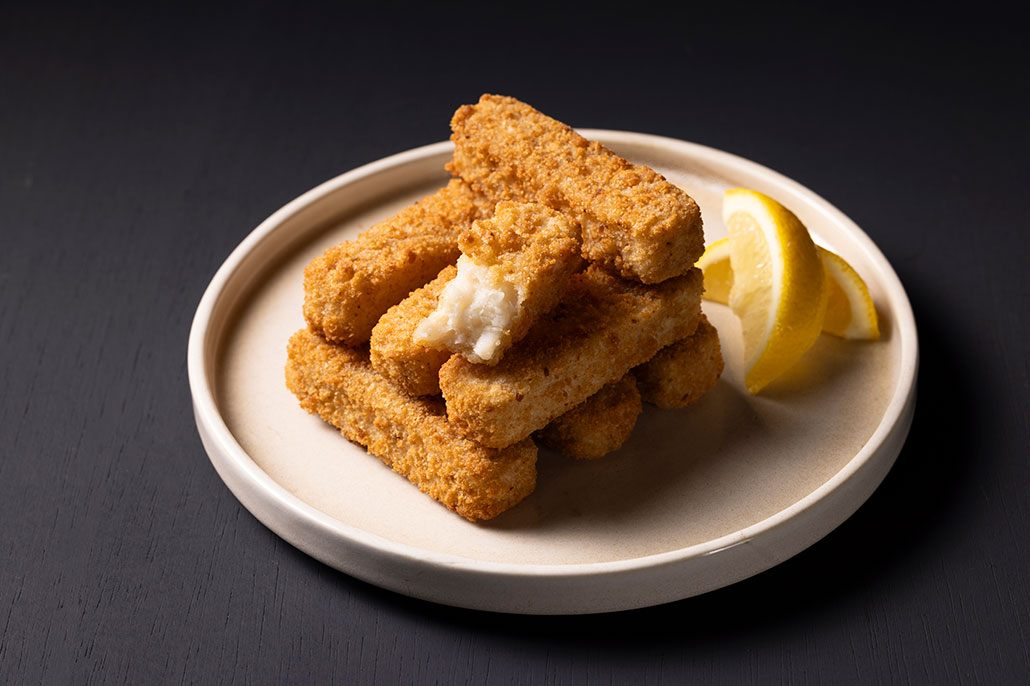 Can you find “fingers” on a fish? These sticks are usually made from pieces of fish or some other protein mixed with fillers and additives to improve their flavor and texture.Jenner Images/Moment/Getty Images Plus
It’s easy to overeat UPFs, too. Think of the last time you reached for a couple of chips, only to finish the whole bag.
UPFs typically strip out the parts of whole foods that make us feel full — such as fiber. The chemicals that UPFs are made from don’t make us feel as full when we eat them. They also make the UPFs as tasty as possible. And they cost little. Some researchers think that the way UPFs have been designed can make some as addictive as cigarettes or alcohol.
Kids are a common target for UPF ads, Juul says. And the strategy is working. “What we see across the board, both in the [United Kingdom] and the U.S.,” she says, “is that consumption of ultraprocessed food is higher among teenagers than among older adults.”
The microbiomes in kids are less stable than are those of middle-aged people, Chassaing adds. This, his team suspects, makes kids more vulnerable to the effects of food additives.
What we still don’t know
Most research on UPFs is still correlational. In other words, people who eat more UPFs are at greater risk of poor health, studies find. But that research has not proven that eating these foods causes disease. This tentative link makes it hard to work out exactly how UPFs might be affecting our bodies.
It’s a common problem in nutrition studies. Ideally, researchers might ask one group of people to eat more processed foods for a period of time and another to eat only unprocessed foods. But volunteers in these studies often underestimate what they eat. Plus, it’s hard for this type of study to look for long-term effects — diseases that may take a decade or longer to develop.
Scientists also disagree on whether all UPFs are bad. The Nova system remains popular with some researchers. But others point to its flaws. Some of the ways that it classifies foods are unclear and inconsistent, notes Edward Giovannucci. He studies links between food and health at Harvard University in Cambridge, Mass. “Whole grains and yogurt may technically be considered UPFs in some systems,” he says, “but they are not unhealthy.” says Giovannucci.
Juul, though, supports the Nova system. She says UPFs that appear healthy can often be swapped out for something less processed.
Do you have a science question? We can help!
Submit your question here, and we might answer it an upcoming issue of Science News Explores
UPFs and healthy choices
What does this mean for your food choices? A good first step, Giovannucci says, is to avoid processed foods high in sugar, saturated fats, salt or refined carbohydrates (such as white flour).
Juul suggests looking at food labels to know more about what you’re eating. If a food contains chemicals like emulsifiers or preservatives, it’s probably ultraprocessed. When possible, it’s best to eat these foods sparingly.
“If you have a soda once a week or some candy once a week, that’s fine. It’s a treat,” she says. “But that’s not how a lot of people in the U.K. and in the U.S. eat right now. Their diet is actually completely ultraprocessed.”
Juul wants to see governments step in to help shoppers purchase fewer UPFs. Currently, the United States has very few restrictions on advertising these foods. Limiting ads could change how people eat, she thinks. So might making UPFs more expensive. For many people, she points out, these foods are now the cheapest and easiest to access. Taxes on UPFs, she says, could be used to make less-processed foods more affordable.
“Right now, the UPFs are the default,” she concludes. “That’s what people can afford. That’s what they have time for. That’s what’s always available. We need to switch that.”




 Bengali (Bangladesh) ·
  English (United States) ·