
 2 hours ago
1
2 hours ago
1 
Wednesday marks the 33rd year that NASCAR suffered one of the saddest days in its history.
On the calendar, April 1, 1993, was supposed to be April Fools Day, but it was the farthest thing from a joke when NASCAR fans awoke that morning to the news that defending Winston Cup champion Alan Kulwicki, at only 38 years old, had been killed in a tragic plane crash.
The plane carrying Kulwicki, along with the pilot and two other passengers, suffered unexpected icing on the wings, slamming into a meadow on final approach to Tri-Cities Regional Airport, just outside Bristol, Tennessee, where that weekend’s NASCAR race was scheduled at Bristol Motor Speedway.
Kulwicki barely had time to enjoy his reign as Cup champ, dying just over four months after beating Bill Elliott for the Cup crown by a mere 10 points, at the time the closest season-ending margin between first and second in the sport’s history.
Of all the drivers he’s faced in his legendary career, Mark Martin felt a special kinship with Kulwicki.
Martin and Kulwicki drove similar paths to NASCAR greatness
They literally grew up together racing on the American Speed Association (ASA) circuit, along with numerous late model races around the Midwest, essentially Kulwicki’s backyard, as he grew up in Milwaukee, Wisconsin.
While Martin never went to college, he was one of the most intelligent and technically minded young drivers who would eventually make his way to NASCAR, just like the university-educated Kulwicki, who earned a degree in mechanical engineering at the University of Wisconsin – Milwaukee.
Martin and Kulwicki were almost like symbiotic twins; there were so many similarities in how they raced and how each man made his way up the competition ladder to eventual stardom in NASCAR.
Both came from blue-collar racing backgrounds, Martin from Arkansas and Kulwicki from the Badger State. They were both Ford-powered drivers through most of their respective careers. Both were inducted into the NASCAR Hall of Fame (Martin in 2017 and Kulwicki in 2019) and are both in NASCAR’s 50 all-time greatest drivers.
The duo worked diligently on their respective race cars throughout their careers. Even when Martin was promoted to Jack Roush Racing, he still worked on his car, just like Kulwicki did – although the man also known as “Special K” had to do so more out of necessity, as he was not just the driver but also the car owner.
In essence, the buck stopped with Kulwicki, who oftentimes early in his career after races went scavenging for other teams’ throwaway tires and equipment in an attempt to try to save money.
Martin and Kulwicki were fierce competitors, but from their first ASA and late model races together and on through into their respective NASCAR careers, they raced each other cleanly. That’s why they respected each other so much.
And while Martin would go on to race for team owners including Roush, Rick Hendrick, Dale Earnhardt Inc., Michael Waltrip and Stewart Haas Racing, among others, Kulwicki turned down a number of offers to drive for other teams, including legendary Junior Johnson (declined Johnson’s offer not once, but twice), preferring to run things by himself with his AK Racing operation.
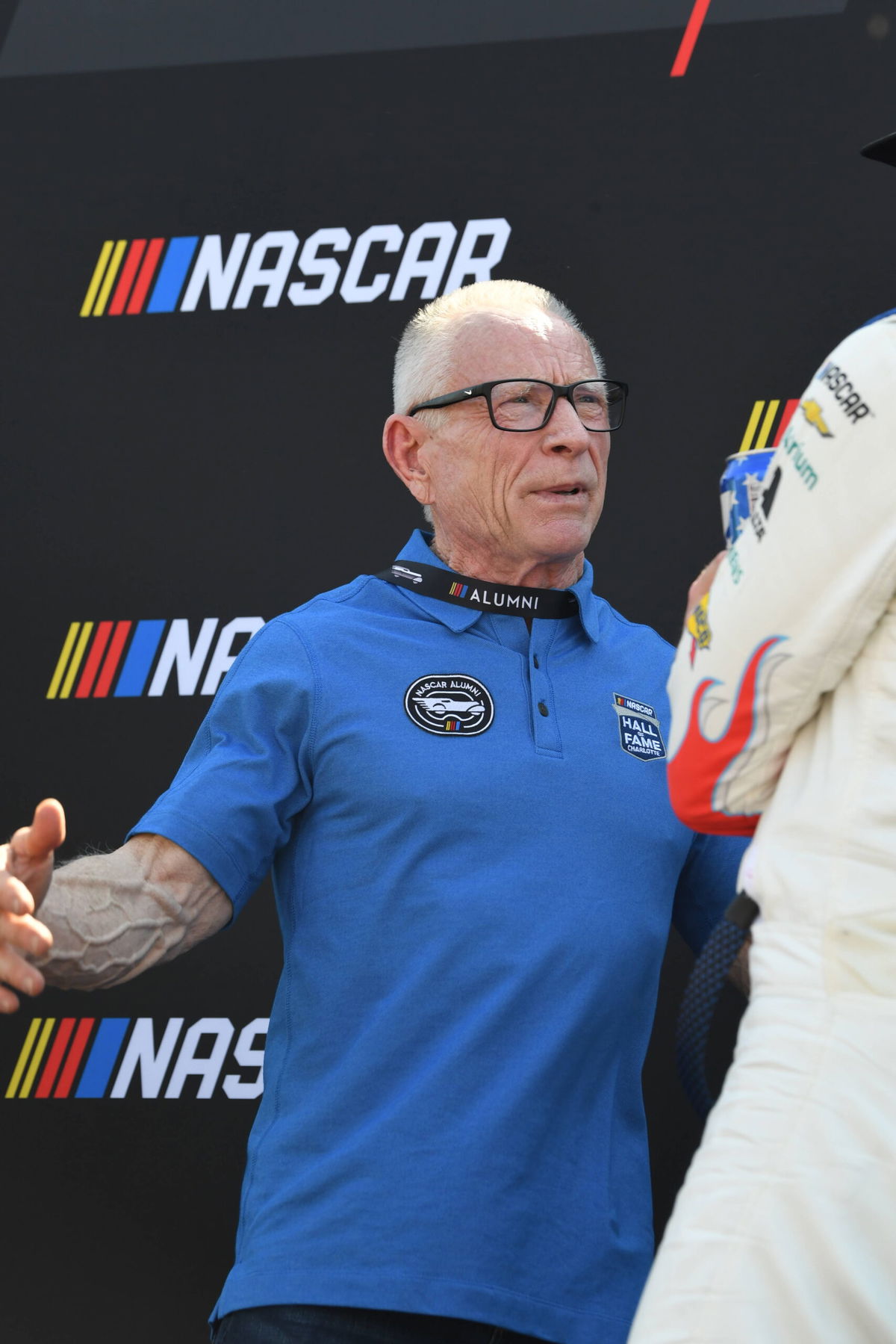 DARLINGTON, SC – MARCH 22: Mark Martin looks on prior to the running of the NASCAR, Motorsport, USA Cup Series Goodyear 400 on March 22, 2026, at Darlington Raceway in Darlington, SC. Photo by Jeffrey Vest/Icon Sportswire AUTO: MAR 22 NASCAR Cup Series Goodyear 400 EDITORIAL USE ONLY Icon260322234
Martin and Kulwicki also shared tragedy together. Kulwicki was killed in a plane crash, and so were Martin’s father, stepmother, and half-sister, who perished together nearly 5 ½ years later when their plane went down in a mountainous area in Nevada.
The Mark Martin interview about Alan Kulwicki
EssentiallySports spoke with Martin recently about his recollection of Kulwicki. Here are some excerpts of Martin’s memories of the man they called “the Polish Prince”:
“I raced in Wisconsin a lot besides ASA, and we raced together for six, seven years before Alan went NASCAR racing. We were together from very young, from our late teens till we both went NASCAR racing. That was kind of the same path that he went. He started young and then eventually he went to NASCAR racing.
“Could I see the talent and the potential he had back when he was racing in ASA and all the short tracks in Wisconsin and the Midwest? Yeah. I mean, he was the same level as Rusty (Wallace) because Rusty came through the same way. Rusty and I raced each other from teenagers all the way to NASCAR as well.
“He was on the Rusty Wallace level for sure, and there were a few others too that were on that level that made it to NASCAR, but just didn’t break all the way through. It was highly unlikely to come from the short tracks of the Midwest to the NASCAR Hall of Fame, but Alan, Rusty and myself all did.
“Not only were Alan and I alike in the way we came up through the ranks in racing, there were other similarities, like in 1985 and 1986, when I raced (in ASA) for Jerry Gunderman and Jimmy Fennig (who would go on to be a longtime crew chief for Roush Racing) was my crew chief. We all worked out of the same building. There was a wall separating us and Alan’s car and team in Franklin, Wisconsin (a suburb of Milwaukee).
“I talk a lot about that in my book (Martin’s biography, ‘Never Lift’ will be released this summer).’ We were not best friends, but we were friendly competitors and it will be greatly detailed in the book, our relationship, but we were great competitors.
“What kind of guy was he? Um, serious. He was always very focused and very serious. He asked a lot of questions, so we talked a lot. When you asked if we were friends, to me a friend is somebody you would go out to dinner with or go to the bar to hang out with. We did not do that.
“Like I said, we were friendly competitors.
“The day he died, when I first heard the first news report, I was sitting in my motorhome at the racetrack at Bristol. What did it mean to me and the sport? I don’t know how to put it into words other than to say it was just so devastating.
“And then, only about three months later, we lost Davey (Allison) in a helicopter crash. When those kind of things happen unexpectedly out of nowhere, it just kind of leaves you with a blank feeling, an empty feeling.
“People ask me what would have happened if Alan hadn’t died in that plane crash. He would have been a multi-season champion. Yeah, you could say that for sure. He probably would be a top team owner today. He would have continued with the racing operation beyond his driving. He was just different. He was different than a lot of people and you need that in the sport.
“He would be an owner today that truly got there with dirty hands. And that’s cool to have a businessman and also one that comes from dirty hands in the shop. We need all of them. We need a little bit of all of that.”
I was in attendance when Kulwicki celebrated his first of the eventual five Cup race wins he’d earn in his career, the fall 1988 race at Phoenix International Raceway (Nov. 6, 1988). It was the day Kulwicki became the first driver in NASCAR history to perform the so-called “Polish Victory Lap,” where he celebrated taking the checkered flag by driving around the one-mile flat track in the opposite direction, a clockwise path. When Kulwicki climbed from his car and spoke with the media, it was one of the most emotional celebrations the writer has ever been part of or witnessed.
And one of the first persons to congratulate Kulwicki on his well-deserved and hard-earned victory was none other than Mark Martin.
The post Exclusive: Mark Martin Will Never Forget Alan Kulwicki, Whom We Lost 33 Years Ago appeared first on EssentiallySports.


 Bengali (Bangladesh) ·
  English (United States) ·