
 4 hours ago
8
4 hours ago
8 

Key Points
The U.S. Department of Education announced a final rule that will, for the first time, strip federal student loan eligibility from college and career programs whose graduates fail to out-earn workers who never enrolled.
The Student Tuition and Transparency System (STATS) and Earnings Accountability rule applies a single standard across every sector of higher education, from public universities to for-profit certificate schools, regardless of an institution's tax status or the credential it awards.
The premise is simple: undergraduate programs must demonstrate that their graduates earn more than working adults who hold only a high school diploma. Graduate programs must show their completers earn more than typical bachelor's degree holders. A program that can't clear that bar for two of three years will lose the ability to enroll students who borrow federal loans. That doesn't mean it has to shut down - but the government is not going to continue to lend to students who end up having a bad financial outcome.
"If a program cannot show that it leaves its graduates financially better off than if they had never enrolled, it should not be underwritten by federal taxpayers," said Under Secretary of Education Nicholas Kent. He pointed to "rising rates of default and delinquency in the $1.7 trillion federal student loan portfolio" as the backdrop for the new framework.
The rule is the third and final rulemaking package authorized by the One Big Beautiful Bill Act, which President Trump signed on July 4, 2025. It also folds the new earnings standard into the Department's existing Financial Value Transparency and Gainful Employment regulations, replacing what officials described as nearly two decades of regulatory back-and-forth with one test that reaches almost every program and sector.
Would you like to save this?
How the Earnings Test Works
The test is calculated annually using the median annual earnings of a program's completers, measured four years after they finish.
Those earnings get compared against a benchmark tied to workers aged 25 to 34. For undergraduate programs, the comparison is the median earnings of someone that age with only a high school diploma, drawn either from the institution's state or the national figure, depending on where its students come from.
For graduate programs, the benchmark is a young worker with only a bachelor's degree.
The Department will run its first calculation in early 2027, covering the 2027–2028 academic year. A program that fails in both 2027 and 2028 could be labeled a "low-earning outcome program" starting in the 2028–2029 award year, at which point it loses Direct Loan eligibility unless it wins an appeal.
Again, the 2028–2029 academic year is the first year any college could lose access to federal student loans under this new rule.
Some Programs Get A Small Break
The final rule added several carve-outs after the Department reviewed nearly 10,000 public comments from the preliminary rule.
Institutions that exclusively serve students with documented disabilities are exempt from the program eligibility consequences altogether.
Certain career programs also get a reprieve. Fields where most workers earn tipped income, including cosmetology, barbering, and massage therapy, will see at least a one-year delay so that earnings data reflects the Act's "No Tax on Tips" policy, which starts with the 2026 tax year. During the delay these programs are neither passed nor failed, though the Department will still publish their earnings data.
This was feedback we even saw in our comments when discussing the proposed rules.
When Pell Grants Are At Risk
Losing federal student loans is the first consequence. Losing Pell Grants is the next, and it operates at the institution level. A school faces the loss of all Title IV aid, including Pell, if more than half of its Title IV recipients are enrolled in low-earning outcome programs, or if more than half of its Title IV dollars flow to those programs.
Schools have ways to protect their eligibility.
After the first year a program fails, an institution can voluntarily pull that program out of the Direct Loan program for at least five years, which shields it from the administrative-capability penalties that threaten Pell.
It can also run an orderly closure, stopping new enrollment while teaching out current students and keeping financial aid eligibility for the length of the teach-out or three years, whichever is shorter. The catch: a school that takes no action after the first failure forfeits both options later.
Programs are exempt from the Pell Grant consequences if the institution hasn't participated in the Direct Loan program for the five most recent award years, or if it agrees to bar its students from borrowing Direct Loans in that program for at least five years.
What Programs Are Most Impacted?
Early estimates from the Department's Office of the Chief Economist offer a preview (PDF File) of which programs stand to lose the most, though officials stress these are projections, not the official results that arrive in 2027.
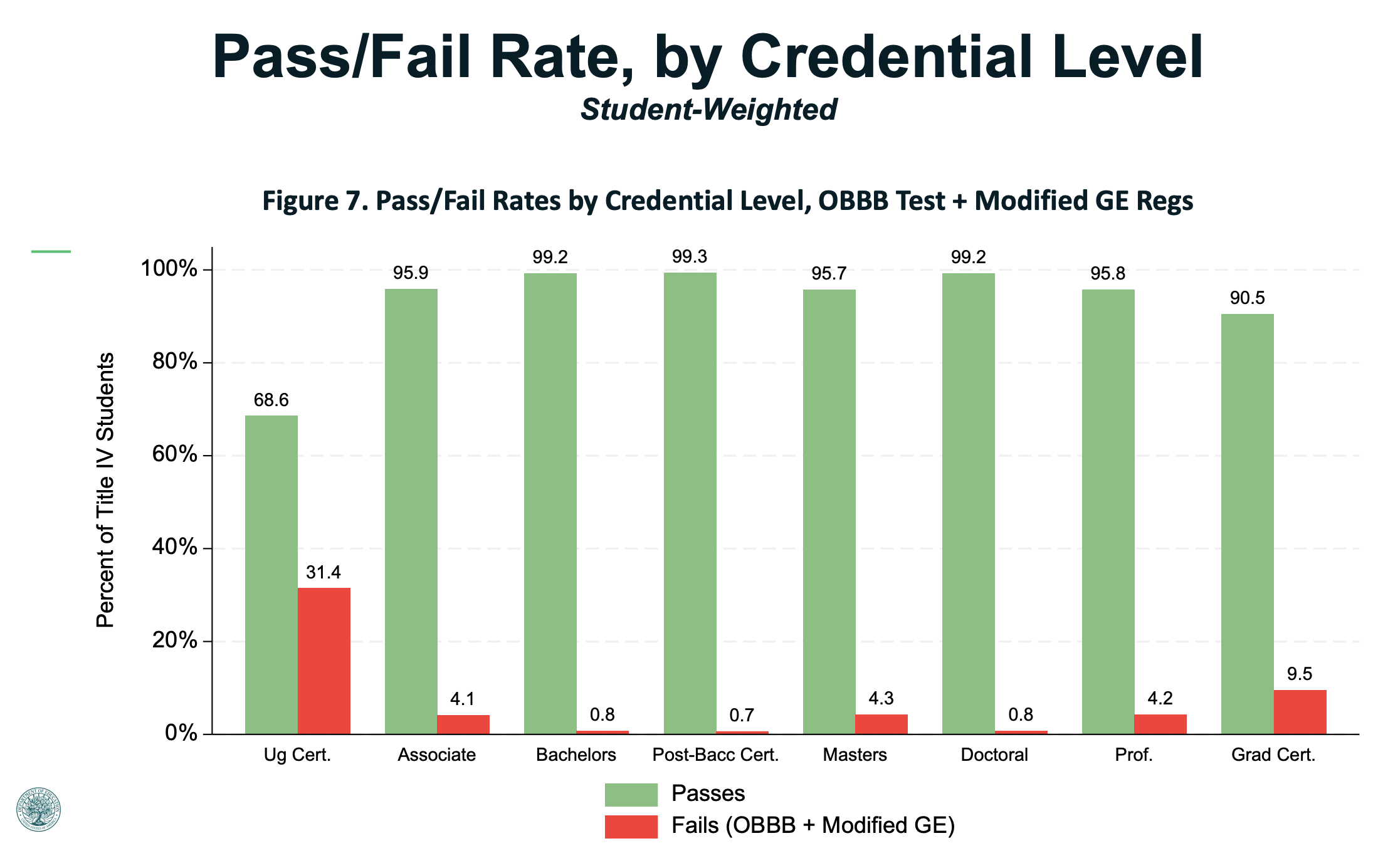
Across all of higher education, roughly 6% of programs and about 5% of Title IV students would fail the combined earnings test but the impact is heavily concentrated. For-profit institutions account for the bulk of it: about 35% of for-profit programs would fail, compared with under 4% at public and nonprofit schools, and roughly 55% of the estimated 650,000 students in failing programs attend a for-profit college.
Credential level matters too. Certificate programs are by far the most likely to have issues, with about 29% projected to fail and nearly one in three of their students enrolled in a failing program, while bachelor's, master's, and doctoral programs mostly pass.
The fields with the highest failure rates cluster in personal-service and arts-heavy disciplines (several of which would see 90% to 100% of their certificate or associate students fall short of the earnings bar):
Culinary servicesCosmetology Somatic bodywork (massage)Drama and fine artsReligious studiesAlternative and complementary medicineGeographically, Florida, Louisiana, Tennessee, California, and Idaho show notably higher shares of failing programs than the rest of the country.
What This Means For Students And Families
For families weighing a degree or certificate, the most useful change isn't the penalty, it's the disclosure requirements. Under the STATS collection, institutions must report program-level data including total cost of attendance, private student loan borrowing, and completion versus withdrawal, with the first submission due October 1, 2026.
That gives prospective students a clearer read on what a program costs and whether its graduates actually earn a return.
Current students gain new warnings too. Schools must notify both enrolled and prospective students when a program is flagged as potentially losing aid eligibility, and must tell students how much lifetime Pell eligibility they have left each time a grant is disbursed.
The practical risk for students is disruption. If a program loses Direct Loan eligibility, the college may be forced to shut down a program or at least block future enrollement. That move could also put the overall college at risk of closure. A program that closes leaves students to complete a teach-out or move elsewhere.
Colleges also have a new option in the 2026–2027 year - reducing the loan limits. Some colleges may be proactive and reduce the amount of money students borrow to prevent future issues.
None of this impacts the 2026–2027 year, but families making multi-year plans should factor in that a program's federal aid status could change by 2028–2029.
At the end of the day, the Department of Education is betting that tying financial aid to earnings, the rule pressures schools to cut programs that reliably leave graduates underwater and to bring down costs. Over time, this could mean fewer borrowers stuck repaying student loans for credentials that didn't pay off.
Don't Miss These Other Stories:
The post Education Department Will Cut Federal Loans From Low-Earning College Programs appeared first on The College Investor.





 Bengali (Bangladesh) ·
  English (United States) ·