

The Marvel Cinematic Universe really should be called the Marvel Cinematic Multiverse. In the films, alternate realities can be created and destroyed. Characters can also hop between them. This has allowed heroes like Spider-Man and Loki to team up with various versions of themselves. The Scarlet Witch and Doctor Strange can even possess the bodies of their interdimensional doppelgängers.
Superhero screenwriters aren’t the only ones intrigued by the idea of a multiverse. Some physicists think it’s possible that a multiverse might really exist. Why? Because the existence of many other universes could answer deep questions about our own.
“There are a lot of abstract ideas about other universes,” says Paul Halpern. He’s a physicist at Saint Joseph’s University in Philadelphia, Pa. One popular multiverse idea, he says, comes from the physics of the very biggest things: cosmology. Another comes from the physics of the very smallest stuff. That’s quantum mechanics.
A bubble bath of universes
Shortly after the Big Bang, our universe went through a brief period of superfast expansion. Scientists call this growth spurt inflation. In that time, tiny quantum fluctuations in the structure of the universe got stretched to huge sizes. In parts of space close enough for our telescopes to see, those quantum blips seeded galaxies.
“If you can produce a galaxy from quantum fluctuations, what else can you produce?” wonders Andrei Linde. This physicist was involved in creating the theory of inflation. He’s now retired from Stanford University in California.
At even larger scales, Linde says, quantum blips could have seeded regions of space with vastly different properties. Such places would exist far beyond what telescopes can see. In some of them, electrons might be much heavier, Linde says. Or gravity might behave differently. There, life might not be able to exist.
What’s more, inflation has stopped in the universe we can see. But it may continue elsewhere, Linde says. It could blow up more bubbles of space with unique properties forever. Each bubble would be so distant and distinct from the others that they would effectively be different universes.
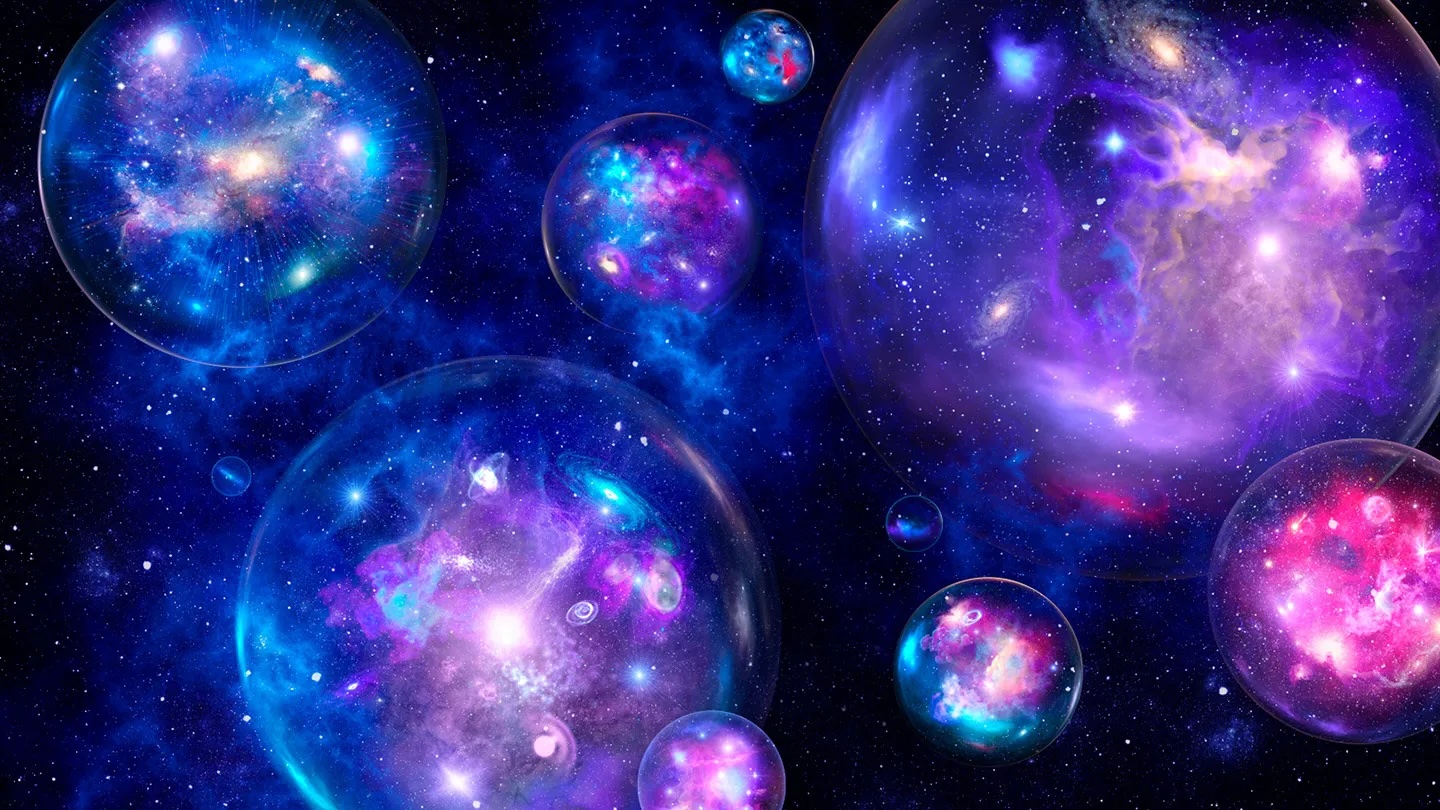 One concept of the multiverse envisions our universe as one bubble in a vast cosmic foam. Other bubbles might have different properties than our own. “In some of them you can have people, in some of them you may not have people,” says physicist Andrei Linde. Spooky Pooka
To Linde and some other scientists, this scenario answers a big question in cosmology. That is: why the masses of particles and strengths of forces in our universe seem perfectly right to create life.
At a glance, this looks like “many strange coincidences,” Linde says. But in mystery novels, “there’s always the detective who says, ‘I do not believe in coincidences.’”
Linde doesn’t, either. If a multiverse exists, he says, then it’s not so strange that conditions in our universe are ripe for life. Among many bubble universes, those particle masses and force strengths were bound to pop up somewhere.
If our universe is one bubble in a fathomless froth, maybe another universe has bumped into ours, Halpern says. That could have left a mark on the afterglow of the Big Bang that fills space. “No one has seen yet the rings that would represent the scars of bubble collisions,” Halpern says. “But scientists are still looking.”
Do you have a science question? We can help!
Submit your question here, and we might answer it an upcoming issue of Science News Explores
Branching timelines
Another multiverse idea comes from quantum mechanics. That branch of physics says that until they’re measured, particles can exist in a mix of multiple states at once.
“Once somebody takes a measurement, that blurred scenario collapses into a single possibility,” Halpern says. For instance, an electron that existed in a smear of possible places is observed in just one spot.
At least, that is the traditional idea in quantum mechanics. But it “is a little bit odd, because it requires a human measurer,” Halpern says. If it’s true, how did the universe function before humans were around to observe it?
In 1957, physicist Hugh Everett III offered an explanation. Maybe, he proposed, observation doesn’t cause a spread of quantum possibilities to collapse into a single outcome. Perhaps all possibilities unfold in alternate realities. For instance, an observer splits into multiple copies of herself who each saw an electron in different places.
“The versions separate seamlessly,” Halpern says. “They never will know about each other and they live in parallel universes.”
Unfortunately, that would make this idea extremely hard to test. “We can’t have somebody split in an experiment between two possibilities and ask each one what it was like,” Halpern says. “If the theory is right, you wouldn’t notice it.”
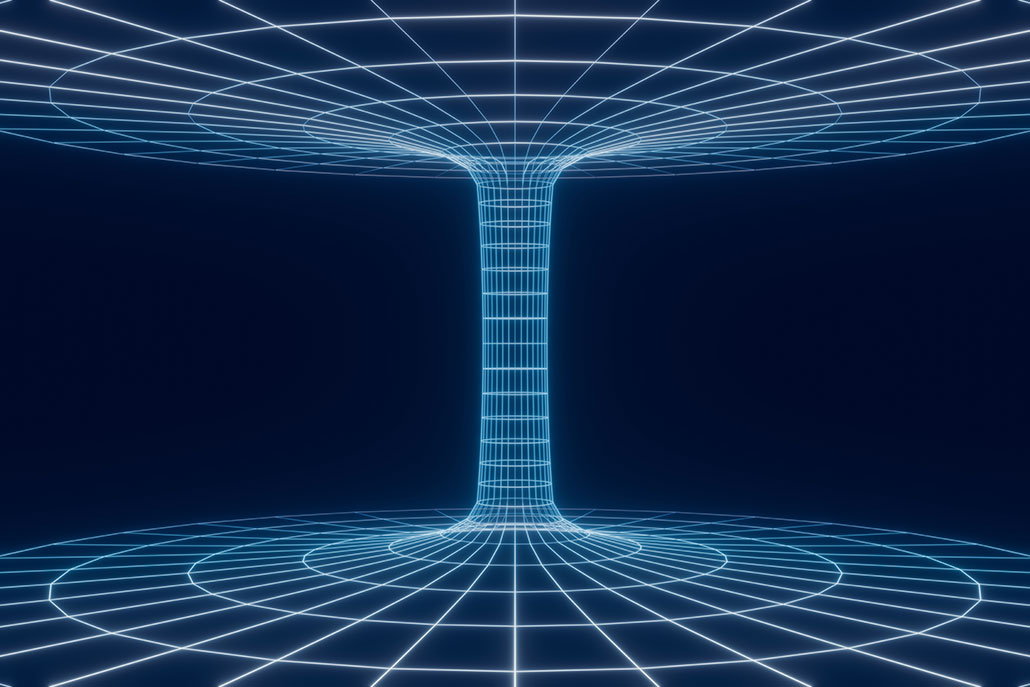 If they exist, tunnels in the fabric of spacetime — known as wormholes — might offer a way to travel between realities. “The wormhole idea comes from Einstein’s general theory of relativity. [It] says that if you have concentrated amounts of matter and energy, you can warp or twist spacetime itself and create something like a tunnel,” explains physicist Paul Halpern. “But nobody knows where these tunnels would end up going to, because no one has ever been through one.” Flavio Coelho/Moment/Getty Images
Cosmic crossover
The chances of visiting other universes, if they exist, are similarly dim.
In theory, tunnels in the fabric of spacetime — known as wormholes — might bridge realities. But “we don’t know if they’re possible to create,” says Halpern. If they were, “they would require so much energy and mass that they would be well beyond current technology.”
We’re talking about the mass of a galaxy, Halpern adds. “If there was [a wormhole] near Earth, Earth would be crushed almost immediately,” he says. “So it’s not like you can have a wormhole in a secret closet in your bedroom and every night open up the closet door and jump in and travel to all these other places. Your parents might be a little upset when the bedroom starts to collapse into nothingness.”
That may be bad news for anyone who dreams of teaming up with their alter egos to save the day. But on the bright side, you’ll probably never have to fight off your evil twin, either.




 Bengali (Bangladesh) ·
  English (United States) ·