
 1 month ago
22
1 month ago
22 
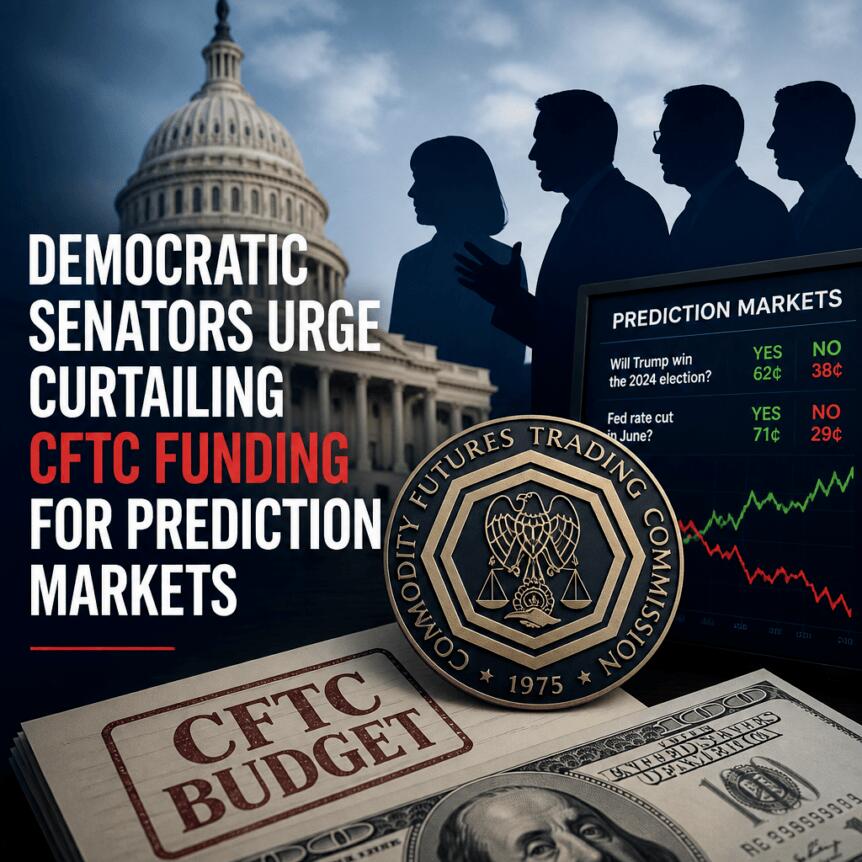
A group of 17 Democratic US senators has asked leadership of the Senate Appropriations Subcommittee on Financial Services and General Government to prevent the Commodity Futures Trading Commission (CFTC) from using federal funding to continue lawsuits targeting state regulators over prediction markets. The senators’ request centers on Chair Michael Selig’s litigation strategy, which asserts that the CFTC has “exclusive jurisdiction” over certain prediction market products.
The letter—sent to the chair and ranking member of the appropriations subcommittee—frames the issue as a practical and compliance-relevant question of federal oversight, state consumer-protection authority, and how enforcement resources are deployed in parallel regulatory systems.
Key takeaways
17 Democratic senators urged subcommittee leadership to block CFTC access to federal funds for litigation against state gaming authorities tied to prediction market enforcement. The senators contend that ongoing CFTC lawsuits could undermine state consumer protections and intensify a “race-to-the-bottom” dynamic across jurisdictions. CFTC litigation has targeted multiple states, while some market operators—including Kalshi and Polymarket—have brought related lawsuits challenging state actions. The dispute sits within a broader legislative debate over the Digital Asset Market Clarity (CLARITY) Act and the division of authority between the CFTC and SEC. Legal observers have pointed to the possibility that one of the cases could eventually reach the US Supreme Court, potentially revisiting the balance of state authority in sports betting.Senators seek limits on CFTC litigation funding over state actions
In the Wednesday letter, Senators Richard Blumenthal, Jeff Merkley, and 15 additional Democrats asked the appropriations subcommittee to intervene in the budgeting and oversight process governing how the CFTC can use federal resources. Their request is directed at preventing the CFTC from employing federal funds in Chair Michael Selig’s legal challenges against state-level authorities pursuing crackdowns on prediction markets.
The senators argue that the CFTC’s litigation posture risks distorting federal-state regulatory balance in a way that could benefit online prediction markets while reducing consumer protection and oversight. They specifically warn that the CFTC’s use of enforcement litigation as leverage against state authorities may enable platforms to evade local guardrails.
While appropriations do not determine the legality of the CFTC’s underlying statutory interpretations, the senators’ intervention signals a policy and accountability concern: whether enforcement resources should be used in a way that the senators view as escalating conflict rather than clarifying jurisdiction.
Jurisdictional fight: CFTC “exclusive jurisdiction” and “swaps” characterization
At the center of the dispute is the CFTC’s position that certain contracts used on prediction market platforms fall within its regulatory authority. According to the senators’ framing, Selig and the agency defend the view that the event contracts in question qualify as “swaps,” placing them under the CFTC’s purview.
This jurisdictional argument has been tested across a growing set of state challenges. As of June, the CFTC has pursued legal actions involving prediction markets in a range of states, including Connecticut, Illinois, Arizona, Kentucky, Wisconsin, New York, Minnesota, Rhode Island, and New Mexico. In parallel, some companies, including Kalshi and Polymarket, have filed their own lawsuits against state authorities, a development that underscores how quickly these disputes have evolved into multi-forum litigation.
According to Cointelegraph’s reporting, the CFTC’s cases have included litigation such as its suit against Kentucky after state-level prediction market enforcement actions. Cointelegraph has also covered related operator litigation, including challenges that support the CFTC’s broader view of federal jurisdiction.
Potential Supreme Court implications and the sports-betting jurisdiction precedent
As the legal battles progress, some experts have suggested that the trajectory of these cases could ultimately produce a Supreme Court outcome. The concern is not limited to prediction markets alone; it also relates to the broader constitutional and statutory question of how much regulatory space states retain when federal agencies assert exclusive control over particular types of wagering or trading-like instruments.
The senators’ letter implicitly draws on the existing legal framework around state regulation of sports betting. In the 2018 Supreme Court decision Murphy v. National Collegiate Athletic Association, the Court held that states may regulate sports betting. If the justices were to grant review in one of the currently pending prediction market-related matters, they could be asked to clarify or revisit the scope of state authority under circumstances where federal regulators contend that certain products fall within an exclusively federal regulatory category.
For compliance and legal teams, the potential for Supreme Court review matters because it could reshape how state gaming rules apply to contracts characterized by federal agencies as financial derivatives. It could also determine whether state enforcement efforts remain viable when operators argue federal preemption or exclusive jurisdiction.
CFTC leadership, agency structure, and the CLARITY Act debate
Beyond the litigation itself, the senators’ intervention comes amid a broader debate over how US regulators should divide responsibility for digital assets and related market structures. Chair Michael Selig is currently the sole commissioner and chair of the CFTC, giving him significant control over the agency’s leadership-driven policy direction. The senators’ focus on appropriations reflects their view that the CFTC’s current approach is not merely an isolated enforcement matter, but part of a wider institutional posture toward prediction market regulation.
The CFTC is expected to have a bipartisan group of five commissioners in the long run, but as of Friday there had been no announcement of additional CFTC appointments to fill vacancies. That governance context can affect regulatory predictability: when leadership is concentrated, courts and Congress may scrutinize whether enforcement priorities align with statutory intent and legislative design.
Meanwhile, the US Senate is expected to vote on the Digital Asset Market Clarity (CLARITY) Act, a proposal intended to establish separate regulatory roles for the CFTC and the SEC over digital assets. The prediction market enforcement controversy intersects with this legislative discussion because some stakeholders have argued that the CLARITY Act should not be used to extend federal oversight in ways that they believe exceed the CFTC’s mandate.
Last week, gaming organizations petitioned the Senate to add language barring sports event contracts from CLARITY’s coverage, contending that the CFTC was not created to regulate such wagers. This reflects how prediction markets are increasingly treated as a legal and policy test case for the broader question of how Congress intends to allocate authority across regulators.
What to watch next
The immediate next step is whether appropriations subcommittee leadership will act on the senators’ request to restrict federal funding for the CFTC’s prediction market litigation. Separately, the ongoing multi-state cases and related challenges by market operators will determine how quickly courts clarify jurisdictional boundaries—potentially culminating in higher-court review. Until then, uncertainty remains for institutions trying to map compliance obligations across federal and state regimes, particularly where contract structuring, derivative labeling, and wagering classifications overlap.
This article was originally published as Democratic Senators Urge Curtailing CFTC Funding for Prediction Markets on Crypto Breaking News – your trusted source for crypto news, Bitcoin news, and blockchain updates.





 Bengali (Bangladesh) ·
  English (United States) ·