
 2 weeks ago
7

Something rare occurred in the UFC. For a person known for almost never accepting his mistake or walking back on a stance, Dana White just did the unthinkable—offer an apology.
The moment came at the UFC 333 post-fight press conference when White was asked about undefeated bantamweight Farid Basharat’s release earlier this month. The UFC CEO last week had suggested that Basharat’s release was due to “either guys aren’t good to deal with, or the matchmakers don’t want to deal with them.” His comments drew immediate backlash, particularly from Basharat who pushed back against the accusation that he had done something to jeopardize his UFC career. Addressing the reaction from the 16-0 fighter, Dana White clarified that he wasn’t referring to Basharat specifically and had never intended to damage the fighter’s reputation.
“When I was talking to the media that night and I was saying reasons that you could not get re-signed, I wasn’t saying that about [Farid Basharat],” White said. “I was just saying, they were asking me, ‘Why didn’t he get re-signed?’ and you know, I said, ‘Well, it’s happened before. There’s lots of reasons why guys don’t get re-signed.’ I wasn’t talking about him specifically. Okay.
“So, I actually saw his video on my Instagram, and I was like, ‘Oh sh-t, I didn’t mean to do that to that kid.’ And I saw he had said something like, ‘You know, if you’re not going to resign me, don’t try to hurt my career.’ And in no way, shape, or form did I try to do that. I have no problems with him whatsoever, personally or professionally. And, you know, I’m sure with his record and what he’s got going on, he’ll get re-signed somewhere.”
White’s explanation suggests that he didn’t mean to personally disparage the undefeated bantamweight with his earlier remarks. However, it also raises a question: Was the apology prompted by the backlash his comments drew, or by the fact that they had hurt Basharat himself?
Basharat’s release and White’s subsequent comments at the UFC Edmonton post-fight press conference last week had drawn angry responses from prominent MMA figures, including Ariel Helwani and Demetrious Johnson. Even UFC commentator Joe Rogan expressed his anger, while questioning the logic behind letting an undefeated fighter go just because he’s considered “boring” by some.
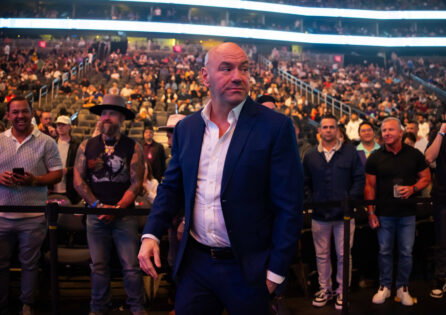 MMA: UFC 300 – Pereira vs Hill Apr 13, 2024 Las Vegas, Nevada, USA UFC president Dana White in attendance during UFC 300 at T-Mobile Arena. Las Vegas T-Mobile Arena Nevada USA, EDITORIAL USE ONLY PUBLICATIONxINxGERxSUIxAUTxONLY Copyright: xMarkxJ.xRebilasx 20240414_mjr_su5_008
“Like, you know that dude who just got cut, Farid Basharat. Undefeated. Undefeated, got cut,” Rogan stated. “And the last time I talked to him was inside the Octagon. It was the last fight of his career, when I was like, ‘I’m sure you’re going to get another contract.’ Like, I think I said that to him in the Octagon cuz he was saying it’s his last fight. He’s undefeated. I don’t like that thinking that you have to be uber exciting.
“The guy’s very skillful. Obviously, he’s undefeated, and they just decided that they didn’t like his style…. I don’t know what happened. I don’t know. But I didn’t like it. I don’t like when a guy gets cut that wants to keep fighting in the UFC. He’s undefeated. Just because you think he’s boring. Well, put him in with someone who’s f–king exciting.”
While Dana White’s apology clears Farid Basharat of the accusations surrounding his exit, it still begs the question: Why did the UFC drop an undefeated, ranked contender in the first place?
Part of the answer may lie in the way the promotion handles roster cuts more generally.
The UFC rarely offers a detailed public explanation for every fighter it releases or chooses not to re-sign. However, contractual circumstances, fighters’ own comments, and statements from UFC executives, including White, offer some clues.
A contract coming to an end doesn’t necessarily guarantee a new deal. Financial demands that the promotion considers too high relative to a fighter’s promotional value can also become a factor. Repeated weight misses and conduct-related issues may create further problems.
The most common reason a fighter’s contract might not be renewed, however, is a prolonged losing streak. Even then, there are exceptions. Australian heavyweight Tai Tuivasa, for instance, remains with the promotion despite an eight-fight losing streak, having not won a fight since 2022.
Roster management is another consideration.
With the influx of new prospects through Dana White’s Contender Series (DWCS) Season 10, which wrapped up earlier this month, the UFC has to make room for incoming talent. The promotion’s roster is estimated to number around 550–600 fighters, and a significant intake of prospects can mean difficult decisions for established names. In August, the UFC released around nine fighters over a span of a few weeks following a substantial intake from the Contender Series.
Fighters who have been with the promotion for a long time but are no longer climbing the rankings or delivering the kind of finishes that attract attention can also find themselves on the roster-cut list.
But that doesn’t quite explain Farid Basharat’s situation.
He was ranked No. 9 in the bantamweight division when the UFC chose not to offer him a new contract, and he had won all seven of his Octagon appearances. His release has therefore fueled speculation that winning alone may not be enough if a fighter’s style doesn’t match what the promotion wants to sell.
The 29-year-old himself has been vocal about that concern.
Speaking about his exit, Basharat said: “I think the company, the UFC, is manufacturing a fan base that doesn’t appreciate good-quality fighting. Even if it’s a mismatch, even if it’s a low-level fight, as long as there’s blood, as long as it’s a first-round finish, we’re happy.”
Basharat’s case isn’t the only recent departure to raise questions about how much emphasis the UFC places on entertainment value. Michael ‘Venom’ Page was recently dropped by the promotion after a four-fight winning streak, despite going 5-1 in the UFC. Muhammad Mokaev, meanwhile, was released after winning all seven of his UFC fights.
While the circumstances differed, each exit has added to the debate over what the promotion expects from its fighters beyond winning.
When Dana White’s comments missed the mark
A similar pattern appeared in Muhammad Mokaev’s case. The Brave CF champion, who has been regarded by many as the best flyweight in the world, was on a seven-fight winning streak in the UFC when the promotion released him after UFC 304 in 2024.
Unlike Farid Basharat, who recorded six decision wins and one stoppage during his UFC run, Mokaev finished four of his seven UFC opponents. Yet his winning record wasn’t enough to secure his future with the promotion.
And, as with Basharat, Mokaev’s release was followed by a pointed comment from White.
Speaking about Mokaev at the UFC 304 post-fight press conference in 2024, White said, “The matchmakers aren’t big fans of his for many different reasons, and not just that there’s a lot of people who shoot takedowns in this business… a lot of guys that fight with that type of style, but it’s a lot more than just that… I think the PFL is going to get a great undefeated guy. Really good luck to him.”
Dana White offered a similar defense in 2013 when addressing the UFC’s decision to release top-ranked welterweight contender Jon Fitch. At the time, White argued that Fitch was on the downside of his career and had become too expensive to keep under contract.
At the time too, Fitch’s departure prompted questions about the UFC’s decision-making, with many in the MMA community pushing back against the explanation.
While the circumstances were different each time, the reactions point to a recurring debate: how much weight does the UFC place on a fighter’s record, and how much does it value the style and marketability of their performances?
The post Dana White Apologizes to Undefeated Fighter Amidst UFC’s Recent Roster Cuts appeared first on EssentiallySports.




 Bengali (Bangladesh) ·
 English (United States) ·