
 2 hours ago
10
2 hours ago
10 
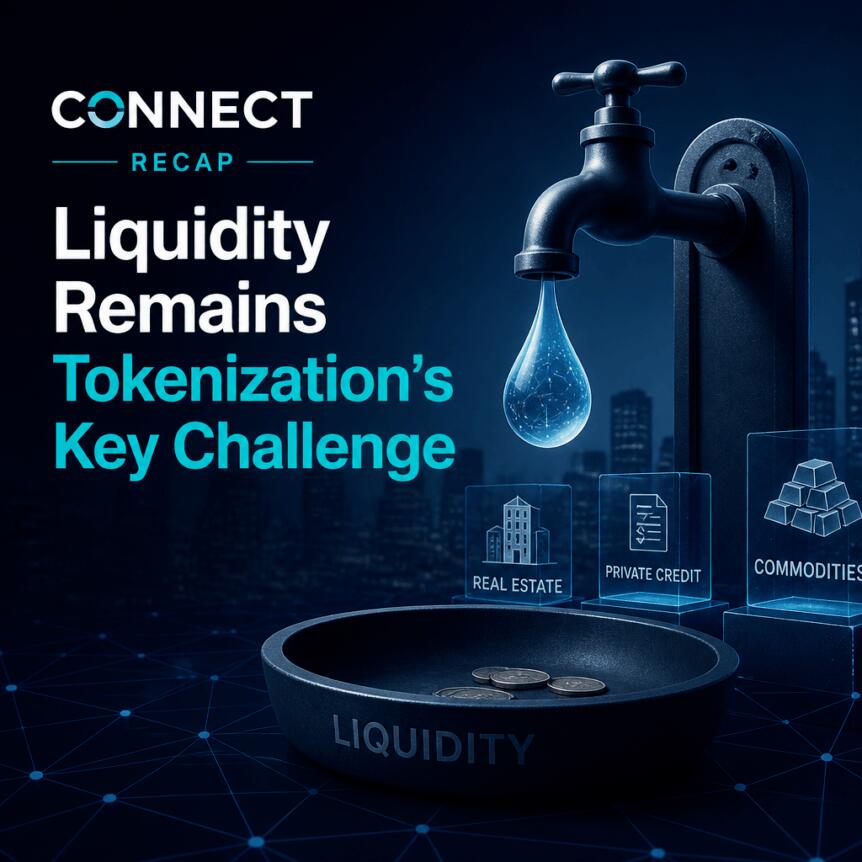
Tokenization is moving beyond niche trading experiments and into broader capital markets—yet industry participants say the ecosystem is still struggling with a basic mismatch: too much real-world asset (RWA) supply has hit onchain venues, while demand for fully tokenized instruments remains thinner than expected.
Speaking on a panel at CONNECT by Cointelegraph: Singapore Edition on Oct. 9, Alex Taaffe, chief revenue officer at GSR, said liquidity has improved in several tokenized market segments, including pre-IPO stock trading, commodities, and global equities. But he argued that the push by asset managers and issuers to “bring capital formation onchain” has outpaced investor appetite for fully tokenized RWAs—creating a supply-and-demand imbalance across parts of the market.
Key takeaways
Liquidity for some tokenized markets (pre-IPO stocks, commodities, global equities) has improved, but fully tokenized real-world assets still face weaker demand, according to GSR’s Alex Taaffe. Fragmentation is worsening as more asset issuers and blockchain networks tokenize similar assets into separate liquidity pools. Stablecoin usage for everyday spending is still limited by consumer experience and local financial rails, not just cross-border transfer capability. Onchain trading faces persistent execution and risk-management gaps, including difficulty measuring true available liquidity and counterparty exposure across networks. As crypto markets mature, investors are finding it harder to exit—especially in smaller tokens—leading to a shift toward longer time horizons.RWAs onchain: supply grows faster than demand
Taaffe’s core point was that tokenization is creating new access and trading pathways, but it is not automatically translating into sustainable demand. “Specifically on RWAs, and fully tokenized assets, there’s a supply and demand imbalance,” he said, adding that “there’s a ton of supply” as issuers seek to raise capital through onchain platforms.
He also highlighted how the market’s structure contributes to the problem. As more asset managers tokenize and more blockchains participate, liquidity can become fragmented—splitting across multiple venues rather than concentrating where the deepest bids and offers exist.
Lingling Jiang, a partner at DWF Labs, agreed that fragmentation remains a practical challenge. Her emphasis was on a recurring pattern in tokenized markets: when different issuers tokenize the same underlying asset, they can create separate liquidity pools that don’t necessarily benefit each other.
Still, Jiang suggested crypto liquidity has improved meaningfully over the years, even if the sector has “more work to do.” The implication for participants is straightforward: the next phase is not just onboarding new tokenized products, but engineering liquidity concentration and improving interoperability so that assets can trade efficiently at scale.
Stablecoins: transfers are easier than everyday spend
The discussion then shifted from tokenized assets to stablecoins, with panelists framing adoption as a question of daily usability rather than technical transfer speed. Mike Silagadze, founder and CEO of ether.fi, argued that stablecoins have made cross-border movement simpler, but broader take-up depends on whether consumers can actually use them for routine expenses.
Silagadze pointed to Singapore as an example of the friction that can persist even when stablecoins are available. Consumers may hold USDC, but still need local currency for bills, underscoring a gap between blockchain payment infrastructure and the surrounding consumer financial services that people rely on.
Yvonne Chia, head of communications at USDD, stressed that stablecoin design should consider user experience. She said that if an issuer truly considers “the user’s point of view,” the experience itself becomes the deciding factor—aiming for a flow where people can use stablecoins without having to consciously manage them like a separate tool.
Panelists also connected the adoption story to regulation. Ilya Podoynitsyn, co-founder and CEO of FinHarbor, said providers have to comply with rules that vary across jurisdictions, which forces infrastructure and compliance systems to adapt from market to market.
Ashna Vaghela, chief customer officer at crypto payments provider Mercuryo, tied the ideal user journey to mainstream fintech convenience—saying stablecoin payments should feel as straightforward as using Apple Pay, including completing transactions without forcing users to leave an app.
The session also came as stablecoin market capitalization stood at $306 billion, up about 2% year over year, after growing roughly 74% in the prior 12 months, according to DefiLlama data.
Onchain trading: fragmented liquidity and tougher risk controls
Another panel addressed what remains missing from the onchain trading stack in 2026, focusing on both execution mechanics and risk management. Austin Federa, co-founder of DoubleZero, said moving liquidity between blockchain networks is harder than in traditional markets. He argued that fragmentation isn’t just an “execution problem” but also a “data problem,” because it can be very difficult to reliably determine how much liquidity truly exists onchain.
On the risk-management side, Miguel Morel, founder and CEO of Arkham Intelligence, described how onchain data can support counterparty risk assessment. In prediction markets, he noted, some participants may possess informational advantages—so knowing who is on the other side can influence how much risk a trade carries. Morel said that when a firm can evaluate counterparties more precisely, it can potentially offer tighter spreads, which may improve pricing for customers.
Morel also suggested the same data can help exchanges evaluate deposits, including where funds originated. Rather than asking users for a “passport,” the logic is that exchanges can use deposit provenance to decide whether trading should be permitted or whether funds should be routed into compliance review processes.
Investors face harder exits as markets mature
Liquidity and fragmentation came up again in the context of investor exits. Panelists discussing “The Exit Problem: How Investors Get Their Money Back” said liquidity constraints have complicated sell-offs for crypto venture capital investors, particularly when exits depend on liquid market depth.
Pulkit Gupta of Nomad Capital said liquidity has been especially weak over the past three months, with trading concentrated more heavily in larger cryptocurrencies. He added that getting exits on altcoins has been particularly challenging, describing it as “really tough” for their firm.
Sonia Shaw, CEO of OneAsset, framed the change as part of a broader maturation of the market. Recalling an investor expectation for an exit within six months, she said she doesn’t believe the market works that way anymore. Shaw characterized the move away from rapid exits as a sign of maturation rather than only a problem.
Aleksandr Nechaev, partner at Funders VC, pointed to the effect of fast-changing environments on investment decisions, arguing that the pace of change can make founders’ expertise and ability central to how investments are evaluated. The panel discussion also touched on how uncertainty and shifting conditions affect founders, a theme that later surfaced during the event’s pitch competition powered by Funders VC.
For readers watching the sector, the key question is whether the industry can translate tokenization’s growing product supply into deeper, more centralized demand—while also improving liquidity discovery across chains, stablecoin everyday usability, and exit pathways as the market’s structure continues to evolve.
This article was originally published as CONNECT Recap: Liquidity Remains Tokenization’s Key Challenge on Crypto Breaking News – your trusted source for crypto news, Bitcoin news, and blockchain updates.





 Bengali (Bangladesh) ·
  English (United States) ·