

In 2010, researchers at Purdue University and the University of New South Wales began an investigation into a macabre question: What's the upper temperature limit at which humans can survive? The answer, according to their calculations, was 95 degrees Fahrenheit (35 degrees Celsius) at 100% humidity — a "wet bulb" temperature that sets an absolute "unsurvivable" threshold for the human body.
Beyond this temperature, a cascade of irreversible physiological processes begins, sending organs into shock, causing blood to clot and ending in inevitable death.
As the climate warms and heat waves multiply, more places across the globe are creeping towards this threshold, with climate models projecting the first 35 C wet bulb temperatures by the middle of the century.
But conditions don't have to be this hot or humid to be unlivable in a practical sense for wide swaths of the population. The threshold is lower for those who are older, for women, and those with certain medical conditions. Any kind of physical activity also raises the risk of heat stress.
In some parts of Asia, South America and Australia, the hottest days are already "unlivable," meaning a healthy adult sitting in the shade in a slight breeze could be at risk from heat illness, a recent study found.
A heat dome hit the western U.S. on July 12, 2026, air temperature data from the GEOS (Goddard Earth Observing System) revealed. Numerous weather stations in Utah, Montana and Wyoming recorded their highest temperatures since record-keeping began. Such heat waves will become more common as the climate warms. (Image credit: NASA Earth Observatory/Michala Garrison)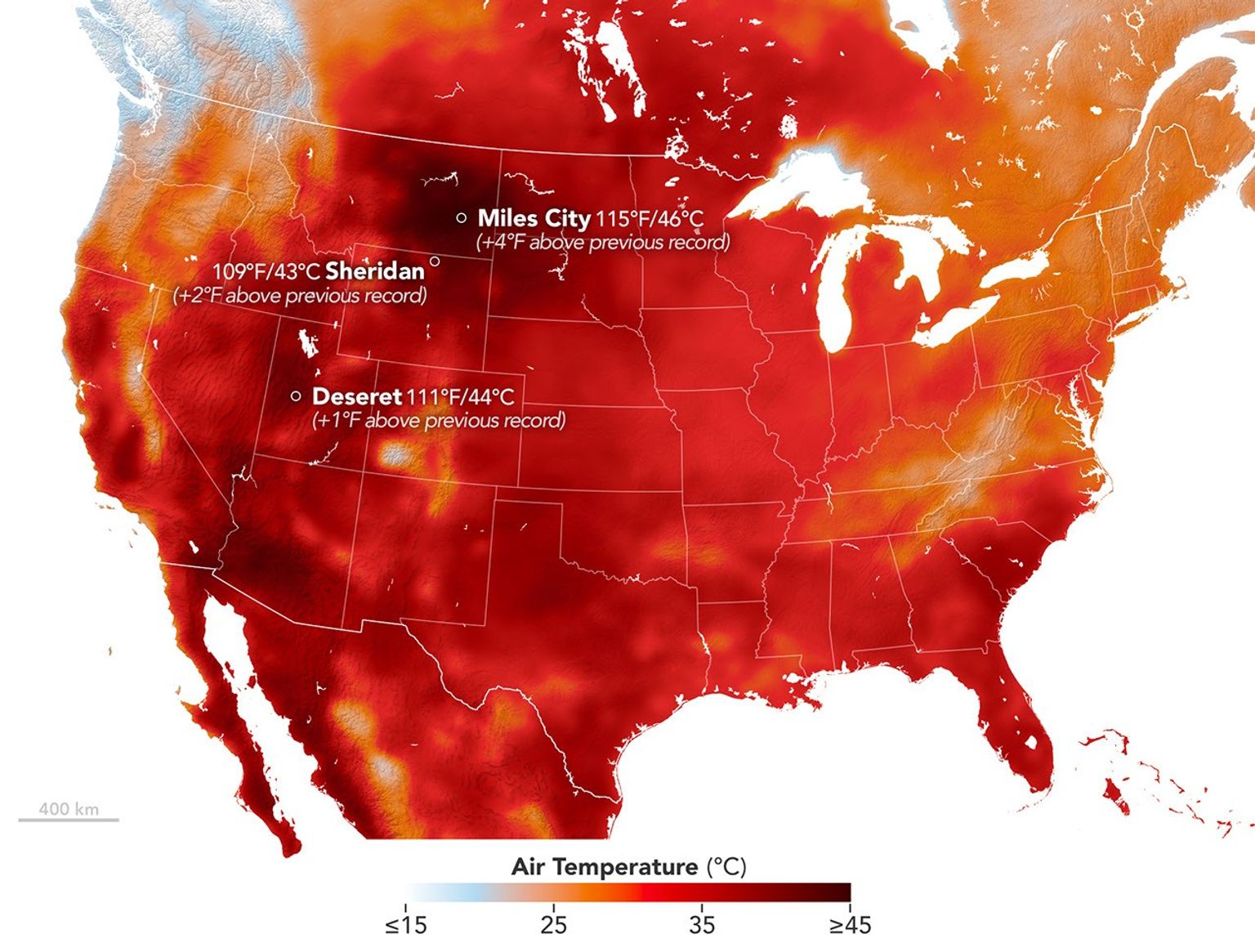
In North America, the hottest days in parts of the Southwest and Southeast pose that same risk, the study found. And more heat is coming: Under projected warming, the country will see tens of thousands more heat-related deaths by 2100.
Nearly 20,000 people could die from extreme heat each year by the middle of the century in the United States. The U.S. and Mexico could see an additional 9,000 suicides each year.
Heat can kill directly, via heat stroke, but it can also worsen underlying cardiovascular health, turning chronic, manageable heart conditions deadly. Heat waves often occur hand in hand with droughts or other extreme weather and may lead to food and water price hikes or shortages, said Marina Romanello, a senior research fellow at the University College London Institute for Global Health who tracks how the climate affects health. In that sense, climate change acts as a stress multiplier.
And heat could erode health in other, subtler ways, making nights more sleepless and our cognition a bit cloudier.
"No individual metric really does justice to the overall risk to health and well-being of these multiple stressors being exacerbated all at once and compounding each other," she told Live Science.
Heat wave deaths
Heat kills most immediately through heat stroke, which occurs when the core body temperature soars over 104 F (40 C) and doesn't cool down. Dangerous heat waves — and resulting deaths — have already increased over the past several decades. In 2023, heat was described as the main cause or a major underlying cause of death on 2,325 U.S. death certificates, an increase from 1,069 in 1999, research shows. When adjusted for age of the population, that represented a 63% rise in heat-related deaths.
But scientists think heat already contributes to many more deaths than that, because heat isn't always listed as a contributor to death on official records, even if it may have played a role in exacerbating an underlying health condition.
Heat is particularly hard on people with cardiovascular issues, with the risk of a heart attack more than doubling on extreme heat days. The risk of stroke, too, nearly doubles on the hottest days. Some early evidence hints that heat's impact on the immune system may play a role in these cardiac cases. Deaths related to extreme heat days for all reasons are projected to more than double by the mid-century in the U.S., leading to up to nearly 20,000 deaths if temperatures warm 8.1 degrees F (4.5 degrees C).

And rates of hyponatremia, or low sodium levels — which can cause seizures and coma — are also projected to increase as climate change worsens.
Most at risk are older adults, kids and teens, and people who work outside. The heart pumps less efficiently as people age, so older people struggle to pump blood to the skin to cool down. Children produce more heat than adults, given differing fat makeup and a lower skin surface area, and sweat less, making them more prone to developing heat stroke. Outdoor workers often have to exert themselves on hot days and may struggle to hydrate enough to compensate for extreme heat.
People with certain medical conditions are also at high risk. Diabetes can impair sweating and the dilation of the blood vessels that helps cool the body in hot temperatures, making people with diabetes more susceptible to heat stroke. Some medications, including diuretics often taken by people with heart disease, beta blockers for people with heart conditions, and selective Serotonin Reuptake Inhibitors (SSRIs) taken for mood disorders, also increase the risk of heat-related illness because their side effects make it harder for the body to cool itself.
Mental illness itself is also a risk factor. Higher temperatures have been linked to an increase in suicides, with 0.7% more instances of suicides in the U.S. per for every 1.8 F (1 degree C) increase in monthly average temperature. Were temperatures to rise more than 5 degrees C (9 degrees F), that rise could translate to between 9,000 and 40,000 additional suicides in the U.S. and Mexico by 2050, the researchers wrote — similar to the increase in the suicide rate expected in a serious economic recession. (Fortunately, that temperature rise is now considered unlikely due to the world moving away from coal as an energy source.)
It's not clear exactly why hotter days fuel more suicide, but one possibility is that feeling hot and uncomfortable can increase the impulsivity that may underlie the behavior.
And impulsivity rises in people who struggle to stay comfortably cool in their homes, Kim Meidenbauer, a neuroscientist at Washington State University who studies the effect of heat on emotion and behavior, has found.
The effects may be hardest on those who have preexisting mental health conditions, ranging from schizophrenia to anxiety: Mental-health-related emergency department visits have been shown to rise with the temperature.
Perhaps the most universal way heat may compromise health in the U.S. is through sleep. Heat reduces both sleep quality and sleep quantity. For every degree-Celsius increase in nighttime temperature, there is a loss of 3 good nights of sleep per month per 100 people, according to one large-scale sleep-tracking study.
Those sleep disruptions may be the major reason heat has a corrosive effect on mood and mental health, even for those without existing mental health conditions, Meidenbauer noted.
"We see worsened emotional state," she told Live Science. "We see increases in impulsivity." And underslept people struggle to stay on an even keel, perhaps explaining both E.R. visits and a heightened risk of suicide.
"Emotion regulation is a lot harder if you've had poor sleep quality," Meidenbauer told Live Science.
Heat waves have been increasing in frequency, intensity and length since the 1960s, and the seasons in which they occur have lengthened as well. (Image credit: Socioeconomic Data and Applications Center (SEDAC))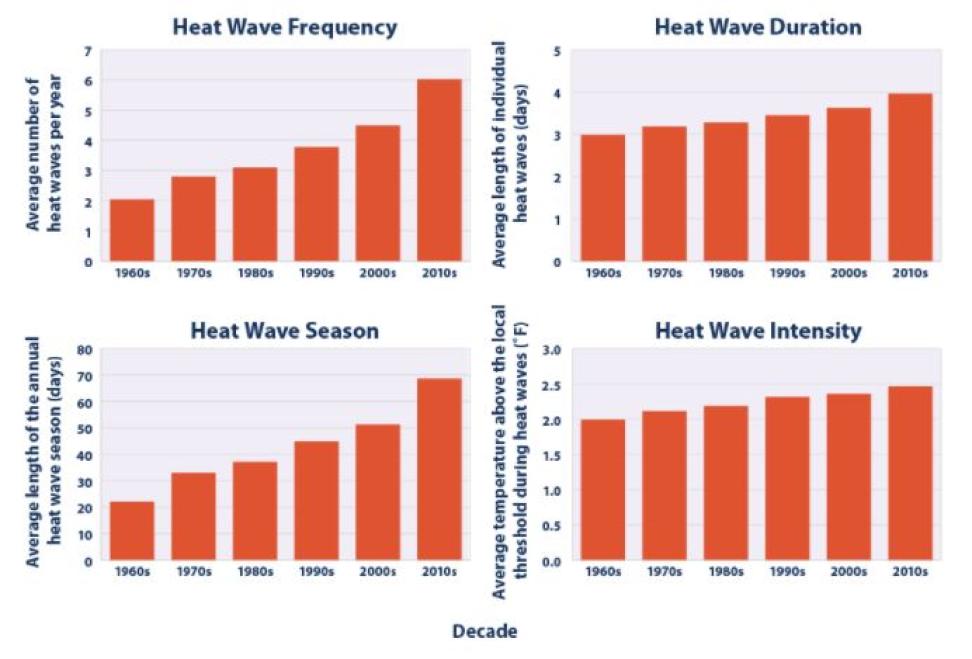
Daily health in a hotter world
Heat affects the mind in other ways, too. People have trouble thinking clearly once temperatures reach 89.6 F (32 C), a study that administered math and verbal reasoning tests to 50,000 people in China found.
The number of days in the U.S. with heat indices over 100 F (37.8 C) is expected to double as soon as a decade from now, while the number of days with heat indices over 105 F (40 C) is expected to triple. The heat index is a measure of what the temperature feels when taking into account air temperature and relative humidity. The more humid the air, the harder it is for the body to cool off by sweating.
Nearly nine in 10 U.S. households have air conditioning, but that doesn't mean Americans are immune to heat waves. The 2024 study in China found that even short-term exposure to extreme heat — on the order of an hour in a couple of days — can cause small declines in math and verbal test scores, indicating some degree of mental sluggishness in hot weather.
The effects of heat can be exacerbated by outdoor exercise. (Image credit: FG Trade via Getty Images)
Hotter days may drive people indoors, potentially worsening physical and mental health. Exercising outdoors may provide a mental health boost above and beyond exercising indoors. The data is limited by research designs that don't always follow rigorous methods, but losing outdoor exercise opportunities could mean a slide in physical fitness even if people switch to indoor workouts. For example, cancer survivors randomly assigned to indoor and outdoor exercise worked harder when exercising outside, according to one 2020 study. Likewise, teen boys with obesity prescribed playful exercise outside lost more weight and saw greater increases in a molecule that regulates appetite and wakefulness than those who were assigned to use a treadmill indoors, a 2019 study found. People also reported more satisfaction with outdoor exercise versus indoor exercise, which might influence their willingness to keep working out.
Hot days could also curtail kids' sports, which are often played outdoors. In Japan, summer outdoor youth sports in much of the country might need to be restricted for one to four months a year, even under lower-warming scenarios; similar issues could crop up in much of the U.S., which sits at approximately the same latitude as Japan.
Overall, studies find a U-shaped relationship between obesity and temperature, with higher body mass index (BMI) in the coldest and hottest places. One study in Australia found that regular exposure to temperatures above 86 degrees F (30 degrees C) was associated with increases in BMI and obesity.
Adapting to extreme heat
People do adapt to warmer temperatures over weeks or months through physiological changes, as their sweat glands become more efficient and their water retention increases. The cognition study conducted in China found that people who lived in climates that were warmer on average were more resistant to declining test scores in the face of warmer temperatures, perhaps indicating that these physiological changes have practical impacts.
However, extreme heat — and short-term spikes — outpace the human body's ability to adjust, as the increases in heat-related deaths already measured between 1999 and 2023 attest. Likewise, kids are already suffering, especially those in the South where temperatures are highest. A study of two major hospitals in Texas found a 170% increase in pediatric emergency department visits for heat-releated illness between 2012 and 2023.
What works to reduce the impacts of extreme heat is an open question, said Marshall Burke, a professor of global environmental policy at Stanford University. Cities often open cooling centers during heat waves, which may save lives, but whether they do enough hasn't been well studied, he told Live Science.
To try to answer that question, Burke and his colleagues have put together a website, the Environmental Hazard Adaptation Atlas, to pull together data on temperature, heat-related illness and death, and what adaptations might help.
"We need good case studies of what things have worked," he said. "We need good systematic evidence."





 Bengali (Bangladesh) ·
  English (United States) ·