

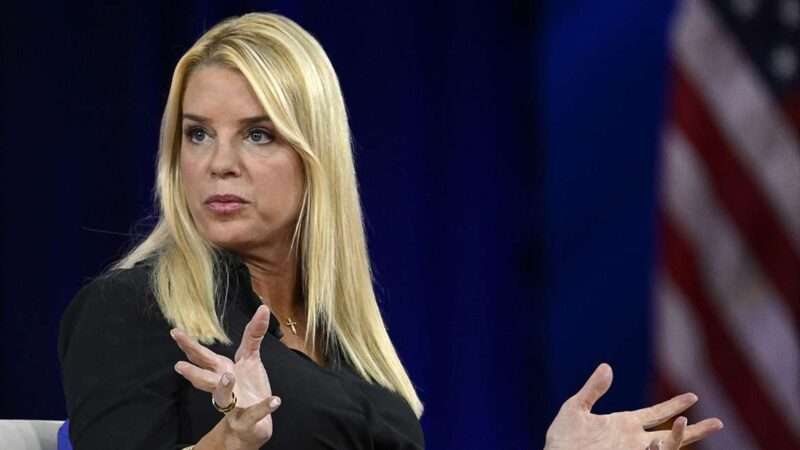
Bondi out. Yesterday, after months of private complaints and rumors of tension, President Donald Trump ousted Attorney General Pam Bondi, saying that she will be taking a job in the private sector. It's not clear what the new job will be. Bondi's deputy, former Trump lawyer Todd Blanche, will take over the Justice Department in an acting capacity. Environmental Protection Agency chief Lee Zeldin is reportedly being looked at as a possible replacement.
The most straightforward way to understand Bondi's departure is to return to an unusual Truth Social post by Trump from September of last year. The post, directed to "Pam," was reportedly intended as a private direct message, and it gives an idea of what Trump was thinking and saying behind the scenes. The post urged the then-A.G. to move more quickly to prosecute Trump's political enemies, including Sen. Adam Schiff (D–Calif.) and New York Attorney General Letitia James. "We can't delay any longer, it's killing our reputation and credibility," Trump wrote. "They impeached me twice, and indicted me (5 times!), OVER NOTHING. JUSTICE MUST BE SERVED, NOW!!!"
Bondi used Justice Department muscle to pursue investigations into Trump's enemies, but it wasn't enough for Trump. As Politico notes, "Trump's second term has been marked by an unprecedented assertion of executive power. But that hasn't translated into the cascade of criminal prosecutions Trump has long demanded against his enemies."
The president saw Bondi as "weak and ineffective," according to The Wall Street Journal, because she hadn't successfully prosecuted his foes. Trump views the Justice Department as a vehicle for his personal grievances; he felt Bondi wasn't aggressive enough in driving that vehicle.
As Reason's Joe Lancaster wrote yesterday, Bondi's handling of the Epstein files was also a factor.
But even if you set aside her efforts to pursue Trump's personal grievance agenda, Bondi was not exactly a champion of American freedom, especially on issues related to speech.
She suggested that it was legal to prosecute an Office Depot employee for declining to print flyers for a Charlie Kirk memorial vigil. She made utterly bogus claims about hate speech. She once suggested that "domestic terrorists" could be characterized in part by "extreme viewpoints on immigration, radical gender ideology, and anti-American sentiment."
Bondi was simply unmoored from any sort of coherent constitutional view of freedom of expression. That's worrying for any law enforcement official, and especially dangerous when that person is the attorney general. Federal officials should be in the business of protecting American rights and freedoms, not misconstruing them.
Tariff man. Yesterday was the one-year anniversary of what Trump once referred to as "Liberation Day"—the start of his sweeping, and often shifting, tariff regime. The initial justification for those tariffs was struck down by the Supreme Court, but Trump has plowed forward with new (also dubious) legal arguments—and new tariffs.
Yesterday, he announced that he would place tariffs up to 100 percent on some brand-name drugs, and would make further adjustments to existing tariffs on steel and aluminum. These are the first significant changes to Trump's tariff regime since the Supreme Court ruling in February.
The details are somewhat complicated. As The Wall Street Journal reports, "the consequences of the tariff changes will vary widely depending on the product." It's an understatement to say that the words "consequences" and "will vary widely" are not exactly what businesses want to hear right now.
It is worth reiterating that the sheer confusing complexity, combined with the uncertainty of constantly shifting policies, of these tariffs has been a big part of what has made these levies so costly and burdensome. When tariff policy changes repeatedly and without warning, it's very difficult for businesses to plan.
Higher costs get passed off to consumers, and trade pipelines slow down or break down. America is deeply enmeshed in the global economy; Trump's trade policies have mostly served to gum up the works.
Tech bro$. Tech industry-focused podcast TBPN sold to OpenAI, the company behind ChatGPT, for an undisclosed sum. The Financial Times reports the sale was in the "low hundreds of millions." Reports say the deal allows TBPN to maintain full editorial independence.
The podcast, which began in 2024, broadcasts live for three hours every weekday. It has a relatively modest audience but has become influential inside the world of frontier, big-money tech, in part because it's perceived as more friendly to new tech and business building than other tech-focused outlets.
It's boosterish at times, but it's also fun, informative, and most importantly, optimistic—not just about tech, but about business and capitalism more generally.
I'm a casual fan and admirer of the show, and it's pretty clearly a response to the militantly anti-tech, anti-business attitude that so many tech-and-business-focused publications have taken over the last 15 years or so.
The show's core premise is: What if we covered technology—but didn't utterly loathe technology and everyone who makes it? Sounds crazy, but it works.
Scenes from Washington, D.C.: In January, a D.C.-area sewer line failed, resulting in a massive spill of untreated wastewater into the Potomac. D.C. Water, the utility responsible for the pipe, had previously noticed corrosion and applied to fix the sewer line.
But a Washington Post investigation finds that the project was delayed multiple times "as federal officials studied potential environmental impacts, including risks to a blue wildflower and an endangered bat species." In short, a prolonged and politicized environmental review process made it impossible to prevent an environmental disaster.
QUICK HITS
In March, U.S. employers added 178,000 jobs, according to this morning's jobs report. The unemployment rate ticked down to 4.3 percent. It's a strong result for an economy that has recently struggled with hiring. The White House wants $1.5 trillion for defense spending. If approved, according to The New York Times, that would be the highest amount in modern history. Roughly a quarter of Americans are so-called "double haters" who view both parties poorly. But when it comes time to vote, many of those haters still end up making a choice. A new CNN poll finds that "voters in that group prefer the Democrats in the upcoming midterms by 31 points." Is big tech shifting from software to hardware? Trump is reportedly frustrated with other members of his cabinet, including Commerce Secretary Howard Lutnick. A planning commission approved Trump's White House ballroom plans, but there are still legal hurdles following this week's judicial ruling that Congress must approve further construction. Also, the ballroom apparently sits atop a giant military bunker. Secretary of Defense Pete Hegseth fired the Army's top general, along with two others. The photos coming out of the Artemis II space mission are pretty incredible.The post Bye-Bye, Bondi appeared first on Reason.com.





 Bengali (Bangladesh) ·
  English (United States) ·