
 1 hour ago
6
1 hour ago
6 
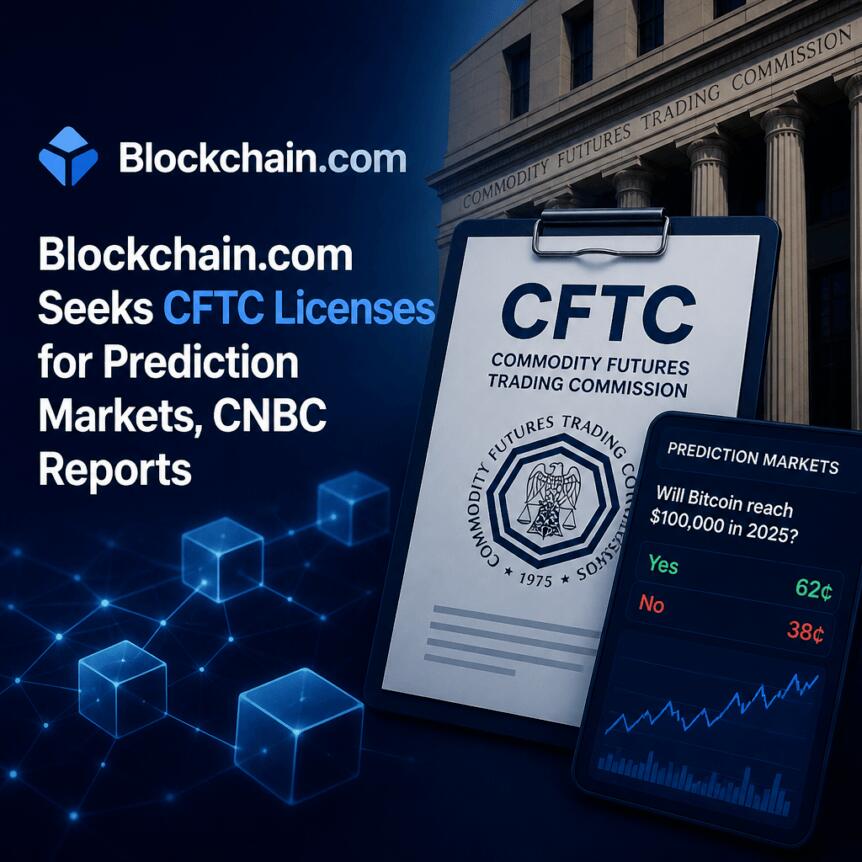
Blockchain.com has reportedly taken steps with the U.S. Commodity Futures Trading Commission (CFTC) to expand into prediction-market products and crypto derivatives—an effort that would bring the company deeper into a regulatory track often dominated by traditional market structures.
According to CNBC, the platform has filed for two CFTC licenses: one to operate as a designated contract market (DCM) for event contracts, and another to function as a futures commission merchant (FCM) for certain derivatives. If approved, Blockchain.com would be able to run a regulated U.S. venue not only for event-based offerings, but also as a broker for crypto derivatives contracts for both retail and institutional participants.
Key takeaways
Blockchain.com reportedly filed with the CFTC for both a DCM license (event contracts) and an FCM license (derivatives brokerage). The filings, if granted, could allow Blockchain.com to offer its own prediction market-style marketplace for event contracts in the U.S. The move comes as U.S. legal scrutiny of prediction markets—especially platforms tied to sports and election wagers—continues in court. CFTC Chair Michael Selig is pushing for crypto rulemaking centered on investor protection, citing the collapse of FTX.Why Blockchain.com’s CFTC filings matter
The core of the reported application is regulatory access to two different roles under CFTC oversight. A DCM license would position Blockchain.com to operate a futures exchange-like venue for “event contracts,” while an FCM license would allow it to broker derivatives contracts—typically within the CFTC’s framework for regulated derivatives markets.
For market participants, this matters because prediction-market products and crypto derivatives have not had a uniform, settled regulatory lane across the U.S. Instead, projects have often navigated a patchwork of enforcement decisions and legal arguments about whether certain offerings should be treated as commodities, contracts of sale, or otherwise regulated instruments.
Blockchain.com has previously signaled interest in the prediction market space via integration plans. In July, it announced it would partner with Polymarket for prediction markets integration on its app. The reported CFTC filings suggest a potentially different—more self-directed—path: building a regulated, on-platform marketplace for event contracts, rather than relying only on third-party prediction market infrastructure.
Prediction markets face an enforcement and jurisdiction test
Blockchain.com’s push lands in the middle of an ongoing U.S. debate over who regulates prediction market platforms and how. Oversight and enforcement questions are being tested in court, including cases where state-level authorities have argued that prediction markets violate state laws related to betting on sports and elections.
Earlier this year, New Jersey officials filed a petition with the U.S. Supreme Court regarding their dispute involving Kalshi. Coverage from Cointelegraph noted that the petition asks the high court to weigh in on the case, which could help resolve tensions between federal and state regulatory authority over certain event contracts. That case is significant for the broader sector because the outcome could influence how other platforms structure or offer event-based products in the U.S.
In that context, the CFTC license application reflects a strategic bet: that federal derivatives and commodities regulation may provide a more predictable route for prediction-market offerings, particularly if the CFTC’s view of its jurisdiction holds.
CFTC Chair Selig ties the agency’s crypto rule push to FTX
While Blockchain.com seeks permission to operate under CFTC licensing, the regulator’s broader approach is still actively evolving. This week, CFTC Chair Michael Selig publicly defended the agency’s emphasis on rulemaking rather than waiting for new legislation passed by Congress.
As reported in connection with a Wednesday Fox Business interview, Selig cited the FTX collapse when explaining why the CFTC is pursuing safeguards for the crypto spot market ecosystem. He argued that proposed rules for firms seeking to register as licensed crypto businesses would provide “safeguards,” linking that stance to the failures that led to major customer harm during FTX’s downfall.
On Friday, Selig also posted that the agency’s rules would prevent “theft of customer funds as we saw with FTX,” continuing a theme of investor protection at the center of the CFTC’s crypto agenda.
Selig remains the CFTC’s sole chair and commissioner, with four agency seats still empty as of Friday, according to the reporting in the source. He has previously said he intends to implement President Donald Trump’s crypto policy direction and has claimed that the CFTC has exclusive jurisdiction over prediction markets—an assertion that becomes especially relevant when firms like Blockchain.com seek authorization to run event-contract products.
What to watch next for Blockchain.com
If Blockchain.com’s applications are approved, the company would be positioned to compete in a space where regulation, platform permissions, and legal risk have often been decisive factors for survival. Traders and users would likely focus on whether the company’s eventual event-contract offerings are launched with clear product boundaries under CFTC oversight, and how they handle compliance requirements that differ from unregulated prediction market experiences.
For the broader market, the next steps are twofold: regulators will need to decide on the specific licenses, and courts may further clarify how prediction markets can operate when state law challenges overlap with federal regulatory claims. Until those answers arrive, prediction-market participants should treat licensing as a meaningful development but not a final resolution to the sector’s legal uncertainty.
This article was originally published as Blockchain.com Seeks CFTC Licenses for Prediction Markets, CNBC Reports on Crypto Breaking News – your trusted source for crypto news, Bitcoin news, and blockchain updates.




 Bengali (Bangladesh) ·
  English (United States) ·