

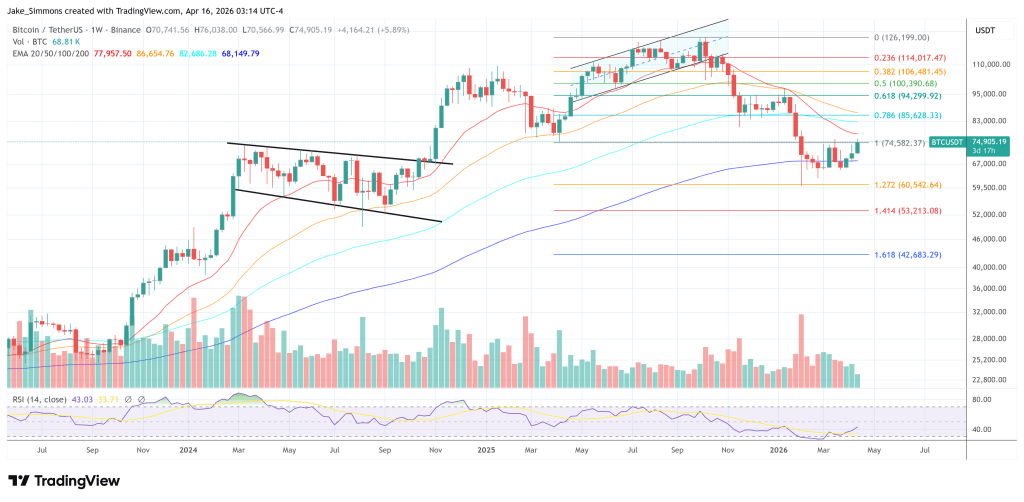
Bitcoin has climbed back toward a key on-chain resistance zone, but Glassnode says the move still looks more like a fragile rebound than the start of a fully convincing trend shift. In its latest The Week On-chain report, the analytics firm said Bitcoin was trading near $74,000, roughly 5.2% below the True Market Mean at $78,100, a level it framed as the market’s most important near-term test.
Glassnode’s central argument is that the market has improved enough to keep the rally alive, but not enough to remove the structural risks overhead. Spot demand has recovered, ETF flows have turned positive again, and institutional exposure is beginning to rebuild. Even so, profit-taking is rising, derivatives positioning remains cautious, and participation is still uneven across venues and investor groups.
Glassnode Flags A Fragile Bitcoin Rally Near Major Resistance
The report said Bitcoin “has gradually trended higher, now trading near $74k, approximately 5.2% below the True Market Mean, tracing the cost basis of active supply.” It added that while price has not yet broken above that threshold and held it, “the probability of a spike toward and potentially above it remains considerable in the mid-term.” That leaves the market in an awkward position: close enough to resistance for traders to focus on a breakout, but not yet strong enough to suggest the ceiling has truly given way.

One of the main reasons Glassnode stops short of endorsing the move outright is the behavior of short-term holders. The firm highlighted the share of short-term holder supply in profit, which measures how much recently acquired supply is sitting on unrealized gains. Historically, local tops in bear market rallies have often formed as that figure approaches its statistical mean of around 54.2%. It currently stands at 43.2%.
That, according to the report, means the rally may still have some room to run before it reaches a more typical exhaustion zone. But it is also a reminder that Bitcoin is moving into an area where distribution pressure tends to build, especially if newer market participants start using strength to de-risk.
Glassnode sees that process already underway in broader realized profit-taking metrics. The 30-day EMA of the realized profit/loss ratio now sits at 1.16, a reading above 1 that signals realized profits are outpacing realized losses. In the firm’s words, “the current reading of 1.16 confirms that investors are broadly seizing the present rally as an opportunity to exit positions at breakeven or capture thin profit margins. While this is not an immediate reversal signal, a sharp spike in this ratio during a bear market rally has historically been a cautionary indicator of distribution rather than genuine demand recovery.”
That distinction runs through the entire report. The rebound is real, Glassnode suggests, but the character of the move still matters. For the rally to evolve into something more durable, the market would need to absorb selling pressure and establish support above $78,100, not merely trade up to it.
Off-chain data tells a similar story. Spot cumulative volume delta has improved sharply since February’s capitulation, but the demand profile remains selective. Binance-led buying has outpaced Coinbase, suggesting stronger participation from offshore and retail-driven segments than from the institutional cohort often associated with Coinbase flows. Glassnode called that divergence notable, arguing that sustained rallies typically need broader engagement from both sides of the market.
Institutional proxies have also improved, albeit cautiously. CME futures open interest has started rebuilding from local lows, and US spot ETF assets under management have turned higher after a stretch of outflows. Still, neither series has returned to previous highs, which Glassnode said points to “a more cautious re-engagement, rather than a full risk-on shift.”
In derivatives, the firm found little evidence of strong directional conviction. Funding rates remain broadly balanced, implied volatility has compressed across the curve, and 25-delta skew continues to favor puts over calls, even if the tilt has softened from more defensive extremes. In plain terms, traders have reduced some of their stress hedging, but they have not rotated aggressively into upside exposure either.
Hyperliquid liquidation data reinforces that picture of a reactive market. Dense long liquidations sit between $63,000 and $65,000, while short liquidation clusters are concentrated around $74,000 to $76,000. Recent price action has repeatedly interacted with those zones, suggesting flows and liquidation mechanics are still shaping the range more than strong underlying conviction.
Glassnode also flagged dealer positioning as a key near-term market structure factor. A large pocket of negative gamma between $74,000 and $76,000 could amplify moves if spot continues higher, turning what might look like resistance into an area where hedging flows accelerate price. Even so, the report stops well short of declaring a breakout regime.
The result is a market that looks healthier than it did during the February washout, but still far from settled. Bitcoin bulls may have a clear target in $78,000, yet Glassnode’s message is that reclaiming it will require more than momentum alone. It will take sustained inflows, deeper institutional participation, and enough real demand to absorb the profit-taking now building into strength.
At press time, BTC traded at $74,905.





 Bengali (Bangladesh) ·
  English (United States) ·