

When the state is so big and intrusive that people need its permission to do everything from building a house to merging businesses, it's easy for the lines to blur between conversations in which government officials merely voice preferences and those in which they twist arms to get their way. That creates room for partisans to defend "jawboning"—government bullying of private parties to do what officials won't or can't do themselves—as nothing more than casual chats.
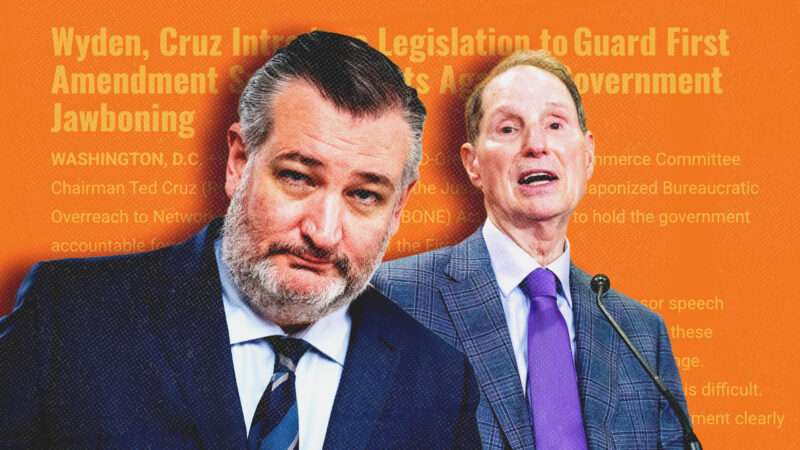
The best way to handle jawboning is to strip government of power so it has little coercive leverage, and we should always work to do just that. Another good approach, embodied in legislation cosponsored by Sens. Ted Cruz (R–Texas) and Ron Wyden (D–Ore.), is to make it easier to monitor government communications with private parties and to punish officials who cross the line.
Leveling the Playing Field Against Government Pressure
"Nearly all of Americans' speech—including TV news, online streams and social media—flows through private corporations that are highly susceptible to government pressure. Regular Americans can't count on those companies to stand up to government jawboning, they need a way to level the playing field," Wyden said while announcing the Justice Against Weaponized Bureaucratic Overreach to Networked Expression Act (JAWBONE) Act.
Being a Democrat, Wyden cites concerns around the Trump administration "threatening cable companies because he doesn't like their late-night shows." Cruz, a Republican, cautions that "the Biden administration weaponized the Cybersecurity and Infrastructure Security Agency to pressure Big Tech into 'canceling' Americans who spoke out against vaccine mandates and election fraud."
That both have credible complaints about the misbehavior of officials from both major parties shows that jawboning is a concern for everybody, and their proposed legislation demonstrates a bipartisan willingness to rein in abuses that cross party lines. It's past time to address the problem, since politicians are increasingly comfortable using regulatory power to coerce private parties into bypassing constitutional protections for individual liberty.
"In America, government censorship is limited by the First Amendment," the Cato Institute's Will Duffield wrote in 2022. But "government officials can use informal pressure—bullying, threatening, and cajoling—to sway the decisions of private platforms and limit the publication of disfavored speech. The use of this informal pressure, known as jawboning, is growing. Left unchecked, it threatens to become normalized as an extraconstitutional method of speech regulation."
Last September, the Senate Commerce Committee, of which Cruz is chairman, released a report which built on revelations in the Twitter files, the Facebook files, and more to conclude that the Biden administration used the Cybersecurity and Infrastructure Security Agency (CISA) as "an unaccountable censorship agency" that suppressed speech by leaning on social media platforms.
Cruz, to his credit, also criticized the Trump administration for pressuring ABC to muzzle Trump critic Jimmy Kimmel. He likened Federal Communications Commission Chairman Brendan Carr to "a mafioso coming into a bar going, nice bar you have here, it'd be a shame if something happened to it," which captures the essence of jawboning.
Improved Transparency and Lawsuits Against Government Bullies
Cruz and Wyden want to address this sort of misbehavior no matter who is in office by creating greater transparency and allowing lawsuits for government bullying.
"The JAWBONE Act would create a cause of action against any government agency or employee that engages in jawboning, regardless of whether the censorship succeeds, and allow plaintiffs to seek monetary damages. It would also require agencies to submit to Congress certain communications with companies, ultimately strengthening oversight and accountability," according to a press release from the senators.
The text of the bill acknowledges that "not all government communication to a private speech platform is coercive," so it proposes to subject such communications to reporting requirements and scrutiny. The bill also specifies that "it shall be unlawful for an agency, or an officer or employee of the United States under color or pretense of office or employment, to coerce or attempt to coerce a broadcaster, a provider of an interactive computer service, or a provider of an artificial intelligence system within the United States (including the territories of the United States) for the purpose of, or if a reasonable person would understand the coercion or attempted coercion to be for the purpose of, incentivizing the broadcaster or provider to take a content action."
Restrictions on Government Should Appeal Across Party Lines
That wouldn't fully preclude back-channel arm-twisting. But it would clarify that such efforts violate the law and create grounds for legal action.
"Jawboning isn't a hypothetical, rare, or partisan problem," commented Carolyn Iodice, Legislative and Policy Director for the Foundation for Individual Rights and Expression (FIRE), which endorses the bill. "It threatens the rights of anyone who uses social media or AI platforms. But there's currently little to no recourse for victims to fight back against this pernicious kind of censorship. The JAWBONE Act fixes that."
"Government officials are free to speak, persuade, inform the public, and enforce the law. What they cannot do is use threats or regulatory power to coerce private intermediaries into suppressing protected speech," agreed Nadine Farid Johnson, policy director at the Knight First Amendment Institute. "The JAWBONE Act would create an important mechanism for accountability when government jawboning crosses the constitutional line, and we appreciate the leadership of Senators Cruz and Wyden in introducing this bill."
What's encouraging about the JAWBONE Act is that it restricts the federal government across the board, without regard to who is in office. Supporters of the bill don't have to agree on whether Democrats or Republicans pose the greater threat to free expression; they just have to concur that government officials shouldn't be able to bypass First Amendment protections by bullying third parties. That's a point on which everybody who claims to believe in free speech should be able to agree. We'll see if they do.
The next step, of course, is to strip government of the coercive power to grant and withhold favors, to regulate, and to punish—everything that makes jawboning threats credible. A transparent government subject to rules is good. A defanged and less dangerous government is even better.
The post Bipartisan JAWBONE Act Targets Government Censorship Threats appeared first on Reason.com.



 Bengali (Bangladesh) ·
  English (United States) ·