
 1 month ago
25
1 month ago
25 
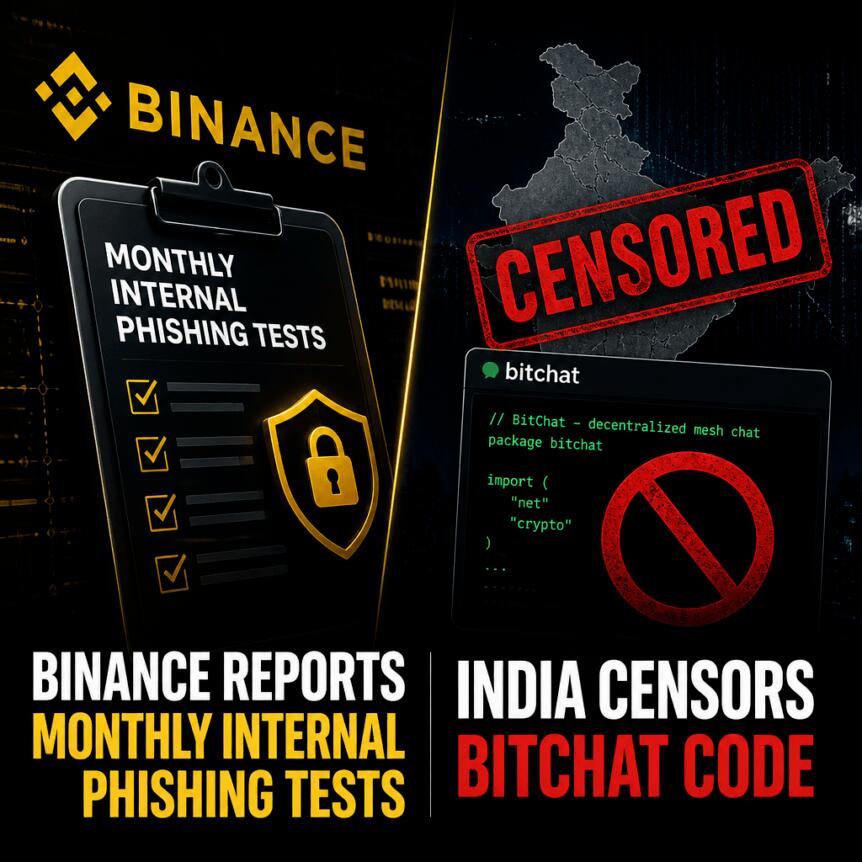
Binance says it has been running simulated phishing attacks on its own staff every month for the past four years, using the results to measure whether its security practices are improving. The exchange’s chief security officer, Jimmy Su, told Cointelegraph that the internal “red team” carries out the exercises and that employees who repeatedly fail may be sent for remediation training.
Meanwhile, the crypto sector also faces policy and compliance pressures across Asia: an Internet rights group in India challenged a government-backed order to remove repositories related to Jack Dorsey’s BitChat, while other developments—from stablecoin payment pilots in the Philippines to shifting retail behavior in South Korea—highlight how technology adoption and regulation are moving in parallel.
Key takeaways
Binance conducts monthly internal phishing tests via its red team and uses the outcomes to trigger remediation training. India’s Internet Freedom Foundation says a recent order to GitHub to disable BitChat repositories is unconstitutional and threatens open-source and free speech. CoinShares-related social-engineering concerns remain in focus, with prior industry estimates suggesting a large share of crypto incidents are driven by manipulation rather than pure technical exploits. South Korea’s five largest crypto exchanges reported a sharp year-over-year drop in combined trading volume, despite growth in equities. Several countries are exploring real-world payment use cases for stablecoins and blockchain rails, even as governance scrutiny tightens.Binance uses internal phishing drills to test security hygiene
According to Cointelegraph, Binance’s security approach includes ongoing, controlled attempts to trick employees with phishing-style tactics. Jimmy Su, Binance’s chief security officer, said the company runs these exercises “on a monthly basis” to determine whether day-to-day security hygiene is improving.
The tests are carried out by Binance’s internal ethical hacking unit—its “red team”—which is tasked with breaking into systems in order to identify vulnerabilities. Su said employees who fail the phishing simulations are not simply tracked; they are expected to undergo remediation training.
The broader relevance is that attackers often target human behavior rather than exploiting only software bugs. In February, AMLBot estimated that 65% of crypto security incidents in 2025 were driven by social engineering, underscoring why organizations have increasingly prioritized employee training alongside technical controls. (AMLBot estimate referenced by Cointelegraph: https://cointelegraph.com/news/amlbot-2025-crypto-incidents-social-engineering-phishing-impersonation)
India challenges GitHub takedown order over BitChat repositories
In India, the Internet Freedom Foundation (IFF) condemned a government order directing GitHub to remove or disable repositories related to BitChat, describing the move as unconstitutional. The group warned that the decision could undermine free speech and the open-source ecosystem.
IFF’s statement, according to Cointelegraph, followed a cybercrime agency directive that ordered GitHub to disable access to three BitChat repositories within three hours. The agency’s rationale was that BitChat could be used to bypass internet shutdowns, evade lawful surveillance, and facilitate unlawful activities.
BitChat is described as a decentralized messaging app designed to route encrypted messages between nearby devices over Bluetooth, without relying on internet connectivity or centralized servers. Cointelegraph also noted that since BitChat’s July 2025 release, it has gained traction during periods of unrest and internet outages in countries including Madagascar, Nepal, Uganda, Jamaica, and Iran. (Cointelegraph links referenced by the original report: https://cointelegraph.com/news/jack-dorsey-launches-bluetooth-relayed-decentralized-messaging-app-bitchat, https://cointelegraph.com/news/48000-nepalis-install-jack-dorseys-bitcoin-amid-protests, https://cointelegraph.com/news/bitchat-second-ranked-app-jamaica-as-hurricane-strikes, https://cointelegraph.com/news/decentralized-messaging-adoption-global-unrest)
For developers and users, the dispute raises a familiar tension in crypto and open-source technology: platforms and code repositories can become collateral in broader concerns about communications infrastructure and governance. What remains to be seen is whether GitHub’s handling of the order, and any potential legal challenge in India, changes how decentralized tools are distributed—or whether similar requests spread to other repositories.
Retail crypto interest cools in South Korea while equities surge
Separately, South Korea’s crypto trading activity has deteriorated sharply even as its stock market climbed. Cointelegraph reports that the combined trading activity across five major won-based exchanges—Upbit, Bithumb, Coinone, Korbit, and Gopax—fell by 89% year over year.
The figure comes from Cointelegraph’s review of CoinGecko’s historical 24-hour volume readings. The comparison used seven-day averages in July 2025 versus July 2026. On a combined basis, average daily volume declined to $305 million from $2.82 billion over the comparable July 2025 period.
Cointelegraph also stated that the KOSPI benchmark more than doubled during the same stretch. While volume has dropped for crypto, the divergence suggests that some retail liquidity may be rotating toward stocks—or that risk appetite and participation in crypto are being influenced by factors beyond token prices alone, such as market structure or broader macro sentiment.
Traders and investors watching South Korea will likely want to focus on whether this pattern persists beyond July and whether exchange-level initiatives or regulatory developments affect participation. The next question is whether lower volumes reflect temporary sentiment shifts or a more durable change in retail allocation decisions.
Stablecoin rails and exchange restructures signal continued build-out
Beyond security and policy disputes, adoption-oriented developments continued. In the Philippines, the Bank of the Philippine Islands (BPI) plans a stablecoin-based settlement rail for cross-border payments to freelancers, virtual assistants, and other workers receiving overseas income. Cointelegraph reports that the project is being developed with Meridian, with the intent to reduce processing cost and time while retaining safeguards associated with traditional banking transactions.
According to Cointelegraph’s reporting, stablecoins would be used as a settlement instrument before funds are converted to Philippine pesos and credited to recipients’ BPI accounts. (Cointelegraph referenced coverage from ABS-CBN and Philippine Daily Inquirer.)
In Singapore, Coinbase is also reported to be expanding its local presence, planning to grow headcount from 150 to about 200 staff members by the end of 2026 and prioritizing roles including engineers and institutional sales. Cointelegraph cited comments from Hassan Ahmed, Coinbase’s country director for Singapore, to the Business Times about the city-state’s role as a strategic hub for crypto innovation. (Cointelegraph referenced link: https://www.businesstimes.com.sg/singapore/coinbase-expand-singapore-operations-grow-headcount-200-despite-global-restructuring)
Elsewhere in Asia, HashKey Holdings said it has merged HashKey Exchange and HashKey Global into a single platform and application, with the goal of giving users a consistent app experience while compliance is managed through local regulatory frameworks. (Cointelegraph link referenced: https://cointelegraph.com/news/hong-kong-crypto-giant-hashkey-merges-its-exchanges-into-one)
Taken together, these stories point to a sector split between defensive maturity—like Binance’s ongoing internal phishing drills—and front-of-house expansion, such as stablecoin payment settlement testing and exchange platform consolidation. The common thread is governance: whether it’s security enforcement inside companies, repository access decisions by governments, or compliance-heavy product rollouts in banking systems, the “how” of crypto adoption is increasingly as important as the “what.”
For the weeks ahead, watch how India’s BitChat repository dispute develops and whether it affects other open-source or decentralized tools, while South Korean trading volume trends indicate whether retail activity is temporarily shifting or settling into a new baseline.
This article was originally published as Binance Reports Monthly Internal Phishing Tests; India Censors BitChat Code on Crypto Breaking News – your trusted source for crypto news, Bitcoin news, and blockchain updates.





 Bengali (Bangladesh) ·
  English (United States) ·