
 8 hours ago
2
8 hours ago
2 

For more than 30 years, Representative Barney Frank was one of the nation’s most visible liberal lawmakers.
The Massachusetts Democrat who died earlier this year was the first member of the House to come out publicly as gay, and the first in Congress to marry a same-sex partner. He fought for funding to combat AIDS, helped end the ban on openly gay members in the military (the policy known as “Don’t Ask, Don’t Tell”), and pushed to pass legislation expanding the federal definition of hate crimes to include acts based on gender, sexual orientation, and disability.
Frank also led the biggest overhaul of the nation’s financial system since the New Deal. In the aftermath of the 2008 financial crisis, he brought a renegade banking industry to heel as co-author of the eponymous Dodd-Frank Wall Street Reform and Consumer Protection Act. Among other reforms, the legislation tightened federal oversight and created the Consumer Financial Protection Bureau (which the Trump administration has tried to dismantle).
Given his legacy of tenacious advocacy to advance progressive ideals, the opening of Frank’s posthumous new book is jarring:
Mea culpa.
This book seeks to undo the damage inflicted by a tragic historical irony. Well-intentioned but deeply flawed choices made by those most deeply committed to liberal values—my fellow and sister members of the democratic left—are largely responsible for the political strength that xenophobic populism has come to enjoy in the developed world.
Frank, who died in May at age 86, had begun to hint at his repudiation of the left when he entered hospice care this spring for congestive heart failure and revealed to journalists he was writing a final polemic. (The Atlantic called Frank’s stand against his party’s progressive wing a “second coming-out.”) The result is a slim volume: The Hard Path to Unity: Why We Must Reform the Left to Rescue Democracy.
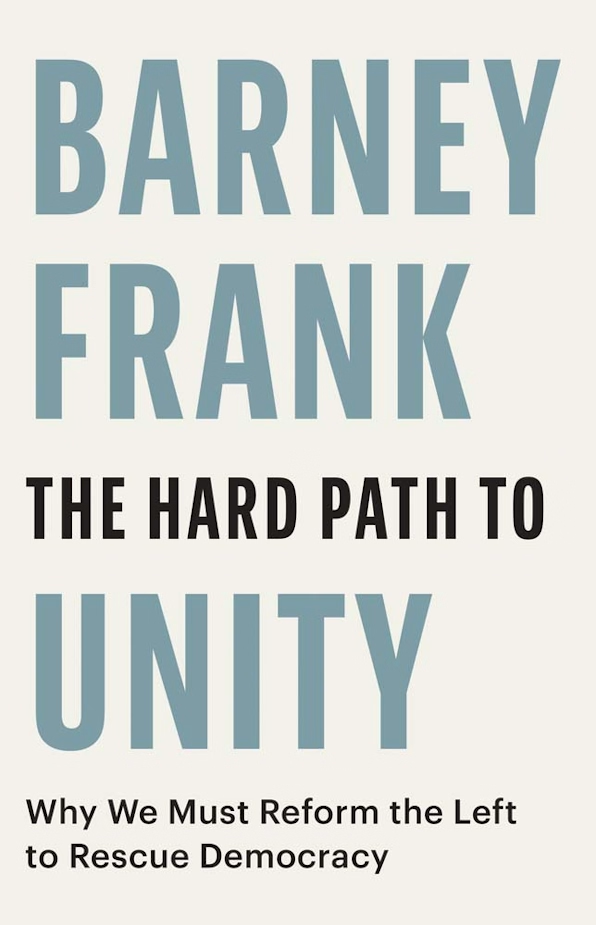 The Hard Path to Unity: Why We Must
 Reform the Left to Rescue Democracy
by Barney Frank. Yale University Press,
144 pp.
Written in the blunt and acerbic style that defined his political persona, The Hard Path to Unity is an unsparing and timely indictment of the ascendant left that all liberals would do well to read—and heed. Left unchallenged, Frank warns, left-wing dominance of the Democratic Party will doom it to political failure, thereby leaving Trumpist populism unchecked. Through its insistence on unrealistic ideals (and its ironic intolerance of differing viewpoints), Frank argues that progressives risk losing everything they purport to champion. Especially counterproductive, he writes, is the left’s vociferous advocacy of proposals like the Green New Deal and Medicare for All, which he characterizes as “voter repelling.”
Not that the center escapes unscathed. In Frank’s view, the original sin belongs to “establishment” centrists, whose policies helped set Trumpism in motion in the first place. During the 1990s, moderates like President Bill Clinton rushed to embrace globalization and free trade without sufficient care for the Americans left behind. “The mainstream insisted that tackling the problem of inequality should be deferred until pro-globalization policies were entrenched,” he writes. The ensuing catastrophic loss in manufacturing jobs—coupled with rising prosperity for the urban and well-educated—catalyzed white working-class resentment. But while the left correctly identifies the problem, Frank argues, its diagnosis and remedies are flawed—intellectually, ideologically, and tactically.
Frank finds the entire premise of the leftist cause logically sloppy: It conflates economic grievance with social injustice and assumes solidarity based on common victimhood. But as Frank points out, experiencing racism is not the same as losing a job to NAFTA. Though the “arithmetic is impeccable,” Frank writes, “the differing causes of each group’s victimization mean that different and sometimes conflicting remedies are required to reach the sections of the two cohorts that fall outside the overlap area in their Venn diagram of discontent.”
Policies like the Green New Deal, for instance, demand yet more sacrifice from working-class Americans who feel that they’ve already lost plenty, thereby deepening their anger instead of mollifying it. The same goes for ideas like “Defunding the Police” and “Open Borders” (to use Frank’s familiar taxonomy), which aggravate working-class anxieties of a society under siege. “As it has been executed by its advocates, the leftward-most strategy deepens the fault lines that separate those discontented with democracy due to economic disparities from those who are primarily upset and motivated by reasons related to social justice,” Frank writes.
He reserves his harshest condemnation for the ideological rigidity of the left and its penchant for firebombing candidates not in lockstep with their agenda:
If there were to be a competition for the dumbest, most counterproductive voting behavior in American history since secession in 1861 … a strong case can be made for awarding first place … to voters who rejected [Kamala] Harris out of a conviction that the Biden administration did too little to combat climate change.
Leftist suppression of robust debate, Frank argues, is both substantively and tactically shortsighted. First, by tarring all critics as “sell-outs” beholden to the rich, the left cuts off avenues for productive discussion and the development of new ideas. “Intra-party debates about the merits of various policy proposals or the mood of the electorate get displaced by attacks on each other’s motives, intensified by the familiar human propensity to react more angrily to heresy than to outright disbelief,” he writes.
Second, the insistence on ideological conformity is a recipe for political suicide. Leftist fury has cowed many moderates into silence, for fear of inflaming internal divisions that weaken the overall cause against the right. But this, Frank argues, has had exactly the effect that party leaders had hoped to avoid: It allows the left to define the party through the prism of its unpopular ideas. “The mainstream’s aversion to left-on-left debate has helped to convince many voters that keeping us out of power is their only defense against Medicare for All, the Green New Deal, Defunding the Police, Open Borders, and the rule of the pronoun police,” Frank writes. No wonder, then, that caricaturing Democrats as “Communists” has become Trump’s closing argument in the final weeks before this year’s elections.
Frank is not opposed to the values that the left represents or the outcomes it wants to see in a fairer, more equitable world. Rather, his primary objection is strategic: that the left has failed to do the hard work necessary to build popular support for its ideas:
Convinced, often correctly, that they were on the right side morally and also certain—usually incorrectly—that they enjoyed majority support, they skipped the step likeliest to bring fundamental social reform: presenting an aspirational list of reforms and then working to educate a skeptical public, accustomed to the status quo, of the benefits of change.
Frank’s solution is not to dismantle the left but to rehabilitate it. As a starting point, Frank argues, the left should leave aside its fondness for denouncing mainstream Democrats reluctant to adopt its ideas. It should also stop disparaging populism’s adherents in ways more likely to repulse than to convert. “Denunciations of the moral defects of populism’s supporters, no matter how soul-satisfying, do much more to reinforce those supporters’ commitment to their cause than induce them to rethink it,” he writes.
And instead of offering unrealistic proposals for radical change that frighten voters, Democrats need to offer ideas “that will enjoy strong political appeal, enhance moral values, and have very visible effects.” For instance, Frank writes, Democrats should propose raising taxes on people earning over $300,000 by exactly the amount needed to pay for reducing the age of Medicare eligibility to 60. He also argues for protecting the rights of vulnerable Americans through “shields” instead of “swords.” Protecting people from unfair discrimination, he argues, is politically easier than mandating equal treatment in ways that voters won’t accept:
If liberalism’s defenders show that the economic goals of growth and equity can be mutually reinforcing; that fundamental improvements in the fabric of society can be implemented in a politically acceptable way; and that we can profit from exploiting populism’s weaknesses as they have exploited ours, we will be able to preserve our most important values.
Rising firebrands on the left are likely to dismiss Frank’s book as just another cup of weak, incrementalist tea. And if social media followings were the only barometer of popular opinion, the appetite for dramatic change is voracious.
Frank’s record, however, speaks for itself. Through decades of advocacy and public persuasion, Frank transformed the politics of equality and improved millions of lives. He showed that the long arc of history does indeed bend toward justice—so long as it’s not forced to break.
The post Barney Frank’s Last Harsh Warning to the Left appeared first on Washington Monthly.




 Bengali (Bangladesh) ·
  English (United States) ·