

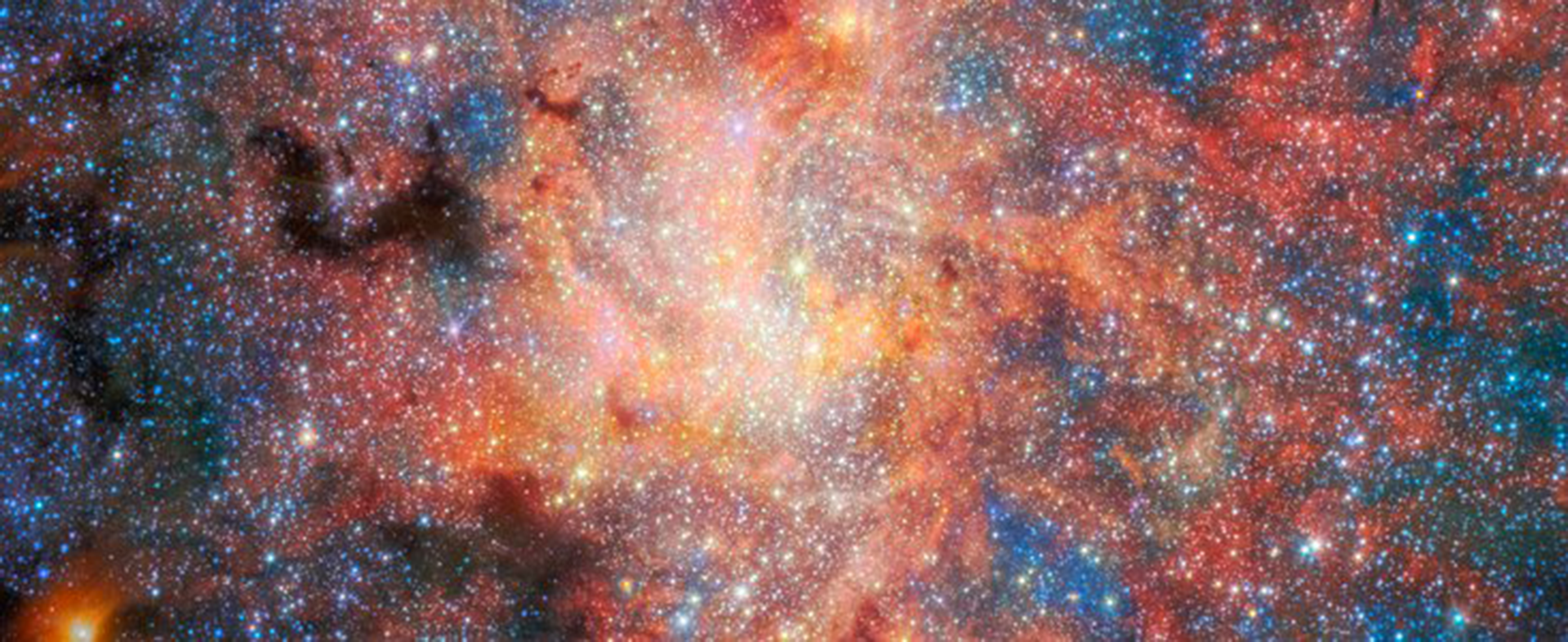
What it is: The region around the star IRS 3
Where it is: 26,000 light-years from Earth
When it was shared: Aug. 11, 2026
This mesmerizing image may look pretty, but it captures a hostile environment: the turbulent region surrounding a dying star close to our galaxy's central black hole.
This unprecedented view of the star IRS 3 (located near the center of the image) shows that it is shedding an enormous amount of material, gas and dust to build a sprawling envelope around itself. Within that star's envelope, scientists detected traces of water.
Although astronomers have detected water near other stars before, this is the first time it's been found this close to the Milky Way's supermassive black hole, known as Sagittarius A*.
The observations, described Aug. 11 in the journal Astronomy & Astrophysics, show that even in the harsh conditions surrounding a galaxy's central region, aging stars like IRS 3 may still be quietly seeding their surroundings with dust. That challenges the assumption that galactic centers are too extreme for this process to happen at all.
"The detection of water is especially exciting because it shows that molecular material can survive in an environment dominated by intense radiation," study co-author Macarena Garcia Marin, a researcher at the European Space Agency, said in a statement.
How the image was captured
The magical view was pieced together by combining data from the James Webb Space Telescope's (JWST) Near-Infrared Camera and Mid-infrared Instrument.
"This is the first time a continuous mid-infrared spectrum has been collected for this star, allowing us to detect the features from the silicate dust and uncover the star's true chemical identity," said Garcia Marin, who is also the principal investigator of the Mid-Infrared Characterization of Nearby Iconic galaxy Centers (MICONIC) program.
Another image shows where this star is located relative to Sagittarius A*: 0.55 light-years away.
This image shows the location of the star IRS 3 (Image credit: ESA/Webb, NASA & CSA, F. Peißker, J. Lu, F. Yusef-Zadeh, N. B. Sabha, C. Chan)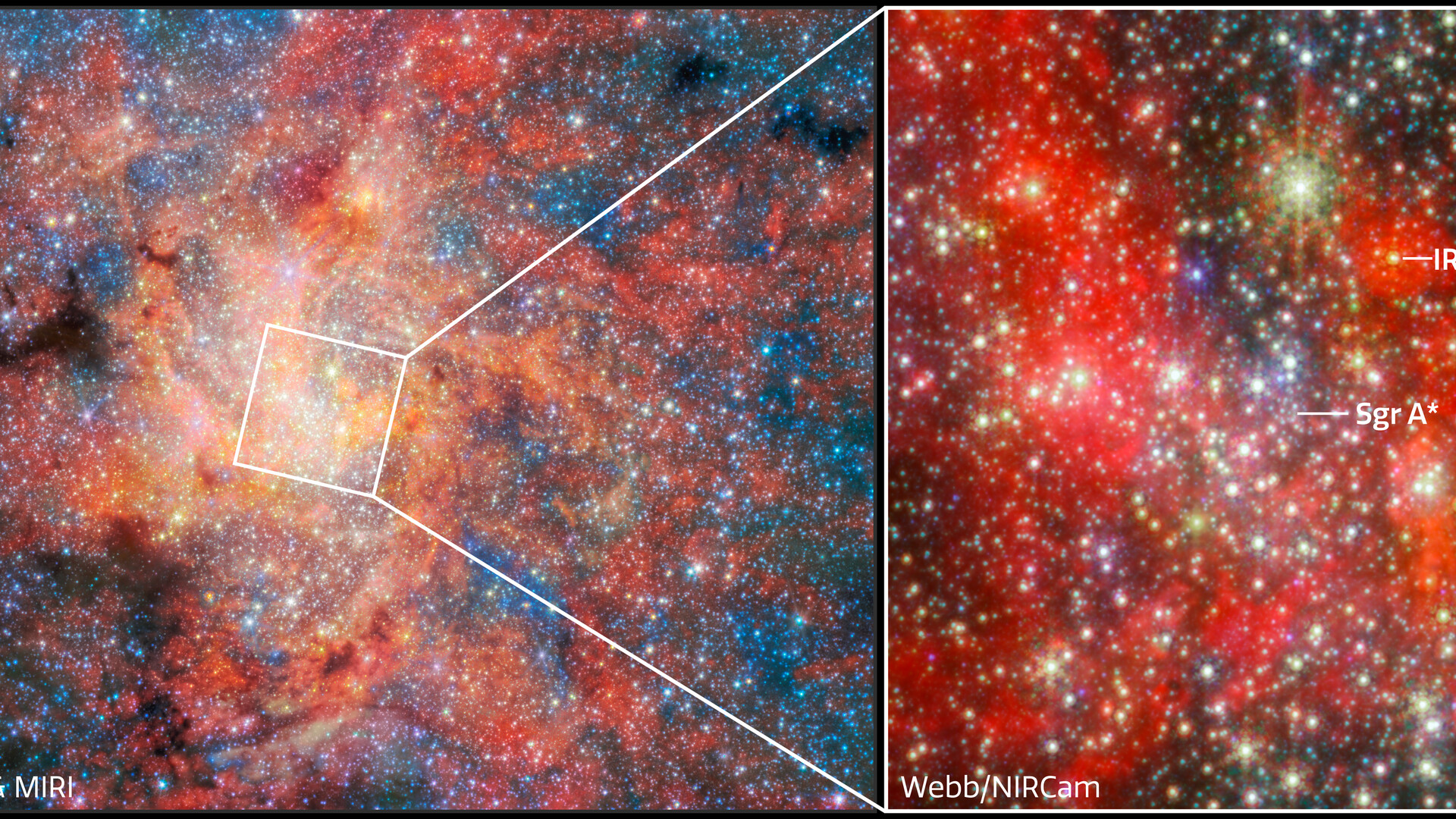
IRS 3 is no ordinary star — it belongs to a class of aging stars living in what astronomers call the asymptotic giant branch phase. In this late-life stage, stars are large and have relatively cool temperatures, and high luminosity. They blow off layers of their own material through intense stellar winds, and that castoff material seeds the universe with cosmic dust.
But given how closely IRS 3 sits next to Sagittarius A*, it wasn't clear whether it could still generate these winds and produce dust. The new study provides a much clearer picture.
To map the structure of the star's envelope, the team combined JWST's spectral data with models simulating how the starlight would travel through different possible dust configurations around the star. The best fit turned out to be a layered, shell-like structure of dust stretching roughly 10,000 astronomical units outward from IRS 3, with temperatures ranging from around 1,200 kelvins (1,700 degrees Fahrenheit, or 927 degrees Celsius) near the star down to about 100 kelvins (minus 280 F or minus 173 C) at the envelope's outer edge.
Digging into the mid-infrared data, the team found clear signs of oxygen-rich dust surrounding IRS 3. This finding overturns an earlier result that had classified IRS 3 as carbon-rich based on the shape of its dust envelope. Instead, the analysis revealed two strong infrared signatures of silicate dust composed of silicon and oxygen — a telltale signature of an oxygen-rich chemistry.
More intriguingly, within the envelope, they also detected traces of water, despite the star's proximity to the harsh radiation environment near a supermassive black hole. Combining the spectral data with stellar models, the team estimates that IRS 3's mass is roughly six times the sun's mass and its age is around 72 million years. The star has a luminosity of roughly 60,000 times that of the sun.
See how much you know about black holes with our black hole quiz!




 Bengali (Bangladesh) ·
  English (United States) ·