

This is a developing story and will be updated periodically.
For the first time in more than half a century, humans are flying to the moon.
At 6:35 p.m. U.S. Eastern Time on April 1, NASA’s Artemis II spacecraft blasted off from the Kennedy Space Center in Florida. Its launch marked the start of a 10-day journey around the moon. It will carry four astronauts deeper into space than anyone has gone before. At its farthest point from Earth, the spacecraft will be more than 400,000 kilometers (250,000 miles) away.
“We have a beautiful moonrise, we’re headed right at it” said Artemis II astronaut Reid Wiseman a few minutes after launch.
The last time anyone went to the moon was in 1972. That year, NASA’s Apollo 17 mission landed two astronauts on the lunar surface. Artemis II won’t land. It will instead loop around the moon — coming within roughly 8,000 kilometers (5,000 miles) of its surface — before returning to Earth.
The flight’s main goal will be to test technology for future lunar missions. One major piece of tech being tested: NASA’s Space Launch System. It’s the rocket carrying the spacecraft into orbit. Artemis II will also put the Orion spacecraft to the test. Orion is the capsule that will fly the astronauts around the moon.
Both systems will be used during the Artemis IV and V missions. They’re scheduled to land astronauts on the moon in 2028.
Artemis II marks a big milestone in human space exploration. This NASA trailer for the mission describes its significance and some anticipated highlights.Artemis ascending
NASA’s Space Launch System rocket blasted Artemis II into the sky at supersonic speed. At that rate, the astronauts reached space in about eight minutes. Then, the rocket’s main engines detached and fell back to Earth. Over the next couple hours, the rocket’s remaining upper stage will push Orion and its astronauts into an orbit high above Earth. There, the crew will spend about one day checking their craft’s systems.
If all goes well, Orion will head toward the moon on the flight’s second day. The astronauts should fly closest to the moon, and farthest from Earth, on the sixth day. People can track the crew’s progress using the Artemis Real-time Orbit Website or the NASA mobile app.
Four astronauts make up the crew of Artemis II. Three work for NASA: Wiseman, Victor Glover and Christina Koch. The fourth, Jeremy Hansen, works for the Canadian Space Agency. Glover is the first person of color and Koch is first woman to travel beyond low-Earth orbit. (That’s where the International Space Station is.)
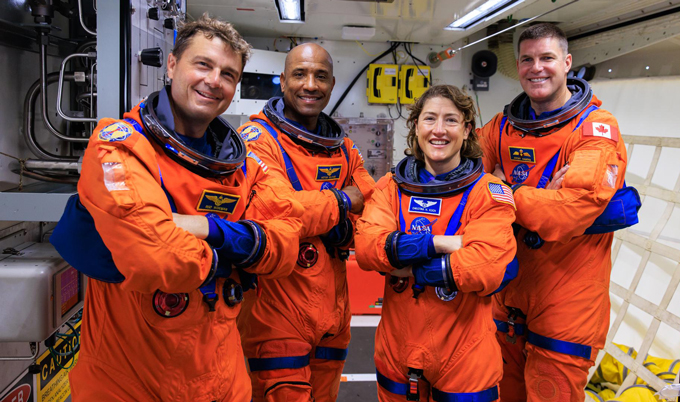 The crew of Artemis II (left to right) includes NASA astronauts Reid Wiseman, Victor Glover and Christina Koch along with Canadian Space Agency astronaut Jeremy Hansen. This 2023 photo at the Kennedy Space Center in Florida shows them inside the mobile launcher at Launch Pad 39B. Frank Michaux/NASA
During their voyage, the Artemis II astronauts will not only make history. They’re also slated to collect valuable data about how space travel affects the human body. Each will wear a wristband their tracks their sleep and stress levels. The team will also carry radiation sensors in their pockets. Those gadgets will measure how many potentially harmful energetic particles they’re exposed to when not shielded by Earth’s magnetic field.
In late March, NASA announced it would dramatically increase the frequency of lunar missions over the next seven years. The agency’s goal is to prep for eventually building a permanent base on the moon.
“Our strong hope is that this mission is the start of an era,” Koch said March 29 at a news event. To people in the future, she hopes, the moon may not be just a pretty sight in the sky. It may be a destination that anyone could dream of visiting.



 Bengali (Bangladesh) ·
  English (United States) ·