

Each year, about this time, the Karolinska Institute and Royal Swedish Academy of Sciences — both in Stockholm, Sweden — announce three world-changing achievements. People who pioneered the work in these fields will receive the most coveted science awards on Earth: the Nobels.
Explainer: The Nobel Prize
The first of the 2026 prizes was awarded for finding a light switch for the brain. The second goes for developing a literally super-cool way to study elusive particles bombarding Earth from outside our solar system. And the last prize highlights the importance of being able to preferentially make certain “handed” molecules.
All three achievements opened up major new windows on — and opportunities in — biology, physics and chemistry.
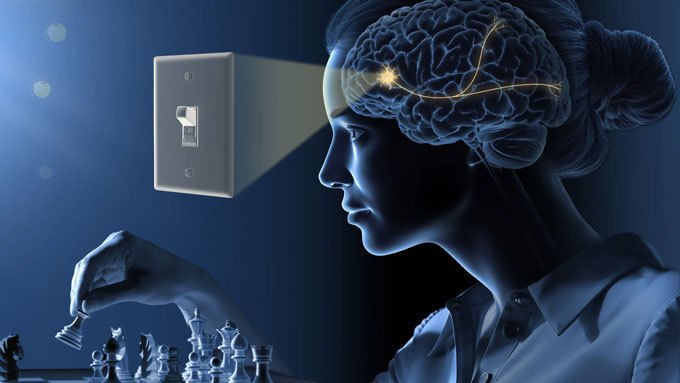 Scientists use optogenetics to precisely activate specific brain cells using light. This tool can let them turn on specific brain circuits and watch for changes in how the body behaves. © The Nobel Committee for Physiology or Medicine. Ill. Mattias Karlén
Shining a light on brain function
Let’s start with the human brain. It hosts nearly 90 billion neurons. They talk amongst each other through some 100 trillion connections. This brain chatter allows our minds to learn, adapt and interact with the world around us.
The 2026 Nobel Prize in physiology or medicine went to Karl Deisseroth, Peter Hegemann and Georg Nagel for developing ways to control nerve cells with light. The technique, called optogenetics, opened new ways to study the brain by turning individual neurons on and off. #nobel #optogenetics #sciencenews  Nikk Ogasa
  Getty Images/Alexander Pytskiy/JONATHAN NACKSTRAND/JOHN SAEKI,LAURENCE CHU/VALENTINA BRESCHI,JONATHAN WALTER,SYLVIE HUSSON,OLIVIER THIBAULT
To find out how, brain scientists needed a special tool. They long “dreamed” of something that might let them “turn specific neurons on or off with great precision,” notes Abdel El Manira. He spoke on Oct. 5, describing the prize for this tool.
Called optogenetics, that tool uses light to switch on specific neurons. Afterward, researchers can watch how a host’s behavior may have changed.
The path to the prize started in an unlikely place: the “eye spot” of a single-celled green alga.
In the early 2000s, biophysicists in Germany discovered a unique protein in that alga’s “eye” spot. The two researchers were Peter Hegemann (who now works at Humboldt University in Berlin, Germany) and Georg Nagel (at the Julius-Maximilians-Universität Würzburg in Germany). The protein that caught their interest had a long name: channelrhodopsin (CHAA-nel-roh-DOP-sin).
When light hits it, the protein produces an electrical impulse. This triggered the alga to move. Later research would show light caused that protein to open like a pore. That let positively charged ions flow into the cell. They are what caused the electrical impulse.
Hegemann and Nagel “had just discovered the switch neuroscientists had long dreamed of,” says El Manira.
Building on the that work, Karl Deisseroth tried using that protein to see if it could turn on brain cells. A neuroscientist, he works at Stanford University in California.
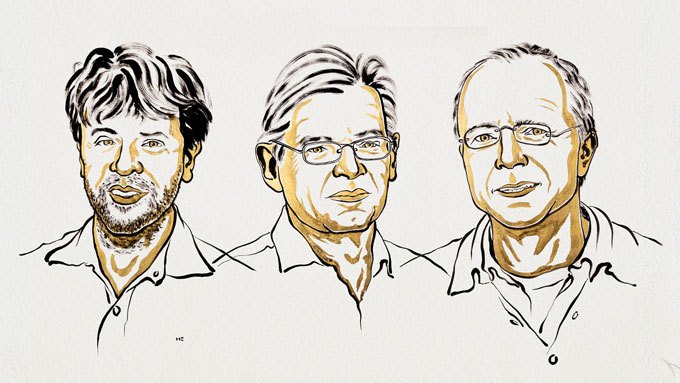 Karl Deisseroth (left), Peter Hegemann (middle) and Georg Nagel (right) have won the 2026 Nobel Prize in physiology or medicine for their creation of optogenetics. Niklas Elmehed © Nobel Prize Outreach
He was part of a team that inserted the gene to make channelrhodopsin into rat nerve cells. These were growing in dishes in the lab. Shining light on the cells triggered an immediate reaction.
This team also put the gene into nerve cells within the brains of living mice. The researchers inserted optical fibers at the same spots, right through the rodents’ skulls. By shining blue light through the fibers, the researchers could now control the movements of the rodents’ whiskers.
Researchers later went on to test the links between other brain circuits and behaviors.
New light on brain science
In short order, optogenetics “transformed neuroscience,” El Manira says. It offered a window on the workings of healthy brains, he says. It helped show how brain circuits can be disrupted, too, he adds. Those findings, he notes, could help researchers treat conditions such as blindness, depression and dementia.
In fact, we didn’t have to wait long for news in one of those areas. Just two days after this Nobel was announced, other researchers described a light therapy for retinitis pigmentosa (Reh-tih-NY-tis Pig-men-TOW-sah). This blinding disease slowly kills off light-sensing cells in the eye’s retina. Optogenetics, the new report showed, helped improve light sensitivity in seven of 10 treated people.
For their pivotal role in optogenetics, all three men are sharing the 2026 Nobel in physiology or medicine.
 The IceCube observatory consists of a cubic kilometer of Antarctic ice threaded with thousands of sensors. They offer scientists with a giant instrument that can detect those rare light flashes given off when neutrinos collide with the nuclei of atoms (illustrated here).© Johan Jarnestad/The Royal Swedish Academy of Sciences
Hunting for ‘ghost’ particles
At the South Pole, scientists have threaded one cubic kilometer (1.3 billion cubic yards) of the ice sheet with thousands of beadlike sensors. Together, the sensors make up the IceCube Neutrino Observatory. The immense instrument lets researchers detect some of the most elusive — shyest, some say — subatomic particles in the cosmos: neutrinos.
Neutrinos have no electric charge. They can pass through objects without interacting. In fact, billions of these ghostly particles pass through each of us every second.
Let’s learn about ‘ghost particles’
Fusion reactions in our sun form most of them. But some had been thought to come from much farther away — in high-energy particle collisions too far off to observe.
Detecting such neutrinos from well beyond our solar system had long been a goal of scientists. Because neutrinos are not deflected by magnetic fields and rarely interact with matter, detecting their path could point back to their distant source. Scientists hoped to one day figure out where and how the universe accelerated these super-small particles to super-high energies.
In the 1980s, physicist Francis Halzen of the University of Wisconsin–Madison had an insight: The South Pole should be an ideal place to look for the flashes of light created by the rare events when neutrinos collide with atomic nuclei. Ice deep within the Antarctic ice sheet could make a large, dark, transparent stage for such a neutrino light show.
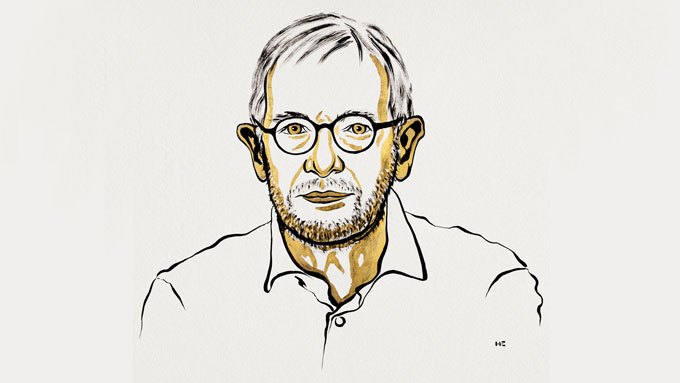 Francis Halzen won this year’s Nobel Prize in physics for his vision and leadership in establishing the IceCube Neutrino Observatory in Antarctica, which discovered high-energy neutrinos from beyond the solar system. Niklas Elmehed © Nobel Prize Outreach
This vision of Halzen’s was realized in 2011. That’s when IceCube’s construction was complete.
Francis Halzen has won the 2026 Nobel Prize in physics for his vision and scientific leadership of the IceCube Neutrino Observatory. IceCube gave us an entirely new way to see the universe. #nobelprize #physics #sciencenews Nikk Ogasa  Getty Images/MARCO BERTORELLO/NSF/Martin Wolf & Sven Lidstrom, IceCube
In part, Halzen got this year’s physics Nobel “for his decisive contributions to [IceCube].” notes physicist Mark Pearce. But Halzen also won for “the discovery of high-energy neutrinos of astrophysical origin,” he adds. Pearce, who chairs the Nobel committee for physics, spoke during the Oct. 6 award announcement by the Royal Swedish Academy of Sciences.
IceCube had been a gamble. “Nobody knew whether a kilometer-field detector was actually large enough to discover neutrinos beyond our atmosphere from the universe,” Halzen said in a phone call during the announcement ceremony.
In fact, he noted, “It only took us two years to detect them.”
And the discoveries didn’t end there. Using IceCube data, researchers reported in 2018 that they had traced a neutrino back to the brilliant core of a distant galaxy, called a blazar. And in 2023, researchers used a decade of IceCube data to produce the first map of the Milky Way made with something other than light.
Plans for a global network of neutrino detectors are now in motion.
This year isn’t the first time a Nobel has gone for work on neutrinos. Two physicists received the prize in 2015 for demonstrating that neutrinos have mass.
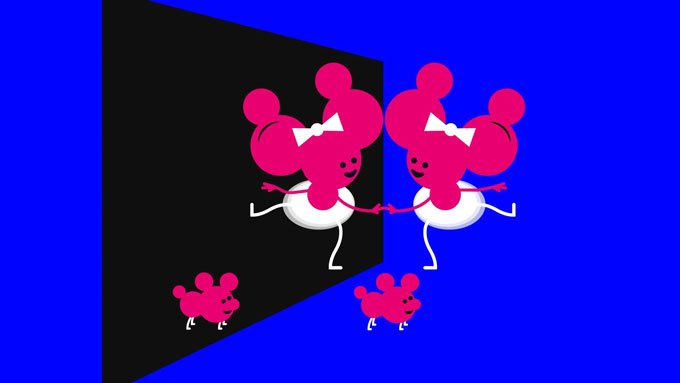 Like your left and right hand, many molecules can exist as either of two mirror-image structures (illustrated). This property is called chirality. Curiously, the building blocks of life overwhelmingly occur as just left- or right-handed forms. Take amino acids: They’re almost always left-handed.© Johan Jarnestad/The Royal Swedish Academy of Sciences
On the one hand …
In nature, the building blocks of life exhibit a striking pattern. Many can exist in two mirror-image structures, much like your right and left hand. Such molecules are said to be chiral (KY-rul). However, in nature, such chiral molecules overwhelmingly occur in just one form. Amino acids, for instance, are nearly always left-handed.
Known as homochirality, this dominance of one type of handedness had long puzzled scientists.
Explainer: What is chirality?
When chemists first attempted to make chiral molecules in the lab, they ended up with roughly 50-50 mixes of right- and left-handed molecules. Why?
“It is this puzzle that this year’s laureates have solved,” said Heiner Linke. He spoke during the Oct. 7 announcement of the chemistry prize by the Royal Swedish Academy of Sciences.
Two scientists will split this Nobel prize. Henri Kagan works at the Université Paris-Saclay in France. Kenso Soai works at Tokyo University of Science in Japan.
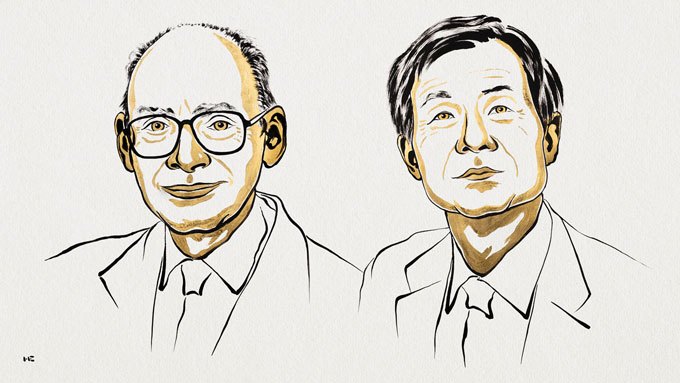 The building blocks of life almost always exist as just one of two possible mirror-image versions. Henri Kagan (left) and Kenso Soai (right) discovered a way to get similarly one-handed molecules made in the lab — and for this insight received the 2026 Nobel Prize in chemistry.Niklas Elmehed © Nobel Prize Outreach
They will share it for discovering a path to creating chiral molecules in such a way that they make one of the possible mirror-image forms. “This is the first time this had happened since the processes that led to the chirality of life billions of years ago,” says Linke. A physicist at Lund University in Sweden, he chairs the Nobel Committee for Chemistry.
Henri Kagan and Kenso Soai won the 2026 Nobel Prize in chemistry for their work on controlling the production of mirror-image molecules. Their discoveries have helped pharmaceutical companies develop safer drugs. #nobel #chemistry #sciencenews Nikk Ogasa Getty Images/Evening Standard/Paul Fievez/Keystone/JONATHAN NACKSTRAND
The award winners’ research has greatly aided development of medicines. A lot of active drug molecules are chiral. But while one form may have a medicinal effect, its mirror-image form might have no effect — or worse, be harmful.
Consider thalidomide (Thuh-LID-oh-myde). Thousands of babies were born in the 1950s with severe birth defects. Their mothers had been prescribed thalidomide while they were pregnant to treat anxiety and nausea. Science would later show that the left-handed form of the drug was toxic. (Even taking the “safe,” right-handed form wouldn’t solve the problem. In the body, it could morph into the left-handed form.)
In 1986, Kagan’s team was the first to report chemical reactions that would lead to production techniques that helped solve the problem. These could make a far larger than normal share of left- or right-handed forms.
Several years later, Soai and his colleagues reported that they had figured out how to make a chiral catalyst that could, in turn, be used to form itself. That allowed his team to perform reactions that resulted in products made almost entirely of one “handed” form of a chiral molecule.
“This is not the final answer,” Soai said of this work. He had called in from Japan to the Nobel announcement ceremony. Speaking to future generations, Soai said, “the study of chirality should be more and more developed.”
The new Nobel scientists will each get a medal. The winners in each category will also split 12 million Swedish kroner (roughly $1.2 million).




 Bengali (Bangladesh) ·
  English (United States) ·