

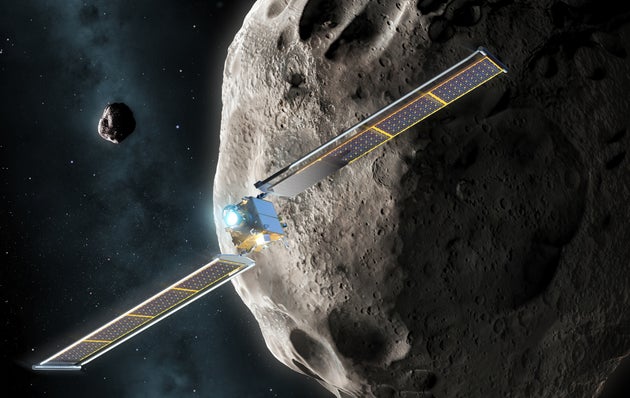
 Illustration of NASA's Double Asteroid Redirection Test (DART) spacecraft approaching the binary near-Earth asteroid Didymos.
 A gigantic asteroid is set to soar past Earth – and, if the conditions are right, it’ll be visible to the naked eye for billions of people around the world.
The asteroid is named Apophis, after the Egyptian god of chaos and destruction, as it was originally thought it might impact Earth in either 2029, 2036, or 2068.
However, scientists have since confirmed that it will safely pass close to our planet – and won’t impact Earth for at least 100 years.
Here’s what you need to know.
How big is the Apophis asteroid?
Pretty huge.
It has a mean diameter of 340 metres, and is at least 450 metres long. To put that into perspective, the Empire State Building is 443 metres tall (including the spire and antenna).
According to NASA, it’s thought to be peanut-shaped and is made up of leftover “raw material” that was never part of a planet or moon.
The asteroid was discovered not too long ago, in 2004, by the late astronomer Roy Tucker, as well as David Tholen and Fabrizio Bernardi.
When will it pass Earth?
Mark your calendars for 13 April 2029.
It will come about 20,000 miles from our planet’s surface – closer than the distance of many satellites in orbit.
Where and how can I see it?
Experts said if conditions are clear, it will be visible to the naked eye in the Eastern Hemisphere, which includes parts of Europe, Asia, Australia and Africa.
NASA said the astronomical event is “an amazing and totally unprecedented opportunity to learn much more about Apophis and similar near-Earth asteroids”.
It added: “An asteroid this large passes this close to Earth only every few thousand years on average, so it’s likely that an event like this has not happened at any time in recorded human history.
“Without a doubt this is the first time it’s happened when humans have had the technology to observe it.”
During the flyby, observatories will be monitoring the asteroid and a couple of spacecrafts will also be sent to study it closely and gather samples.
For those disappointed they have to now wait a few years before seeing the spectacle, there’s a notable sky gazing event happening this summer, too.
In what’s been dubbed a “cosmic double whammy”, on 12 August 2026 there’ll be a partial solar eclipse in the early evening, followed by the Perseid meteor shower later that night.








 Bengali (Bangladesh) ·
  English (United States) ·