

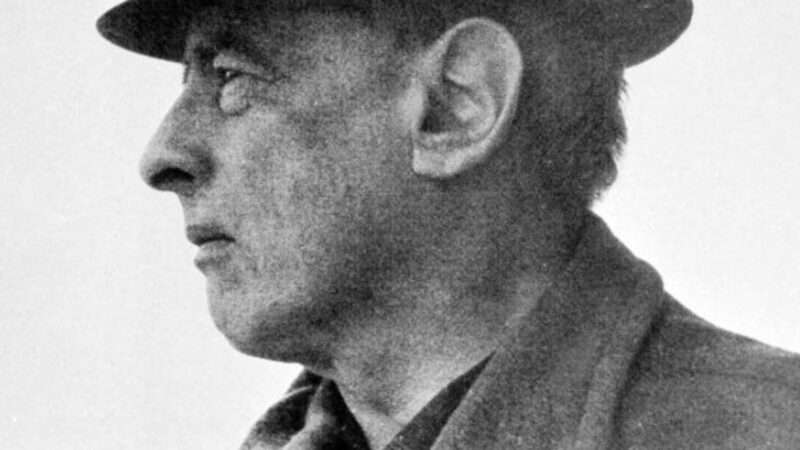
Outsider Everywhere: Witold Gombrowicz in Argentina, by Mercedes Halfon, translated by Rahul Bery, Fitzcarraldo Editions, 152 pages, $18.95
In 1937, at the tender and messianic age of 33, the Polish author Witold Gombrowicz published his first and most famous novel, Ferdydurke. Starting with its nonsensical title, never explained in the text, Ferdydurke declares war on what its highly opinionated narrator calls "maturity."
The 30-year-old protagonist, Joey, finds himself kidnapped by a teacher and taken back to school, where he joins his fellows in games of puerile verbal brinkmanship. (One student cries, "We must redouble our energies, and go on using the choicest obscenities we know!") When Joey is sent to live with a progressive urban family, the novel's middle section veers into disturbing erotic hijinks, as Joey spends much time peering through a keyhole at the teenage daughter, and the book becomes a send-up of the liberal intelligentsia, with the family's bien-pensant parents all too eager to seem sophisticated about their vulnerable daughter's budding sexuality. In the novel's final third, Joey accompanies a gay classmate to the Polish countryside to find a "farmhand" to consort with, only to be taken in by upper-class relatives.
Gombrowicz, born to the Polish gentry, satirizes an aristocracy parasitic for both its pleasures and its self-esteem upon a peasant class it brutally mistreats. Along the way, Gombrowicz regales us with philosophical parables demonstrating the impossibility of language's or the self's coherence, and literary manifestos about the vanity of any art that cuts itself off from the vital force of immaturity dramatized by Joey's metamorphosis back into a schoolboy.
Ferdydurke sits comfortably in the zany proto-absurdist Central and Eastern European tradition of Nikolai Gogol and Franz Kafka, and it has accordingly been celebrated by such later writers as Milan Kundera and Susan Sontag as a major contribution to modernism. But a novelist determined to celebrate the anarchic as such and to mock every piety that came his way—whether aristocratic or bourgeois, progressive or conservative—and even the sanctimony of the literary world itself, could find himself fatally out of place in a Poland about to be taken over first by Nazis and then by Communists.
On the eve of World War II, Gombrowicz traveled to Buenos Aires as a journalist covering the launch of a new Polish luxury liner. When it was time to board the ship for his return journey, about three weeks before Adolf Hitler's invasion of Poland, Gombrowicz decided to remain on shore. He would live in Argentine exile for the next 24 years before returning to Europe, where he died in 1969.
Such a life, lived between languages, countries, ideologies, and hemispheres, demands literary treatment of its own. The Argentine novelist and poet Mercedes Halfon has obliged with Outsider Everywhere, now available in English from Fitzcarraldo Editions, an independent press second to none in its commitment to world literature. In this slim book, Halfon narrates Gombrowicz's 24 years in Argentina in brief chapters, often little more than a page long. She plays with biographical form just as Gombrowicz played with fictional form; as he rejected the totalizing worldview implied by the traditional novel, she eschews the traditionally detail-freighted biographical doorstopper. She favors a glance over a long look, a telling quotation over a long description, and she often lets her interviews with those who knew Gombrowicz or who tend his Argentine legacy today speak for themselves. Outsider Everywhere argues no overt thesis, but it implies that Gombrowicz belongs as much to Argentine as to Polish literature, to the New World as to the Old, a fitting legacy for a writer who defied all categories as intolerable impositions on human freedom and energy.
In Halfon's telling, Gombrowicz surrounded himself from his first days in the city with the bohemians of Buenos Aires as he continued to prosecute his literary case against all forms of overweening seriousness, even as fascism and communism proved his point by dismembering Central Europe. Often poor and forced to work a deadening office job, Gombrowicz lived in relative obscurity in Argentina. He continued to write surreal, absurdist novels and plays in Polish, but his books were banned in his homeland and obscure in his adopted country. In his regular bar, the Rex, with a group of friends he dubbed "the Ferdydurke translation committee," and at a time when no Spanish-to-Polish dictionary existed, he rushed his first novel into his new language in 1945, though its experimental hijinks predictably failed to make him famous.
He tweaked the pieties of his new country as he had in his old one. He avoided Argentina's reigning literati, preferring to consort with youth uncorrupted by his old enemy, "maturity." In halting and rudimentary Spanish, he gave a lecture provocatively titled "Against Poets" to the city's outraged literary intelligentsia in 1947. (Now considered a classic manifesto for a literature liberated from the confines of a suffocatingly self-regarding high culture, "Against Poets" is also, Halfon notes, "a perennial presence in zines at anarchist book fairs.") At the age of 50, he began his celebrated Diary, a public intellectual record running to three volumes and now often regarded as his masterpiece, where he issued his opinions on the literary, political, and philosophical matters of the day in a loose, ongoing literary performance that anticipates the blogs and Substack newsletters of today. He even taught informal philosophy classes for a fee to the intellectually ambitious bourgeois women of Buenos Aires.
No more impressed by Argentine than by Polish politics, Gombrowicz scandalized a leftist acquaintance by denying "the necessity for universal enlightenment." ("You're probably a fascist, eh?" the leftist asked in reply.) As for "rescuing the indigenous essence" of the Argentine countryside from "foreign imperialism," Gombrowicz dismissed such fashionable politics as "blabbermouth Argentina." He enjoyed his sojourns to the provinces but admired only the spontaneous vitality of its carnivalesque popular culture, not its indigenous traditions. Candid about the author's flaws, Halfon records Gombrowicz's persistent misogyny, despite his many female friends and patrons. He judged women to be a conservative force in culture, "representatives of a hoary old morality and all the clichés of tradition, the family above all." As disclosed in his posthumously published private diaries, though this fact can be gleaned from his fiction's subtext, he would cruise the city for young male companionship; he contracted syphilis and was arrested more than once as "a street homosexual."
Only in the late 1950s, with translations of his novels and the Diary into French, was Gombrowicz rescued from obscurity and acclaimed in Europe as a modern master. "But what have I to do here, where I am neither read, nor published, nor recognized?" he asked of his ongoing exile. Recognized on his native continent at last, though still exiled from Poland, he sailed for France in 1963, supposedly (though this has never been verified) calling to his friends on shore from the ship, "Kill Borges!" Ever the iconoclast, Gombrowicz did not much admire Argentina's greatest 20th century writer (for more on Borges, go to page 10). In an irony Halfon relishes, however, the Ignacio Domeyko Polish Library, which holds Gombrowicz's Argentine archive, is located on the Calle Jorge Luis Borges. Now canonized in his second home, Gombrowicz's works can reliably be found, Halfon tells us, in the "Argentine literature" section of the country's bookstores.
With its potent distillation of the author's life and thought, Outsider Everywhere gives us an opportunity to appraise Gombrowicz's relevance today. As a writer, he defined himself exclusively in negative terms: "I was not a typical intellectual, nor a nationalist, nor a Catholic, nor a communist, nor a rightwinger; I didn't worship science, or art, or Marx. Then what was I at that time? Most often, I was the negation of my disconcerted interlocutor."
His disconcerted interlocutor today might say, on the one hand, that what Halfon calls a "war Gombrowicz waged against culture" was almost too successful. As Sontag argued in her otherwise reverent 2000 foreword to Danuta Borchardt's translation of Ferdydurke, Gombrowicz's disparagement of cultural seriousness, whatever its justification in high-modernist interwar Europe or in a Poland still under the spell of Romantic nationalism, is out of date in the contemporary West. "The discrediting of literature and other expressions of 'high' culture as elitist or anti-life is a staple of the new culture ruled by entertainment values," Sontag wrote. Gombrowicz took for granted a readership serious enough about literature and art to read his own experimental fiction. But Gombrowicz, ever alert to the threat of totalizing forces, would also likely not have been surprised to see his subversiveness become a new hegemony, itself in need of further subversion.
On the other hand, the very political ideologies Gombrowicz confronted with his withering mockery in both midcentury Poland and Argentina remain at large today: nationalist authoritarianism, religious traditionalism, progressive totalitarianism. As long as these and other incarnations of oppressive "maturity" threaten to constrain the individual imagination, we will continue to need, as a standing example of freedom, the permanent rebellion embodied by Gombrowicz's life and work.
The post An Absurdist's Exile in Buenos Aires: Witold Gombrowicz's Argentine Years appeared first on Reason Magazine.




 Bengali (Bangladesh) ·
 English (United States) ·