
 1 hour ago
11

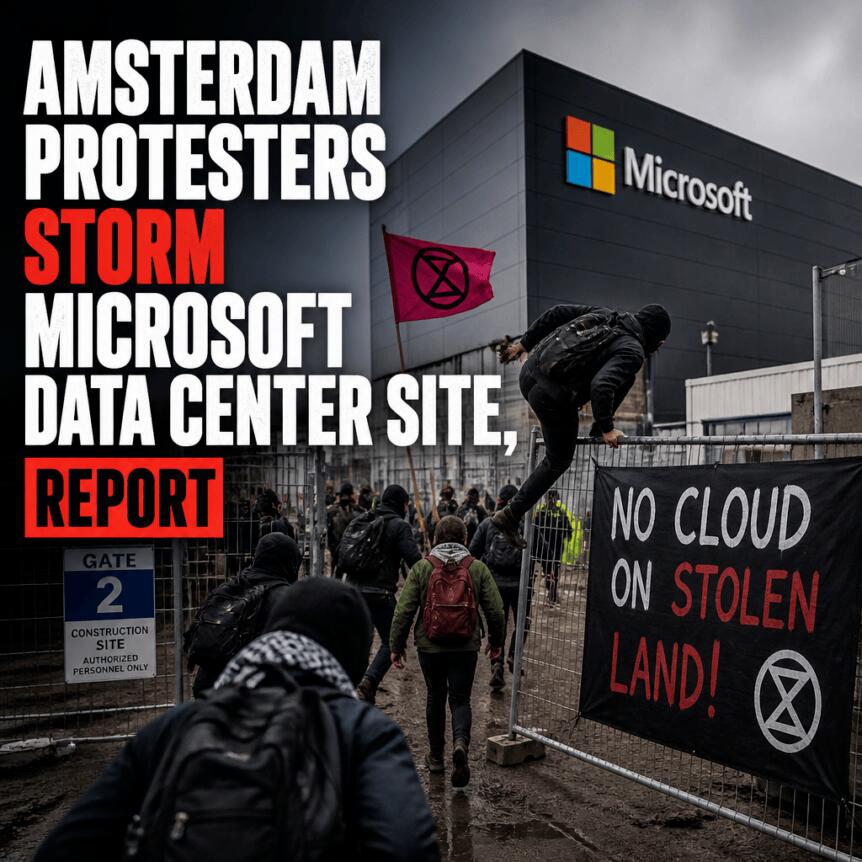
Protesters reportedly entered a construction site in Amsterdam tied to a Microsoft data center and clashed with police, according to an Associated Press report. Authorities in the Netherlands said they detained between 150 and 200 people for trespassing.
The demonstration appears to have been aimed directly at halting or disrupting the project. One protester, speaking to a local broadcaster, said the group was trying to stop construction of the data center. Microsoft, meanwhile, acknowledged awareness of the protest and said it respects peaceful expression while not condoning unlawful actions or anything that endangers safety.
Key takeaways
Dutch authorities detained 150 to 200 protesters after a reported breach of an Amsterdam construction site connected to a Microsoft data center. Protesters said they wanted to stop construction, while Microsoft stated it respects the right to express views peacefully. Microsoft emphasized it does not condone unlawful actions or conduct that puts public safety at risk. Reporting from the US suggests a tightening regulatory environment for data centers may be coming after recent midterm elections. Regulatory pushback is also visible elsewhere, including earlier discussion in New York over temporary land-use restrictions covering AI data centers and crypto mining.Amsterdam protest turns into a police clash
According to the Associated Press, protesters broke into an Amsterdam construction site where a Microsoft data center is being built. The confrontation with police followed the reported entry, and Dutch authorities said detainees numbered between 150 and 200 for trespassing.
The AP report also notes that at least one protester told a local broadcaster their objective was to stop the data center’s construction. While the motivations for such demonstrations can vary—from local environmental concerns to questions about how rapidly new infrastructure is being deployed—the Amsterdam incident underscores how physical disruption can accompany policy debates around large-scale computing facilities.
Microsoft response: peaceful protest allowed, unlawful action not
Microsoft responded through a spokesperson, as quoted by AP. The company said it understands people may feel strongly about the project and that it respects their right to express views peacefully. It added that it does not condone actions that are unlawful or that put people’s safety at risk.
For investors and operators of compute infrastructure, this matters because data center rollouts are often tied to tight construction schedules, permitting milestones, and community relations. A clear statement from the operator also signals a likely preference for legal protest routes and risk management around on-site security.
US policy pressure after midterm elections
AP linked the incident to what it described as a potentially tougher US regulatory environment following the midterm elections. The report said the elections included a wave of Democrats promising to clamp down on data centers, which can consume large amounts of electricity and water.
This political angle is important for the broader sector because it suggests the issues driving local unrest and permitting friction in Europe may continue to echo through US policy—particularly around utilities, water usage, and environmental review. Even when projects proceed, the direction of regulation can affect timelines, compliance costs, and which sites become viable for new capacity.
Regulatory friction reaches beyond data centers, including crypto mining
The wider narrative around data centers and computing infrastructure is not limited to construction protests alone. Cointelegraph previously reported in September that the town of Plattsburgh, New York, held a public hearing to consider a temporary land use moratorium for operations including AI data centers and crypto mining.
That earlier effort highlights a key tension: policies aimed at constraining resource-intensive activities may group together different types of energy-hungry operations under the same scrutiny. For crypto stakeholders—particularly mining participants—such land-use mechanisms can translate directly into operational uncertainty, including whether certain locations can be used, for how long, and under what conditions.
In the context of AP’s description of post-election expectations in the US, the practical takeaway is that computing demand—from AI workloads to blockchain mining—may increasingly face overlapping regulatory and community pressure, even when each sector argues for different benefits and use cases.
Looking ahead, readers should watch whether Dutch authorities clarify the circumstances of the Amsterdam site breach, and whether the political momentum described by AP in the US results in concrete regulatory changes for data centers. In parallel, ongoing local land-use debates like the one in Plattsburgh show how quickly enforcement can shift from discussion to restrictions that affect both infrastructure projects and energy-intensive crypto operations.
This article was originally published as Amsterdam Protesters Storm Microsoft Data Center Site, Report on Crypto Breaking News – your trusted source for crypto news, Bitcoin news, and blockchain updates.





 Bengali (Bangladesh) ·
 English (United States) ·