
 1 hour ago
2
1 hour ago
2 
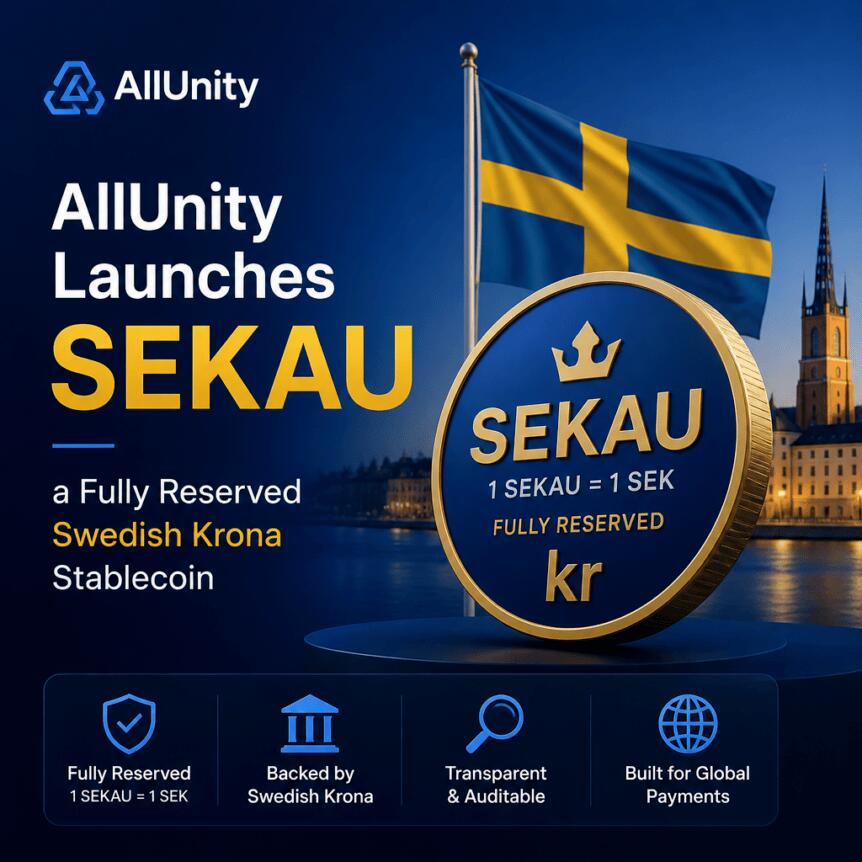
AllUnity is extending its MiCA-regulated stablecoin lineup with SEKAU, a Swedish krona-backed token designed for institutional settlement and cross-border payments. The company said the new stablecoin is issued under the EU’s Markets in Crypto-Assets Regulation (MiCA) as an e-money token, with reserves held in segregated Swedish krona accounts.
The release also highlights how issuers are adapting to MiCA’s framework by moving beyond “early-stage” token concepts and toward bank- and infrastructure-style custody and settlement. AllUnity’s SEKAU follows its earlier Swiss franc stablecoin rollout, reinforcing a multi-currency strategy built for different blockchain ecosystems.
Key takeaways
SEKAU is a Swedish krona stablecoin issued under MiCA as an e-money token, backed 1:1 by segregated SEK reserves. Banking Circle will hold and manage the reserves, with Marginalen Bank supporting the rollout as a banking partner. SEKAU launches on five networks—Ethereum, Solana, Base, Tempo, and Polygon—with plans to add more chains later in 2026. AllUnity frames SEKAU as the first fully reserved Swedish krona-denominated MiCA-aligned stablecoin, contrasting it with non-public tokenized experiments.MiCA compliance becomes the product, not just the legal wrapper
In a statement shared with Cointelegraph, AllUnity described SEKAU as the first fully reserved Swedish krona stablecoin aligned with MiCA, issued as a regulated e-money token (“EMT”). The token’s backing is described as 1:1 by Swedish krona reserves held in segregated accounts, an approach intended to distinguish it from fiat-referenced crypto concepts that may not be designed for regulated redemption and governance.
AllUnity also emphasized that “SEK exposure has previously existed mainly through early-stage concepts,” which it said were not confirmed as MiCA-authorized, fully regulated EMTs. That distinction matters for market participants who care less about token branding and more about how fiat reserves are managed, what oversight applies, and whether the stablecoin is designed to operate as regulated private money under EU rules.
Who will hold the reserves and connect the infrastructure
SEKAU’s structure leans heavily on regulated financial infrastructure and integration partners. Banking Circle, a Luxembourg-based business-to-business bank and financial infrastructure firm, will hold and manage the reserves backing the token. Swedish Marginalen Bank is listed as a banking partner supporting the rollout.
For broader ecosystem access, Trust Anchor Group is named as the infrastructure integration provider for SEKAU. Together, these relationships suggest AllUnity is treating stablecoin deployment as a coordinated effort across custody, banking relationships, and technical connectivity—rather than a standalone token launch.
A multi-chain rollout aimed at liquidity across ecosystems
SEKAU is launching on five blockchain networks: Ethereum, Solana, Base, Tempo, and Polygon. AllUnity said the multi-chain approach is intended to improve access, interoperability, and liquidity across major ecosystems.
The company also signaled it does not intend to stop at the initial set of networks, stating it plans to expand SEKAU to additional blockchain networks later in 2026. The contrast with AllUnity’s previous stablecoin deployment is notable: its Swiss franc stablecoin CHFAU initially launched exclusively on Ethereum in February before expanding to Tempo, implying a more staggered chain rollout for the earlier product.
AllUnity also operates EURAU, a euro-backed stablecoin launched in 2025. According to CoinGecko data cited by Cointelegraph, EURAU has reached a market capitalization of $1.4 million and ranks as the 16th largest euro stablecoin among 23 tracked tokens. CoinGecko also shows the euro stablecoin market totals about $883 million in combined value at the time of writing.
SEK stablecoins in Sweden: public tokens vs closed pilots
AllUnity’s messaging around SEKAU also speaks to the broader question of whether Sweden has stablecoin activity beyond regulated, publicly redeemable products. The company pointed to Sweden’s e-krona project run by the Riksbank as a relevant initiative for tokenized payments infrastructure—but stressed it is fundamentally different from a stablecoin.
AllUnity noted that Swedish banking and fintech pilots have explored tokenized deposit money and settlement systems. However, the company characterized these as “closed, experimental infrastructures” rather than publicly redeemable stablecoins.
The company further referenced communication from the Riksbank earlier in 2026 indicating there were no stablecoins in Swedish kronor. While that does not preclude tokenized pilots or related experiments, it frames SEKAU as a distinct category: a regulated, publicly available krona token built under MiCA’s e-money rules.
What investors and users should watch next
With SEKAU now live across multiple chains, the immediate question is how liquidity and usage develop across Ethereum, Solana, Base, Tempo, and Polygon—especially as AllUnity plans additional network expansion later in 2026. Market participants will also want to monitor how reserve management and EMT compliance are handled in practice over time, and whether the SEK stablecoin narrative gains traction alongside other MiCA-regulated fiat tokens.
This article was originally published as AllUnity Launches SEKAU, a Fully Reserved Swedish Krona Stablecoin on Crypto Breaking News – your trusted source for crypto news, Bitcoin news, and blockchain updates.



 Bengali (Bangladesh) ·
  English (United States) ·