

Shiba Inu stands at $0.00000557 on Wednesday morning, down 4.79 percent in 24 hours. That is the heaviest one-day loss among the six largest coins we track. Over the same period Bitcoin gives up 1.15 percent, Dogecoin 3.66 percent, Ethereum 2.75 percent, XRP 1.29 percent and Solana 0.64 percent. Anyone holding Shiba Inu is not watching a slump of its own making, then, but four times the swing of a market that has barely moved lower.
The figure that matters more in practice sits in the order book. Shiba Inu turns over $83.11 million in trading volume on the day against a market capitalisation of $3.28 billion. That is a turnover ratio of 2.53 percent. Dogecoin records $1.087 billion in volume against $14.21 billion in market capitalisation, or 7.65 percent. The bigger memecoin trades three times as intensively relative to its size. That ratio decides what an exit costs you at the moment you need one.
Shiba Inu price at $0.00000557: 4.79 percent down in 24 hours
Converted at the European Central Bank euro reference rate of October 6, which stood at $1.1269 per euro, the current level equals €0.00000494. Last night the same conversion still gave €0.00000514. The euro value has therefore fallen by roughly four percent within a day, even though the euro firmed slightly against the dollar over the same stretch.
Over seven days Shiba Inu is 3.49 percent lower. Over 30 days it still shows a gain of 1.63 percent. These three signs belong together, and they are the reason a single daily loss says little about this coin on its own: the month is still positive, the week is negative, the day is clearly negative. What has sharpened is the pace.
Shiba Inu is 93.54 percent below its all-time high of $0.00008616. Dogecoin sits 87.57 percent under its record, Bitcoin 33.11 percent. Those gaps are not a forecast but the starting point of any price-target calculation you draw up. A coin trading 93.54 percent below its high needs to multiply fifteenfold to get back there.
Dogecoin down 3.66 percent, Shiba Inu 4.79 percent: 13 times more volume at DOGE
The two large memecoins move in the same direction on the day, but with different force. Dogecoin trades at $0.09096, or €0.08072, and loses 3.66 percent. Shiba Inu loses 4.79 percent. The gap of 1.13 percentage points sounds small. On a position of 2,000 euros it comes to 22.60 euros in a single day, on a day when the broader market barely gave ground.
The real difference lies in trading volume. Dogecoin turns over $1.087 billion on the day, Shiba Inu $83.11 million. The ratio is 13 to 1, against a market capitalisation only 4.3 times as large. In practice that means the same sell order moves the Shiba Inu price considerably more than the Dogecoin price.
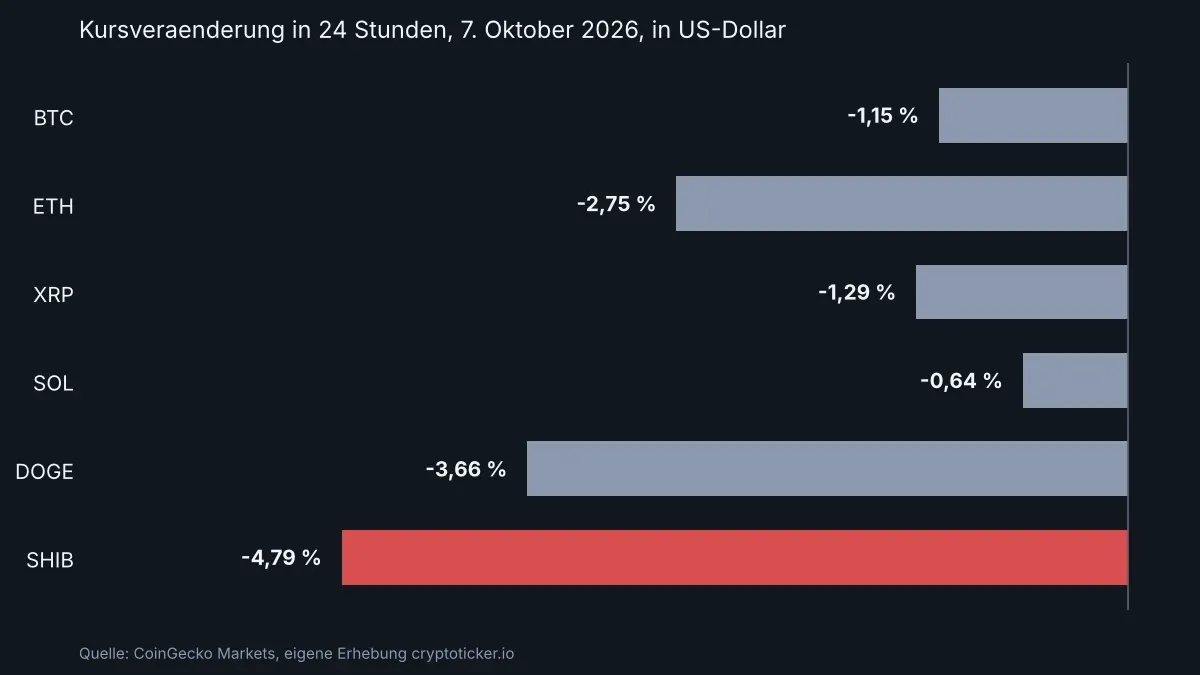 Shiba Inu loses 4.79 percent, Bitcoin 1.15 percent: the same market, four times the swing.
Turnover ratio as a gauge of thin markets: 2.53 percent at SHIB, 7.65 percent at Dogecoin
The turnover ratio is daily volume divided by market capitalisation. It describes what share of the entire supply actually changes hands in a day. A high ratio means plenty of counterparties in the order book, a low one means thin books. For Shiba Inu it stands at 2.53 percent this Wednesday, for Dogecoin at 7.65 percent, for Bitcoin at 1.90 percent.
That Bitcoin has the lowest ratio is no contradiction. Behind every percentage point at Bitcoin sits an absolute depth of $32.27 billion in daily turnover. Behind 2.53 percent at Shiba Inu sit only $83.11 million. The ratio is therefore useful for comparing coins of similar size, not across every size class. Between the two memecoins the comparison holds, and it comes out plainly.
cryptoticker.io compiled this analysis itself on October 7, 2026. It rests on market data for the six coins Bitcoin, Ethereum, XRP, Solana, Dogecoin and Shiba Inu, together with the euro reference rate of the European Central Bank. Six coins and one exchange rate were examined.
What a thin market costs in everyday trading
A thin market shows up in the gap between bid and offer and in the depth behind it, not in the price you see on an exchange home page. With Shiba Inu there is an added quirk that German investors rarely note: the price sits in the eighth decimal place. The smallest tradable tick at many exchanges is $0.00000001, and at a price of $0.00000557 that already amounts to 0.18 percent. A market order that runs through two ticks therefore costs you a third of a percent before any fee applies.
The $0.0000055 level: how much of the October 5 floor still holds
On October 5, in its own burn review of the Solana route, cryptoticker.io named the $0.0000055 mark as the lower floor. That is exactly where the price stands this Wednesday morning. The daily value on October 6 was $0.00000589, the current one is $0.00000557. The level is being tested, then, not broken.
What follows from that hangs on a single observation: if the price holds above $0.0000055 on a daily basis, the range of the past 30 days stays intact. If it drops below, the next documented catchment zone is the 30-day low. Both can be examined without having to believe any forecast.
Shiba Inu levels on the upside: $0.0000059 from October 5, then $0.0000061
The weekly high is $0.00000592 and dates from October 5. That is the first level on the upside, and it is only 6.3 percent away. Above it comes the 30-day high of $0.00000610, which is 9.5 percent above the current level. Only once both marks are cleared on a daily basis can one speak of a trend reversal, and even then only for the monthly window.
The second level is the more important one because it has held for a month. A high that has not been exceeded in 30 days acts as a supply zone on the next attempt: that is where the sell orders of those who bought too dearly last time are waiting.
Shiba Inu levels on the downside: $0.0000049 as the 30-day low
The low of the past 30 days is $0.00000494. From the current level that is 11.3 percent down. This number is the most honest figure in this article, because it maps out a range in which the price has actually moved for a month: from $0.00000494 to $0.00000610, a span of 23.5 percent between floor and ceiling.
Anyone planning a position works with that width rather than with a price target. A coin that has run through a 23.5 percent range in 30 days and loses 4.79 percent in a single day can sit at the lower edge of that range within five days without anything out of the ordinary having happened.
 Exchange balances are falling while the price drops: outflow and selling pressure are two different things.
Shiba Inu beta against Bitcoin: a factor of 4.17 in a single day
Divide Shiba Inu's daily loss by Bitcoin's and this Wednesday gives a factor of 4.17. At Dogecoin the same factor is 3.18, at Ethereum 2.39, at XRP 1.12, at Solana 0.55. The calculation is a snapshot of one day and not a statistical beta over a longer period. As a snapshot it still says something usable.
The order matches market capitalisation in reverse: the smaller the coin, the larger the swing from the same market move. Shiba Inu ranks 37th by size, Dogecoin 12th, Bitcoin 1st. Anyone holding a Shiba Inu position is, arithmetically, holding a leveraged position on the general direction of the market without having bought any leverage.
That is the point at which position size matters more than the price target. A position that arithmetically loses 42 percent when Bitcoin falls ten percent has to be sized from the outset so that this loss is bearable. Anyone working with leveraged products on top multiplies that factor once more, and the liquidation threshold then moves closer than the price levels from the two sections above.
Shibarium at $170,913 in locked capital: the network is not carrying the Shiba Inu price
Shibarium is the Shiba Inu project's own layer-2 network. Layer 2 means a second tier that bundles transactions and settles them more cheaply, while security rests with the chain underneath. The capital locked in Shibarium applications comes to $170,913 on October 7.
That figure stands in a ratio of 1 to 19,200 against the market capitalisation of $3.28 billion. Put differently: for every dollar working in the network there are $19,200 of market expectation. That is not a charge against the project but a frame for your forecast. Anyone explaining the price through usage of the network needs numbers for that case which are not currently available.
The same applies in the other direction: a weak network does not explain the daily loss of 4.79 percent, because it was just as weak yesterday. What explains the day is the direction of the market, multiplied by the factor from the section above.
Position size and limit orders: getting around thin Shiba Inu order books
A concrete action follows from the 2.53 percent turnover ratio. With thin books a market order costs more than the quoted price, because it eats through several ticks. A limit order fixes the price you pay at most or receive at least. In exchange it is not guaranteed to fill. With a coin trading 13 times less than Dogecoin, that trade-off is usually the better one.
Two numbers help in setting the limit: the smallest tick is 0.18 percent of the current price, and last week's range ran between $0.00000556 and $0.00000592. A limit more than one weekly range away from the current price will not fill on a quiet day. A limit within two or three ticks usually will. Which German venues even quote a euro pair for Shiba Inu, and which order types they offer, differs considerably; the section below names the two examinations for that.
A euro pair or the detour through the dollar
If an exchange quotes no euro pair for Shiba Inu, your purchase runs via a stablecoin or via the dollar. You then pay a spread twice, once on the swap into the stablecoin and once on the purchase of the coin. At a turnover ratio of 2.53 percent, the second spread is the dearer one. Before buying, look at whether the pair is quoted directly in euros, and compare the price effectively paid with the quoted market price.
Buying Shiba Inu under MiCA and two contract addresses since October 4
Since October 4 Shiba Inu has existed not only on Ethereum but also on Solana, delivered over the Sunrise infrastructure. For you that means there are two different contract addresses for the same token. If you withdraw SHIB from an exchange to your own wallet, the network has to match on both sides. A withdrawal on the Solana network to an Ethereum address is as a rule lost.
Under the EU's MiCA regulation, only authorised providers may hold and trade crypto assets for retail clients in Germany. In practice that means two examinations before buying: whether the provider appears in the register of authorised service providers, and which network it picks for a withdrawal. The same network problem applies to self-custody afterwards, which is why with a hardware wallet you make sure it supports both chains; our hardware wallet comparison sets out an overview.
Shiba Inu holding period under Section 23 of the Income Tax Act: one year and a 1,000 euro threshold
Gains from the sale of crypto assets count in Germany as a private disposal under Section 23 of the Income Tax Act. If more than twelve months lie between purchase and sale, the gain is tax-free. Within the twelve months a threshold of 1,000 euros a year applies to the sum of all private disposals. Threshold means: once it is exceeded, the entire amount is taxable and not merely the part above it.
With a coin that moves 4.79 percent in a single day, the holding period is the decisive calculation. A sale eleven months after the purchase costs you your personal tax rate on the whole gain, a sale thirteen months after it nothing. Anyone no longer sure of their purchase dates obtains them as a transaction list from the exchange before selling. Tools that turn such lists into a tax calculation read the list in as a file and match every sale to the corresponding purchase.
Offsetting losses at 93.54 percent below the record
Anyone who bought Shiba Inu near its all-time high is sitting on a paper loss. Losses from private disposals can only be set against gains from the same category of income, that is against other crypto or precious-metal gains within the one-year window, not against equity gains and not against salary. An unused loss is carried forward and remains available in future years.
Such a loss is only realised through a sale within the twelve months. Once the holding period has elapsed, a loss is worthless for tax purposes, just as the gain would be tax-free. This is one of the few places where the calendar matters more than the price; towards the end of the year it is therefore worth a look at your own transaction list. On handling older SHIB holdings and the holding period, cryptoticker.io published a separate calculation on October 3.
Shiba Inu price prediction: Your next three steps
Follow the $0.0000055 level on a daily basis. If the daily value holds above it, the 30-day range from $0.00000494 to $0.00000610 remains the frame. If it falls below, the 30-day low is the next documented zone. Where you buy in euros and which order types your venue offers, you compare in the exchange comparison. Size the position by the factor of 4.17, not by the price target. Work through what a ten percent fall in Bitcoin means for your Shiba Inu position. If you are also working with leverage, examine the liquidation threshold beforehand at the perp DEX providers. Find the purchase date of every tranche. Within the twelve months the 1,000 euro threshold applies; after that the gain is tax-free and a loss worthless. You obtain the transaction list from the exchange; the evaluation is handled by the tools in the tax tool comparison.(As of October 7, 2026. This article is not investment advice. Prices and fee structures change; check the terms with the provider before you buy.)




 Bengali (Bangladesh) ·
  English (United States) ·